

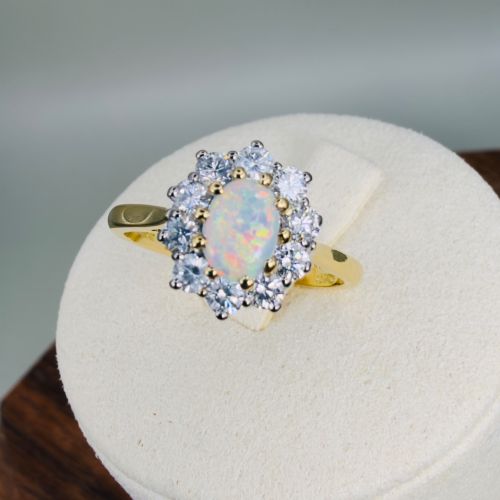
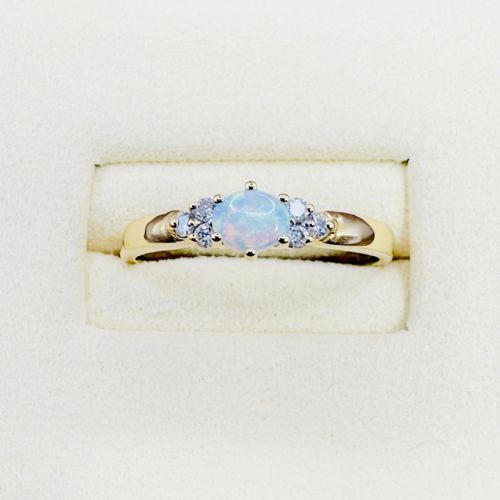


Opal Diamond Cocktail Ring
An opal diamond cocktail ring brings together fiery play-of-colour and brilliant sparkle for maximum visual impact on the hand.
Opal Diamond Cocktail Ring
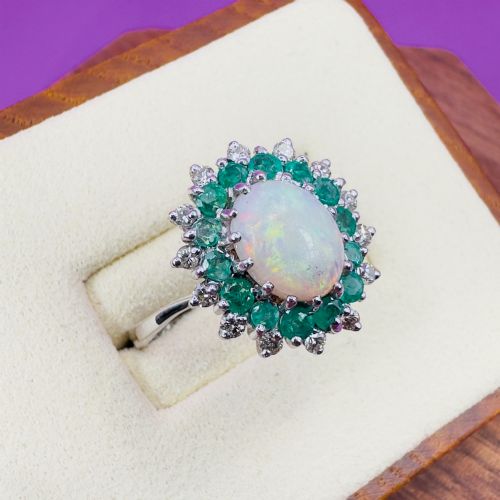
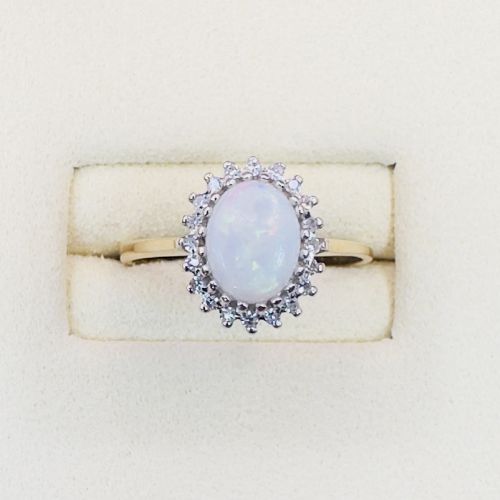
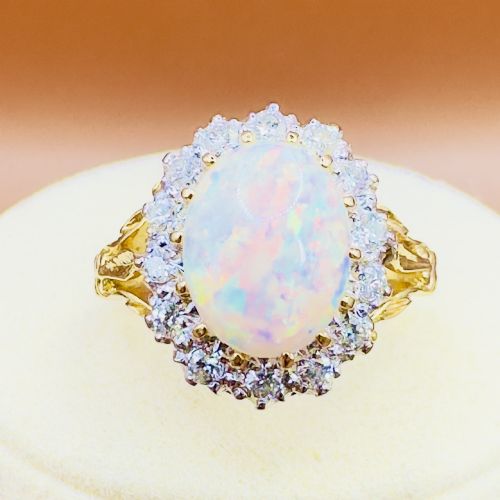
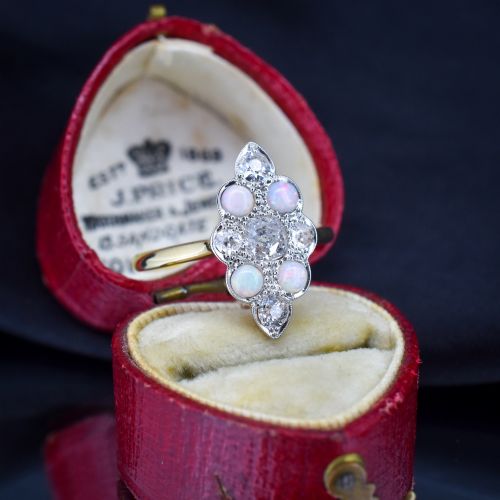
An opal diamond cocktail ring combines central opals with diamond accents in bold cluster or dress configurations designed to stand out. You will encounter pieces spanning the Victorian era through the mid-twentieth century, including Art Deco, Retro, and nineteen-fifties designs.
The stones sit primarily in mountings of eighteen-carat gold, white gold, or platinum, occasionally appearing in nine-carat gold. Cluster formations dominate the selection, framing cabochon-cut opals with brilliant or rose-cut diamonds.
How they were made
Goldsmiths shaped mounts in yellow and white gold as well as platinum, often employing intricate settings to secure delicate cabochon stones. Master craftsmen surrounded central opals with meticulously arranged diamond clusters to enhance the play-of-colour.
Stones range from traditional white opals and water opals to cabochon cuts and oval cuts, paired with diamonds measured in precise carat weights. Specialised techniques like east-to-west stone placement also appeared in mid-century workshops.
Opal Diamond Cocktail Ring Retail Price Guide 2026
Typical asking prices for opal diamond cocktail ring among the pieces listed under this phrase on Sellingantiques today, from the lower quarter to the upper quarter. They describe what is for sale here now, not the wider market.
The listings on this page span multiple eras, encompassing Victorian craftsmanship, Art Deco geometry, and nineteen-fifties modernist cluster designs in gold and platinum.
What varies in quality
The intensity of the opal's play-of-colour dictates visual appeal, with superior stones displaying vivid flashes across the spectrum rather than flat milky surfaces. Setting execution also matters greatly, as robust metalwork protects the softer opal from daily wear.
Diamond selection influences overall brilliance, where clean stones and precise symmetry elevate the surrounding cluster work. Period integrity and the weight of the precious metal foundation further separate exceptional examples from standard production.
The Opal Diamond Cocktail Ring Glossary
- Cabochon
- A polished gemstone with a smooth, rounded, convex top and a flat or slightly curved base. This traditional cut is chosen to maximise the internal fire and colour play of opals.
- Cluster ring
- A ring featuring a central prominent gemstone encircled by a group of smaller stones, typically diamonds. This arrangement maximises surface area and brilliance on the hand.
- Play-of-colour
- The optical phenomenon where spectral colours flash across the surface of an opal as the stone moves in the light. It depends on the internal microscopic silica sphere structure.
- Rose-cut
- An antique diamond cut featuring a flat base and a domed crown composed of triangular facets that culminate in a point. This historic cut produces a subtle, understated twinkle.
- Water opal
- A transparent or translucent variety of opal exhibiting a watery body colour and delicate internal flashes. These stones possess a high degree of clarity compared to opaque matrix opals.
Opal Diamond Cocktail Ring: Frequently Asked Questions
How do I care for an opal ring?
Opals contain water within their structure and score lower on the hardness scale than diamonds, requiring gentle handling during wear. Avoid harsh chemicals, ultrasonic cleaners, and sudden temperature shifts to protect the stone from damage.
Store your ring separately from harder jewellery pieces to prevent scratching the polished cabochon surface. Regular gentle cleaning with a soft damp cloth maintains the lustre of both the opal and its surrounding metal.
Can I wear an opal cocktail ring daily?
These cocktail rings were originally created for evening wear and special occasions, involving prominent settings that catch the light. Daily wear is possible with mindful habits, particularly avoiding impact against hard surfaces.
Because opals are softer than diamonds, choosing when and where to wear the ring preserves the integrity of the central stone and its delicate prongs.
What is an east-to-west setting?
An east-to-west setting mounts an elongated or oval gemstone horizontally across the finger rather than vertically up and down. This technique alters the silhouette of the ring, offering a distinctive profile on the hand.
Jewellers utilised this orientation during the mid-twentieth century to modernize traditional cluster designs and showcase wider stones.
How do I identify a Victorian opal ring?
Victorian pieces often feature characteristic yellow gold mounts, hand-carved details, and cluster configurations that prioritize organic floral or geometric motifs. The craftsmanship reflects nineteenth-century bench techniques prior to mass-produced manufacturing.
Examining the metal purity marks and the specific style of the diamond cutting helps confirm the nineteenth-century origins of the mounting.