
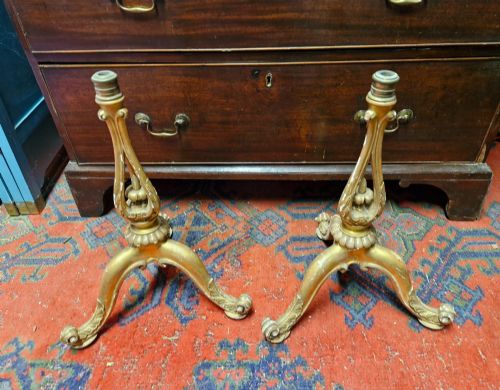
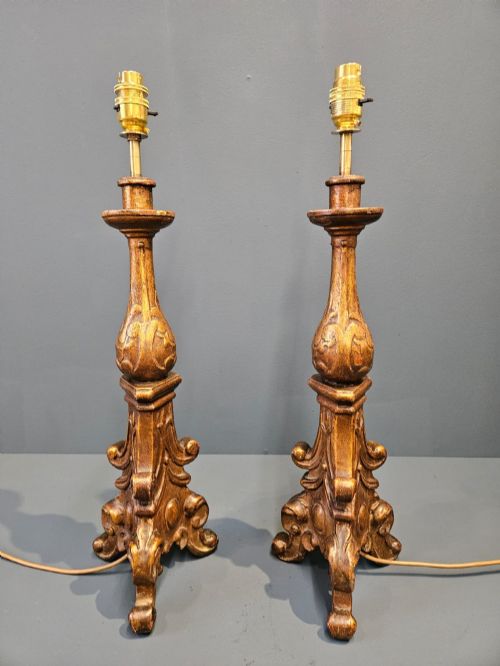


Carved Gilt Candlestick Bases
These carved gilt candlestick bases bring rich texture and period grandeur to an interior, offering repurposed lighting with distinct historical presence.
Carved Gilt Candlestick Bases
When you search for carved gilt candlestick bases, you find sculptural remnants and converted lighting fixtures sourced from eighteenth, nineteenth, and early twentieth century traditions. These pieces predominantly take the form of table lamps and standard lamps adapted from earlier pricket sticks and altar supports.
The selection on this page relies heavily on nineteenth-century examples and Italian Florentine interpretations. You will frequently encounter pairs of tripod bases alongside single monumental standards shaped by Baroque and Neoclassical design vocabularies.
Originating primarily as ecclesiastical or formal domestic lighting, these objects now function chiefly as lamp bases. Their forms transition smoothly from heavy carved timber profiles to slender gilded shafts resting upon tripod or circular supports.
How they were made
Makers shaped these pieces from timber, building up intricate relief work with layers of gesso before applying gold leaf or silver leaf finishes. Giltwood and carved timber provide the structural core, occasionally paired with marbleized accents or supported by iron and brass internal fittings.
The carving technique combines deep sculptural relief with delicate surface detailing characteristic of Baroque and Rococo revivals. Artisans then gilded the carved surfaces using genuine leaf, creating the reflective quality that defines these repurposed antiques.
Several heavy pricket sticks originally destined for silent altars now quietly illuminate modern sitting rooms.
What varies in quality
Quality rests primarily in the depth and crispness of the hand-carved ornament across the timber. Pieces with deep, confident relief work and well-preserved gilding sit at the upper end of the range, showing the hand of a skilled artisan rather than mechanical repetition.
The integrity of the underlying gesso and the warmth of the gold leaf significantly influence visual depth. Surviving elements retain a softer, richer patina where the timber and preparation layers have aged in harmony.
The Carved Gilt Candlestick Bases Glossary
- Giltwood
- Timber that has been coated with gold leaf over a prepared gesso ground. This material provides the characteristic metallic sheen found on classical furniture and lighting bases.
- Pricket stick
- A heavy candlestick featuring an upward-pointing spike designed to secure a large candle. These historic pieces are frequently converted into modern table lamps.
- Gesso
- A plaster mixture applied to carved timber to create a smooth surface for gilding. It allows artisans to carve fine decorative details before applying gold leaf.
- Tripod base
- A three-legged support structure commonly found on standard lamps and heavy candlesticks. This configuration provides stability for tall vertical shafts.
- Florentine Baroque
- A regional Italian decorative style defined by elaborate scrolling foliage and dramatic sculptural forms. It heavily influences many nineteenth-century lighting bases.
Carved Gilt Candlestick Bases: Frequently Asked Questions
Are these wired for modern use?
Most of these pieces function as adapted lamps while preserving their historic carved structures. Wiring is typically integrated carefully through the centre to maintain the visual integrity of the antique base.
Buyers often consult an electrician to ensure the vintage fittings meet current safety standards without altering the surrounding timber or gilt surface.
How do I clean gilded wood?
Dusting requires only a very soft, dry brush to prevent disturbing delicate gold leaf layers. Moisture and chemical cleaning agents must be avoided entirely.
Gentle maintenance preserves the aged patina and prevents the gesso foundation from softening beneath the metallic surface.
What styles are represented here?
The selection spans English and Italian Baroque, French Rococo, and Neoclassical revival movements. These styles dictate the boldness of the carving and the complexity of the scrolling motifs.
Nineteenth-century interpretations often look back to earlier centuries, combining classical proportions with grand decorative flair.
How do I style a tall standard lamp?
These imposing vertical pieces anchor corners in a room, drawing the eye upward toward architectural details. They work well alongside traditional furniture where their textured surfaces add warmth.
Pairing them with a simple, neutral shade allows the intricate carved gilt base to remain the primary visual focus.