
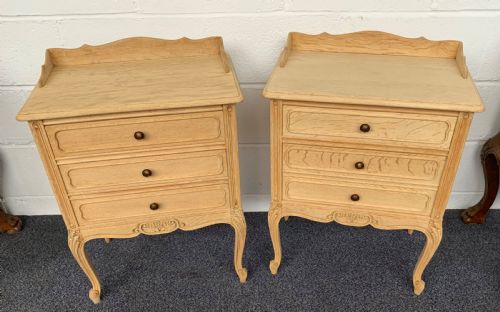


Carved French Commode Pair
A carved french commode pair brings symmetry and substantial French character to a bedroom, combining practical storage with distinctive regional style.
Carved French Commode Pair
When you search for a carved french commode pair, you are looking at matched sets of bedside cabinets, commode chests of drawers, and side cabinets originating from various French stylistic traditions. The pieces on this page span several periods, ranging from nineteenth-century revivals through to the early twentieth century and the Edwardian era.
You are most likely to encounter bedside tables and small bedside cabinets fashioned in walnut, oak, and burr walnut. These functional forms frequently incorporate marble tops and detailed carving characteristic of provincial and revival workshops.
The assortment extends from compact bedside tables to larger side cabinets and multi-piece bedroom suites. Each pairing displays the balanced proportions and matched timber selection expected in dual furniture pieces.
Materials and construction
Cabinet makers utilised solid hardwoods such as walnut and oak alongside decorative veneers like burr walnut to build these pieces. Skilled joinery formed the structural carcases, while marquetry techniques added patterned surface detail to selected bedroom suites.
Marble slabs were fitted to the tops of many cabinets to provide a durable and decorative surface. Metal mounts and brass hardware completed the construction, securing doors and drawers while introducing contrasting metallic accents.
One exceptional six-piece suite includes burr walnut and marquetry, proving that French bedrooms took matching very seriously indeed.
Distinctions in quality
The refinement of the carving defines the upper tier of these pieces, separating standard production from work executed by skilled hands. Crisp detailing in the timber ornamentation and well-executed joinery indicate superior craftsmanship.
The selection and matching of timber veneers, particularly burr walnut, determine the visual impact of the surface. Integrated marble tops of substantial thickness and quality further elevate the standing of an individual pair.
The Carved French Commode Pair Glossary
- Commode
- A low chest of drawers or cabinet. In French furniture history, the term originally denoted a formal chest of drawers designed for principal rooms.
- Bombe
- A swelling, convex furniture shape with curved fronts and sides. This profile creates a bulbous silhouette popular in revival and continental pieces.
- Demi lune
- Half-moon shape denoting a semicircular table or cabinet front. These pieces fit flat against a wall while projecting a curved surface.
- Marquetry
- The art of applying pieces of veneer to a structure to form decorative patterns. Craftsmen use varied timber grains to create pictorial or geometric designs.
- Rococo Revival
- A nineteenth-century style drawing inspiration from the asymmetrical curves and organic motifs of the eighteenth-century Rococo movement. It is characterised by scrolls, shell work, and elaborate carving.
Carved French Commode Pair: Frequently Asked Questions
What is a french commode pair?
A carved french commode pair consists of two matching low storage cabinets or chests originating from French design traditions. They are typically used as bedside storage or side tables in bedroom settings.
These pieces match in timber, carving style, and dimensions to provide symmetrical balance within a room. The listings include examples featuring marble tops and varied regional woodwork.
How were these cabinets used?
These cabinets served primarily as bedside storage for personal items and lighting. Their enclosed cupboards and drawers kept sleeping quarters orderly and refined.
Larger configurations functioned as side cabinets or formed part of coordinated bedroom suites. The surface tops, particularly marble variants, provided practical space for washing basins or decorative objects.
How do I date a french commode?
Dating relies on examining the timber construction, hardware fixings, and stylistic cues present in the carving. Pieces range from nineteenth-century revival examples to early twentieth-century and Art Deco interpretations.
Stylistic shifts, such as the transition from heavy Victorian revival curves to cleaner twentieth-century lines, help establish the period. Material choices like burr walnut and bleached oak also correspond to particular decades of manufacture.
How do I care for marble top cabinets?
Marble surfaces require gentle cleaning with mild, non-acidic soap and water to protect the stone from etching. Regular dusting prevents particle buildup on the polished timber and stone.
Keeping the furniture away from direct heat sources and excessive moisture preserves the timber joints and veneer stability. Waxing the wood components periodically maintains the lustre of walnut and oak finishes.