



Carved Four Fold Screen
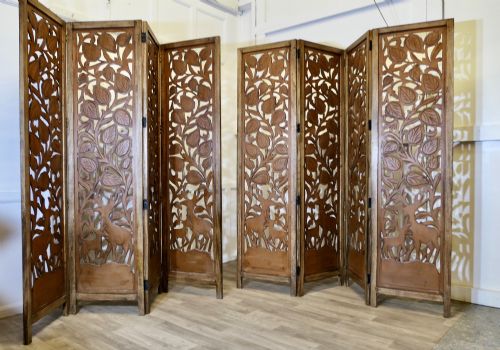
A carved four fold screen divides a room with deep relief and movable panels, bringing rich pattern and texture to an interior.
Carved Four Fold Screen
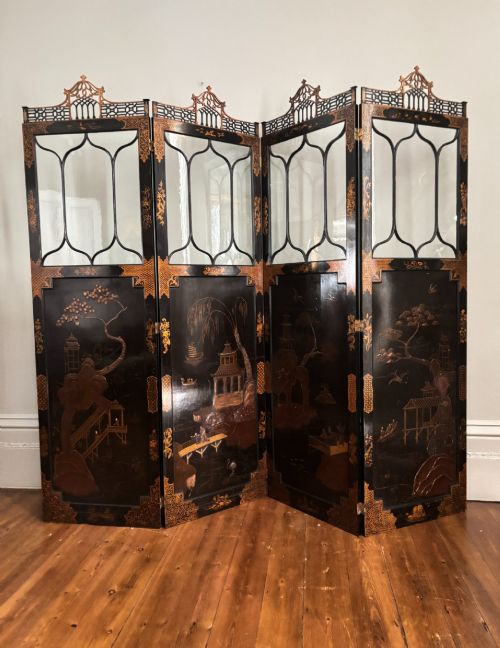
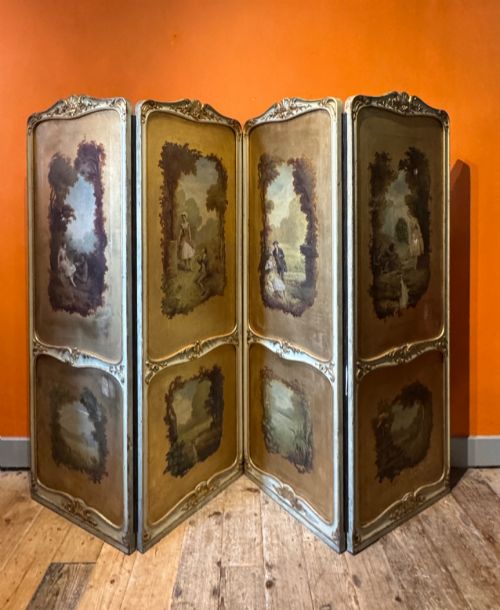
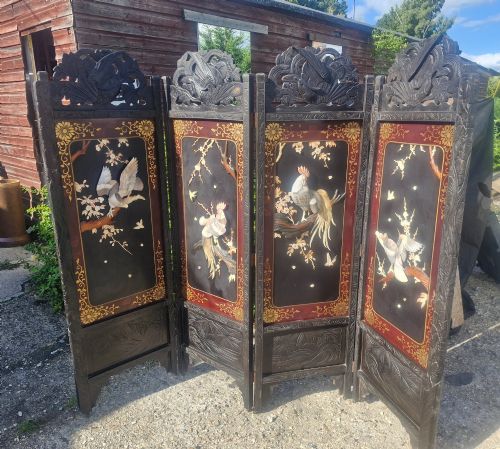
A carved four fold screen stands as a movable partition, creating intimate zones within larger rooms while displaying intricate carving or surface decoration across four hinged leaves. These dividers appear in styles ranging from Chinese Chippendale and French Rococo Revival to Anglo-Indian fretwork and Japanese Meiji craftsmanship, reflecting diverse global aesthetic traditions.
The materials span lacquered and gilt wood, hardwood, brass, metal, painted canvas, silk cotton, and needlepoint, often enhanced with hardstone mounts or bone figures. Examples on this page date from the Regency and Victorian eras through the nineteenth century and into the nineteen-thirties.
Forms function both as practical room dividers and decorative focal points, occasionally serving distinct purposes such as photographic props or privacy screens. The selection includes matched pairs and large singular panels featuring figural scenes, landscapes, and dragon motifs.
How they were made
Construction relies on sturdy timber frames of hardwood or general wood to support four hinged leaves, which allow the panels to fold in alternating directions. Carvers cut deep relief patterns directly into the wood or applied lacquer surfaces, sometimes mounting bone figures or hardstone elements onto the panels.
Surface finishes involve detailed hand painting, gilding, and lacquering, as seen in Chinoiserie black lacquer and gilt wood examples. Textile elements incorporate needlepoint and silk cotton stretched across frames, alongside brass and metal hardware securing the hinges.
Carved Four Fold Screen Retail Price Guide 2026
Typical asking prices for carved four fold screen among the pieces listed under this phrase on Sellingantiques today, from the lower quarter to the upper quarter. They describe what is for sale here now, not the wider market.
Listings feature items from the nineteenth century, nineteen-ten, nineteen-thirty, Regency, and Victorian periods.
What varies in quality
The depth and precision of the carving dictate the visual impact of the piece, with deep relief work and intricate fretwork demanding greater artisan skill than shallow surface incisions. Hand-painted panels show variation in the subtlety of figural and landscape details, particularly in French romantic scenes and Japanese decorated lacquer.
The integrity of the structural joinery and the quality of the original hinges determine how smoothly the four leaves operate over time. Choice of materials, from solid hardwoods and complex hardstone mounts to standard painted canvas, creates distinct tiers of craftsmanship.
Paul Sormani
The Carved Four Fold Screen Glossary
- Coromandel screen
- A Chinese carved lacquer screen where designs are incised into a dark ground and filled with ivories, jades, or colours. These pieces often feature detailed landscapes and court scenes.
- Chinoiserie
- European decorative style reflecting Chinese artistic motifs, popular in furniture and screen design during the eighteenth and nineteenth centuries. It incorporates whimsical landscapes and pavilions.
- Louis XV style
- French aesthetic characterised by asymmetrical curves, scrollwork, and naturalistic floral motifs. Screens in this taste often display romantic figural and landscape panels.
- Meiji
- Japanese historical period spanning the late nineteenth and early twentieth centuries, known for exceptional metalwork, lacquer, and deep carved bone figures on panels. Artistry during this time reached international markets.
- Fretwork
- Ornamental design created by cutting patterns through thin wood or metal plates. Indian and Anglo-Indian screens frequently utilise this technique for geometric or floral panels.
Carved Four Fold Screen: Frequently Asked Questions
How do you arrange a four fold screen?
Panels fold in zigzag configurations to stand upright without additional support, allowing you to adjust the width and angle of the divider to suit the room.
Positioning the screen near a corner or flat against a wall creates a dramatic backdrop, while an angled stance forms a private alcove.
What periods do these screens come from?
Examples span the Regency and Victorian eras, the nineteenth century, and into the early twentieth century around nineteen-ten and nineteen-thirty.
Design details and materials often align with the revival styles popular during those decades, such as French Rococo or Chinese Chippendale.
Are these screens heavy?
Weight depends on the materials used, with solid hardwoods, thick lacquer, and metal components adding considerable heft to large panels.
Lighter textile and painted canvas versions are easier to reposition, while dense wood and hardstone-mounted pieces require steady handling.
Can these screens divide large spaces?
Four-fold panels provide sufficient width to partition corners, block doorways, or section off parts of an open-plan room.
Large nineteenth-century and early twentieth-century examples offer substantial height and coverage for functional privacy.