
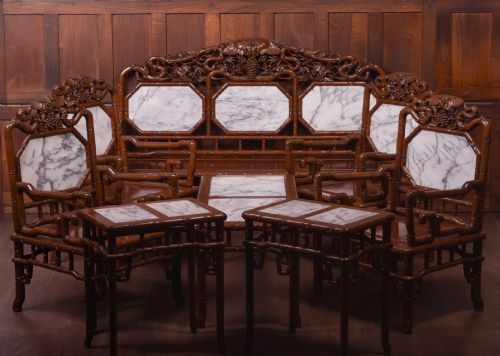


Carved Faux Bamboo Furniture
Carved faux bamboo furniture brings witty mimicry into a room, turning solid timber into slender, knot-banded stems that capture nineteenth-century taste.
Carved Faux Bamboo Furniture
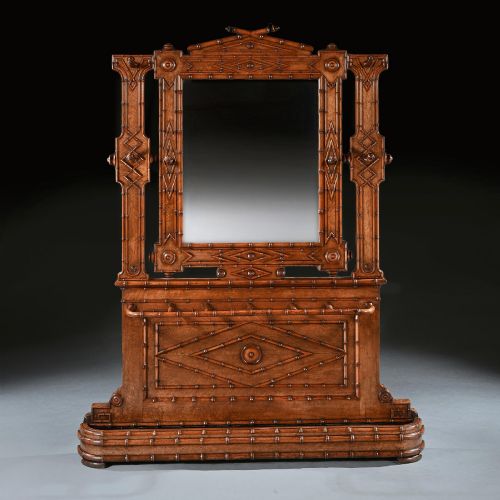
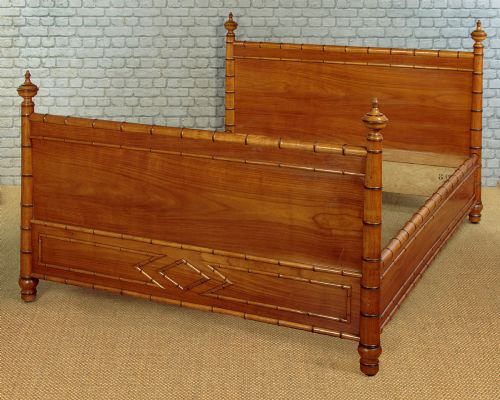
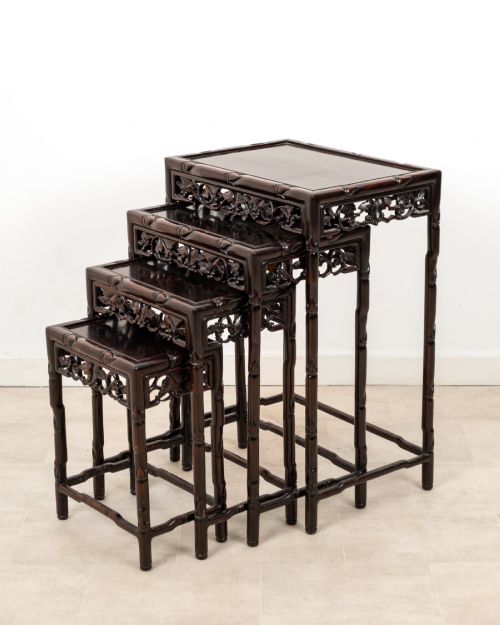
The buyer meets a distinct design language where turned hardwood, walnut, birdseye maple, and pine mimic natural cane with segmented nodal rings. Chinese hardwood tables and cabinets sit alongside French commodes and parlour suites, each piece translating the organic geometry of bamboo into functional household forms.
Originating in periods such as the eighteen-eighties and eighteen-nineties, these items reflect a global fascination with exotic botany and simulated materials. The selection balances European interpretations of Japonisme with Asian export pieces that use carved hardwood to achieve the same botanical mimicry.
How they were made
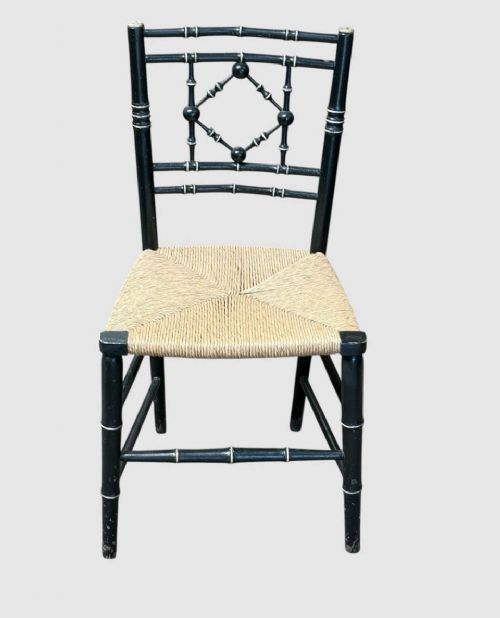
Workshops relied primarily on dense timbers including hardwood, walnut, and birdseye maple, turning and carving the solid wood by hand to create the characteristic swollen nodes and ribbed joints of real bamboo. Ebonised finishes and applied surface treatments frequently enhanced the illusion of natural cane.
Structural elements incorporated marble tops on commodes, glass panels, and metal hardware, while secondary woods like pine appeared in concealed framing. Skilled joinery allowed nests of tables to graduate precisely in size, fitting together in sequence without straining the delicate simulated stems.
Materials recorded across the inventory include marble, glass, metal, and pine alongside primary hardwoods and birdseye maple.
What varies in quality
Quality rests upon the crispness of the turning and the depth of the carved nodes, distinguishing pieces where the bamboo illusion is sharp and convincing from those with blunt, smoothed-off details. The choice of primary timber dictates longevity, with dense hardwoods and figured birdseye maple holding a more precise edge than softer pine carcasses.
Construction integrity separates standard domestic items from superior output, particularly in complex forms like nesting tables and hall stands where slender structural members must bear daily weight. The finesse of the finish, whether French polish or ebonised lacquer, determines how successfully the piece maintains its decorative impact.
The Carved Faux Bamboo Furniture Glossary
- Faux bamboo
- A decorative technique where wood is turned and carved to imitate the segmented stems and nodes of natural bamboo. This mimicry became especially popular during the nineteenth-century Aesthetic Movement.
- Aesthetic Movement
- A late nineteenth-century design current that championed art for art's sake and embraced Japanese artistic influences. Pieces from this period often feature ebonised finishes and asymmetrical layouts.
- Birdseye maple
- A decorative timber showing small, circular eye patterns caused by local disruptions in wood growth. It appears frequently on French nineteenth-century case pieces.
- Quartetto
- A set of four tables designed to graduate in size and slide neatly beneath one another. They were highly favoured in both Chinese export workshops and European drawing rooms.
- Japonisme
- The European adoption of Japanese artistic motifs and design principles during the second half of the nineteenth century. It heavily influenced French and British cabinet makers.
Carved Faux Bamboo Furniture: Frequently Asked Questions
How do I care for faux bamboo?
Dust regularly with a soft, dry cloth to protect the raised nodes and carved rings from accumulating dirt. Avoid modern chemical sprays that can degrade nineteenth-century polish.
Keep pieces away from direct heat sources and strong sunlight to prevent the timber from splitting or the ebonised finishes from fading over time.
Are these pieces French or Chinese?
The selection includes both European examples, such as French Napoleon III and Aesthetic Movement furniture, and Chinese Export or Qing Dynasty hardwood pieces. Makers in both regions utilised the faux bamboo motif.
European pieces often employ turned softwoods, walnut, or maple with painted or ebonised surfaces, whereas Asian examples rely on dense, naturally heavy hardwoods carved by hand.
How do I style a nest of tables?
A quartetto or nest of four tables offers exceptional versatility because the smaller tables pull out independently for entertaining. Stacked together, they occupy minimal floor space in a hallway or parlour.
Use them to display small lamps, ceramics, or books without overwhelming a compact room, allowing the carved wooden stems to provide textural interest.
What is an ebonised finish?
Ebonisation involves staining timber, often fruitwood or hardwood, to achieve the deep, dark appearance of ebony. This technique was widely utilised during the nineteenth century to highlight carved details.
On faux bamboo furniture, the dark surface emphasises the segmented nodes and mimics the polished black lacquer imported from East Asia during the Aesthetic period.