
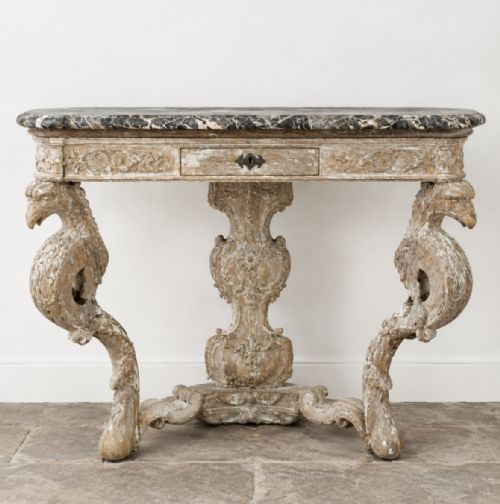
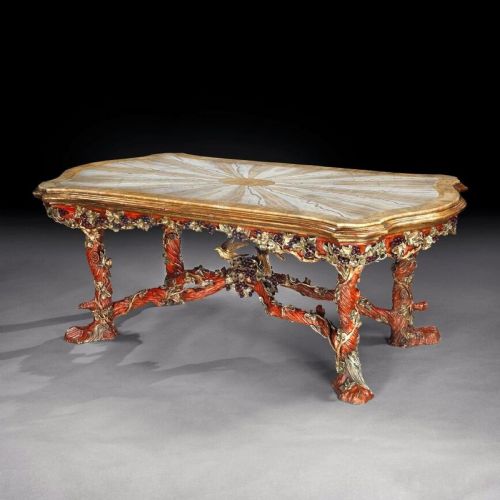
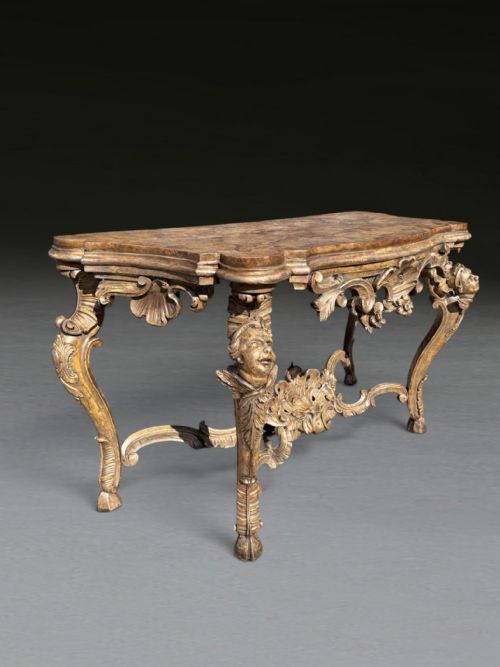
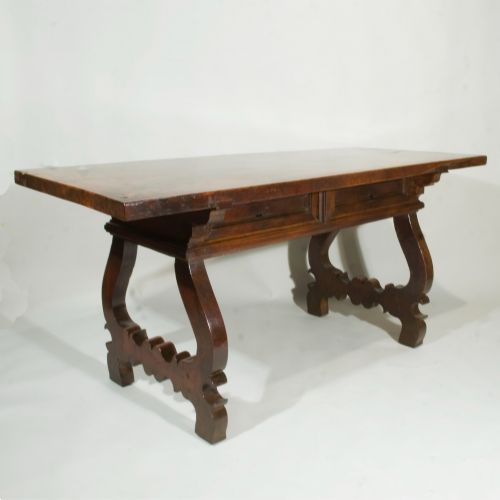
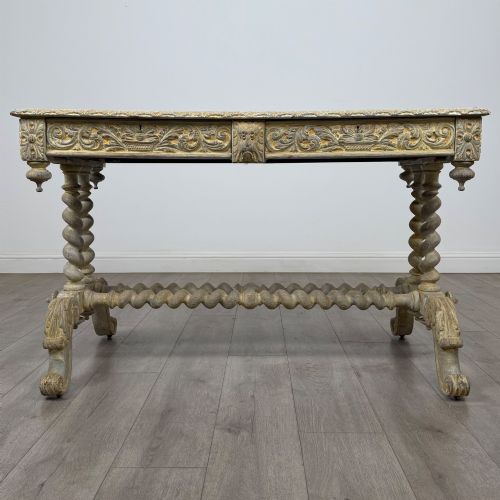
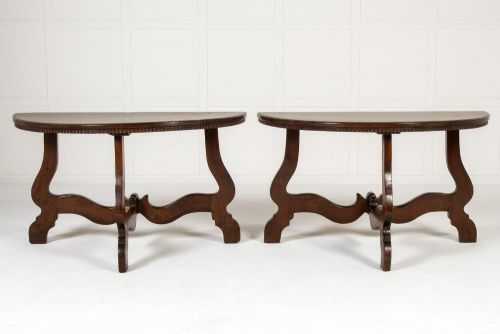
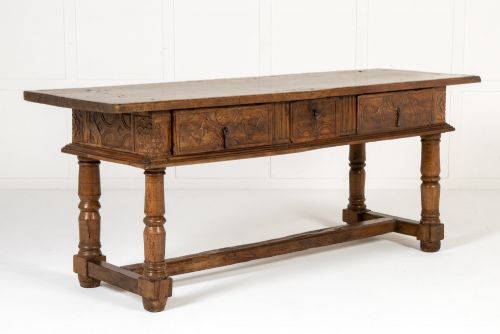


Carved Baroque Console Table
A carved baroque console table brings heavy Italian and Spanish timber work, marble tops and gilt finishes into a room.
Carved Baroque Console Table
A carved baroque console table is typically a heavy wooden frame designed to stand against a wall, frequently topped with marble or onyx.
The pieces appearing on this page stretch from the seventeenth century through the eighteenth and nineteenth centuries, taking forms such as side tables, centre tables and demi lune console tables.
Italian and Spanish examples dominate the selection, executed in walnut, oak, giltwood and carved wood.
How they were made
Carpenters shaped solid timbers like European walnut, oak and rosewood, applying deep hand-carving to legs, aprons and supports.
Many surfaces received layers of gesso before being gilded with gold leaf, silver gilt or finished with polychrome paint.
Heavy stone slabs including pink Salome marble, breccia marble and onyx were fitted to the upper frames to form heavy working or display surfaces.
Listings span seventeenth-century Spanish walnut to nineteenth-century Italian giltwood interpretations.
What varies in quality
The depth and vigour of the hand-carving define the upper tier of these tables, separating lively figurative work like eagles, dolphins and putti from simpler geometric mouldings.
The integration of materials determines the success of a piece, particularly how well heavy marble or onyx tops rest upon carved wooden bases and gilt surfaces.
Amleto Bertoni
The Carved Baroque Console Table Glossary
- Console table
- A table designed to be fixed against a wall, often supported by ornamental brackets or legs at the front.
- Giltwood
- Timber that has been coated with a thin layer of gold leaf over a prepared base.
- Demi lune
- Half-moon shaped, describing tables with a semicircular front and a flat back to sit flush against a wall.
- Gesso
- A plaster-like mixture applied to wood as a smooth base for painting or gilding.
- Breccia marble
- A variegated stone composed of broken fragments cemented together in a fine-grained matrix.
Carved Baroque Console Table: Frequently Asked Questions
Where should a carved baroque console table go?
These tables suit hallways, drawing rooms or principal reception spaces where their decorated frames and stone tops can be seen properly against a flat wall.
Because many versions feature flat backs meant to anchor against vertical surfaces, they fit well beneath large mirrors or paintings.
How do I care for a marble top?
Marble and onyx surfaces require simple dusting and immediate wiping of liquid spills to prevent staining the porous stone.
Avoid harsh chemical cleaners that can dull the polished surface or damage the surrounding wooden frame.
How do I spot an 18th century piece?
Seventeenth and eighteenth century pieces display hand-cut joinery, timber shrinkage appropriate to age, and wear patterns on walnut, oak and gilt surfaces.
Examine the underside and joints for tool marks and construction methods consistent with earlier workshop practices.
Are these tables freestanding?
While console tables are traditionally built to stand against a wall, some pieces listed as centre tables or demi lune forms can sit away from boundaries.
Check the finishing on the back edge of the frame to see if it was intended to be viewed from all sides.