


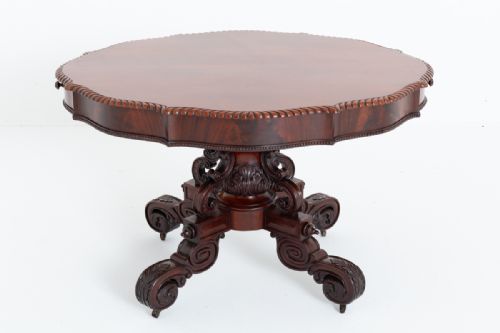


Carved Acanthus Pedestal Table
A carved acanthus pedestal table brings architectural presence and classical leaf ornament to a room.
Carved Acanthus Pedestal Table
A carved acanthus pedestal table is a distinctive form defined by a central support embellished with classical foliage carving and a spreading base. These tables serve primarily as centre tables, occasional tables, side tables, and work tables within formal rooms.
The versions most commonly met on this page span the Georgian, Regency, and Victorian eras, alongside continental examples. Mahogany and rosewood form the core of the English selection, while limewood and painted finishes appear on European works.
How they were made
Cabinetmakers shaped dense timbers such as mahogany and rosewood by hand, employing solid construction methods alongside wood veneer over secondary woods. The characteristic acanthus foliage was gouged and chiselled directly into the solid timber of the pedestal or pillars.
Giltwood and parcel gilt finishes required the application of gold leaf over prepared gesso surfaces, whilst specific pieces incorporated inset marble or leather tops. Tripod designs utilised robust peg and tenon joints to secure the central column to the supporting legs.
Listings feature mahogany, rosewood, limewood, and marble across Georgian, Victorian, and Regency periods.
What varies in quality
The standard of carving determines much of the distinction across these tables, separating deep, crisp foliage with undercut leaves from shallow, mechanical moulding. Crisp definition in the acanthus curls reveals the hand of a skilled carver rather than a hurried workshop.
Choice of timber grain and the integrity of structural joints dictate the long-term character of the piece. Well-figured mahogany and richly toned rosewood elevate the object, supported by stable pedestals that bear the weight of heavy marble or timber tops without wobble.
The Carved Acanthus Pedestal Table Glossary
- Acanthus
- A classical carved ornament modelled on the leaves of the Mediterranean acanthus plant. This motif appears frequently on the columns and pedestals of formal furniture.
- Centre table
- A freestanding table designed to be viewed from all sides, placed in the middle of a room rather than against a wall. These often feature elaborate pedestals beneath circular or rectangular tops.
- Tripod table
- A small table supported by a central pillar resting on three legs. Many examples incorporate a tilt-top mechanism for convenience.
- Giltwood
- Timber that has been coated with gold leaf. It is frequently seen on pieces influenced by Baroque and Rococo design.
- Work table
- A small table fitted with drawers or a bag for sewing materials. They often stand on a single turned or carved pedestal.
Carved Acanthus Pedestal Table: Frequently Asked Questions
Where should I place a pedestal table?
These tables work best as centrepieces in hallways or principal rooms where they can be approached from multiple sides. Their circular or compact footprints also suit corners or beside seating.
Because the carved pedestal is a primary visual feature, ensure the table stands clear of heavy drapery or low furniture that might obscure the craftsmanship.
How do I care for a mahogany table?
Dust the timber regularly with a dry, soft cloth and avoid placing the table in direct sunlight or near heat sources. Excessive temperature changes cause wood to shrink and split.
Apply a microcrystalline wax occasionally to nourish the surface and protect the polish without building up sticky layers.
How do I identify a Regency table?
Regency tables typically display classical restraint, incorporating dark timbers like rosewood alongside brass inlay, gilt details, or heavy pedestals. The influence draws heavily from Greek and Roman archetypes.
Look for robust columns, tripartite or quadruped platform bases, and restrained use of carved foliage rather than exuberant Rococo curves.