
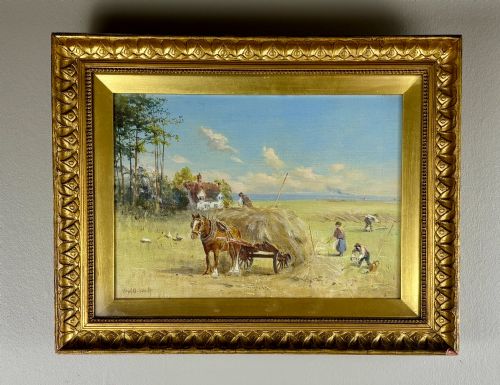
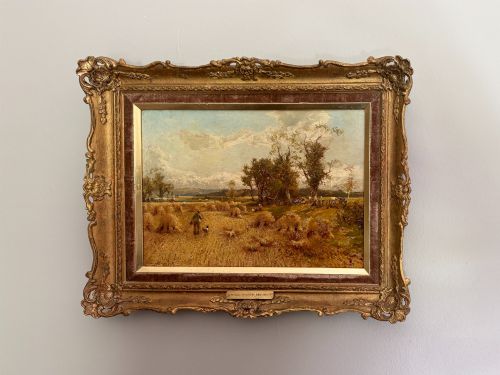
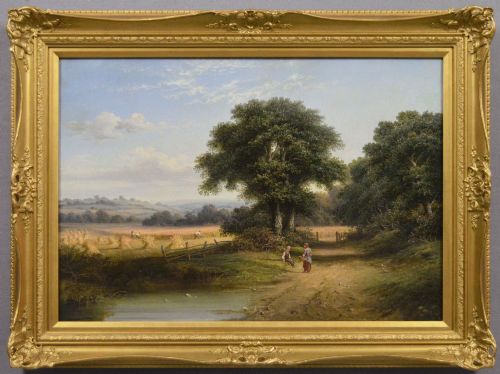


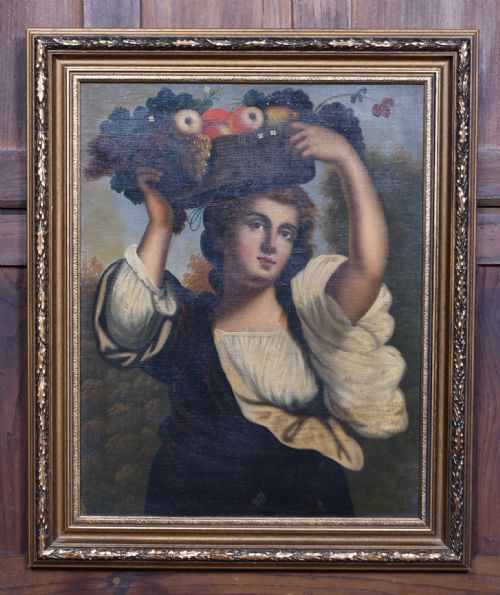

Canvas Harvest Oil Painting
These canvas harvest oil painting works bring 19th-century and early 20th-century rural life into your home with rich texture and warm pastoral light.
Canvas Harvest Oil Painting
A canvas harvest oil painting depicts rural labourers, hay fields, and agricultural scenes created during the nineteenth and twentieth centuries. These artworks capture historical farming methods through traditional landscape compositions.
The pieces you encounter most often on this page date from the Victorian and Edwardian periods, stretching into mid-century realism. They range from intimate pastoral views to larger narrative scenes involving horses, farmers, and harvested crops.
Makers recorded in the evidence include named artists such as Walter Heath Williams, Henry John Boddington, and Arthur Walker Redgate. Works also appear from European and naive schools without a single named author.
Materials and technique
Artists painted primarily with oil paint upon woven canvas stretched over wooden supports. Many surviving pieces retain their original wood and giltwood framing.
Techniques combine layered oil pigments to capture natural light, shadow, and atmospheric depth across harvest fields and rural landscapes. Gold leaf occasionally highlights decorative details within the framing.
Materials recorded in these listings include oil paint, canvas, wood, giltwood, and gold leaf.
Distinctions in quality
Compositional strength and atmospheric handling separate masterworks from simpler naive examples. Skilled artists balance figures, light, and landscape depth with precise brushwork.
The preservation of the original oil pigment and canvas substrate influences the visual impact. Strong provenance and documented attribution to established painters elevate a piece further.
Walter Heath Williams·Henry John Boddington·William Grant Murray·J.C. Grey·James William Booth·Henry H Parker·Helmut Reuter·Arthur Walker Redgate·Herbert Royle·Frederick J. Knowles·Joseph Paulman·Henry John Kinnaird·Frederick William Jackson·George Cole·William Greaves·William Savage Cooper·Joseph Thors·Alfred Augustus Glendening Snr·William Kay Blacklock·John Clayton Adams·Arthur Heinrich Wilhelm Fitger·Bertha Rhodes Carrick·Charles H. Passey
The Canvas Harvest Oil Painting Glossary
- Canvas
- A heavy woven fabric used as a surface for oil painting. It provides the tensile strength needed for large historical artworks.
- Giltwood
- Carved wood coated with a thin layer of gold leaf or gold paint. This material forms the ornate period frames surrounding many harvest paintings.
- Impressionism
- An art style focused on accurate depiction of light and fleeting visual moments. British and Scottish variations appear frequently in pastoral scenes.
- Pastoral
- A genre of art depicting country life and idealized rural landscapes. These scenes emphasise harmony between agricultural workers and nature.
Canvas Harvest Oil Painting: Frequently Asked Questions
How old are these paintings?
The pieces span from the mid-nineteenth century through the Edwardian era and into the mid-twentieth century. Many carry specific dates or stylistic markers from the 1860s to the 1950s.
Victorian and Edwardian works make up the majority of the selection, reflecting a strong historical interest in rural naturalism and pastoral subjects.
Where were these scenes painted?
Locations range across British countryside settings, including regional landscapes in Nottinghamshire, Yorkshire, Sussex, and the Vale of Evesham. European school locations also appear.
Artists typically worked outdoors or based their studio compositions on direct observations of haymaking, cornfields, and agricultural labour.
How should I hang an oil painting?
Support the weight using appropriate wall fixings matched to the heavy wood and canvas construction of the piece. Hang the artwork away from direct sunlight and excessive moisture.
Stable indoor temperatures help protect the wooden stretcher frames and prevent cracking in the aged oil paint layers.
Are these paintings signed?
Many examples feature artist signatures, monograms, or period inscriptions on the canvas or frame. Unsigned works also appear, attributed through stylistic analysis to specific schools of painting.
Documentation often links anonymous pieces to regional British or European artistic traditions of the nineteenth century.