
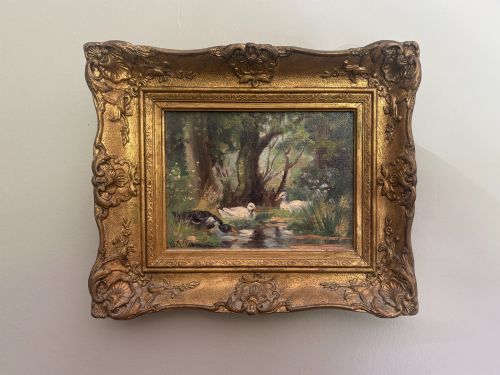


Duck Landscape Painting
A duck landscape painting brings the quiet movement of rural waterways and farmyards into a room through nineteenth-century brushwork.
Duck Landscape Painting
When you search for a duck landscape painting, you find works capturing riverbanks, ponds, and pastoral settings inhabited by waterfowl alongside farm animals or country folk. These pieces reflect Victorian interests in rural realism, naturalism, and pastoral scenes.
The versions most common here are nineteenth-century oils on canvas and watercolours on paper. They range from intimate river sketches to large framed canvases depicting ducks in farmyards or beside rivers.
Materials and methods
Artists worked primarily in oil on canvas or wood panel, and watercolour pigment on paper. Giltwood frames frequently complete the presentation of these pastoral works.
Techniques span detailed brushwork for animal plumage and foliage to looser watercolours capturing river light. Panels and canvas provide the varied grounds for these nineteenth-century scenes.
The selection includes works from the nineteenth century utilising oil on canvas, watercolour pigment, and wood panel supports.
Judging quality
Quality rests in the handling of the landscape and the naturalism of the animals. Stronger works display confident brushwork in the water and realistic posture in the ducks.
The integration of the birds within the wider river or farmyard scene distinguishes accomplished artists from standard decorative studio output.
John Frederick Herring Jnr·George Armfield·James Hardy Junior·George Kilburne·Claude Cardon·Arthur Walker Redgate·Alfred Banner·Constant Ludovic Artz·David Adolph Constant Artz·Singleton Jowett·Alfred Augustus Glendening·Thomas James Lloyd·John Falconer Slater·William Greaves
The Duck Landscape Painting Glossary
- Oil on canvas
- Pigment bound in drying oil applied to stretched woven fabric. This medium allows for rich colour blending and textured brushwork.
- Watercolour pigment
- Finely ground colour mixed with a water-soluble binder for use on paper. It creates luminous, transparent washes of tone.
- Giltwood
- Wood carved and coated with gold leaf or gold paint. Frames in this finish are typical of the period.
- Victorian pastoral
- A style celebrating rural life, agriculture, and untamed countryside. These scenes often feature farm animals and domestic fowl.
Duck Landscape Painting: Frequently Asked Questions
What periods do these paintings cover?
The works span the nineteenth century into the early twentieth century, capturing Victorian rural interests and later pastoral scenes.
Dating relies on the artist records, material types like canvas or wood panel, and stylistic movements such as naturalism.
How were these artworks displayed?
Many of these pieces are housed in decorative giltwood frames suited to nineteenth-century domestic interiors.
The original framing often preserves the historical context of the painting.
What subjects accompany the ducks?
Ducks appear alongside farm animals, horses, pigs, and figures feeding them near cottages or rivers.
Scenes range from winter snow landscapes to sunlit riverbanks and farmyard settings.
Are watercolours common in this selection?
Watercolour pigment on paper appears frequently alongside oil paintings on canvas and wood panel.
These watercolours offer lighter, more transparent views of rivers and ponds.