
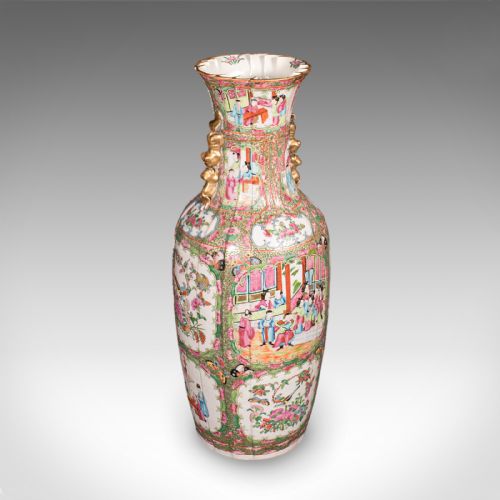


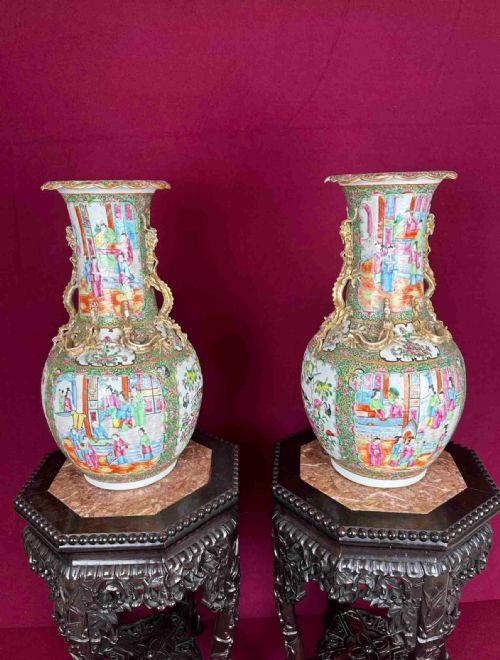


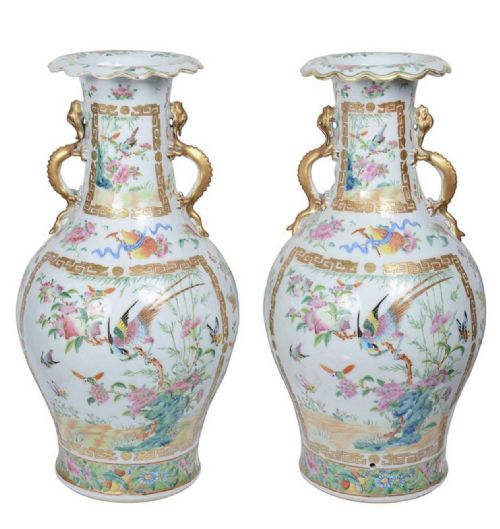
Canton Enamel Baluster Vase
These canton enamel baluster vase pieces bring vibrant Cantonese craftsmanship and hand-painted detail into a room.
Canton Enamel Baluster Vase
A canton enamel baluster vase is a distinct type of Chinese export ware designed with a characteristic sweeping profile that swells gently toward the centre before tapering.
The versions most commonly met on this page belong to the nineteenth century, including pieces associated with the Victorian era and the Qing dynasty.
These items often appear as monumental floor pieces, pairs, or table lamps, reflecting the varied ways these ceramic objects have been adapted for domestic interiors over time.
How they were made
Makers utilised porcelain as the primary ceramic body, shaping the vessel into the classic baluster form before applying detailed decoration.
Overglaze enamel pigments, including the characteristic rose palettes, were hand-painted onto the surface alongside gold leaf and gilding to catch the light.
Some examples incorporate brass and wood mounts or conversions, particularly when adapted into lamps during later periods.
The listings on this site span the nineteenth century, including Victorian examples, 1920 adaptations, and pieces attributed to the Qing dynasty and Chinese export production.
What varies in quality
The refinement of the hand-painted figures and floral panels separates standard production wares from pieces executed with greater artistic control.
The application of overglaze enamel and the preservation of the gold leaf or gilding determine the visual depth and crispness of the surface over time.
The Canton Enamel Baluster Vase Glossary
- Baluster
- A vertical architectural form resembling a vase or pillar, characterised by a rounded lower body that narrows toward the neck. This silhouette provides stability and visual balance.
- Famille Rose
- A major palette of Chinese ceramic overglaze enamels introduced in the Qing dynasty, dominated by opaque pink or rose colours. It allowed for subtle tonal gradations in painted floral and figural scenes.
- Rose Medallion
- A specific style of Cantonese export porcelain decoration featuring distinct alternating panels of figures, birds, and flowers framed by intricate borders. The palette relies heavily on green and pink enamels.
- Overglaze Enamel
- Mineral colours painted onto a previously fired and glazed ceramic surface, which are then fixed by a second, lower-temperature firing. This technique permits a wide spectrum of decorative hues.
Canton Enamel Baluster Vase: Frequently Asked Questions
What is a canton enamel baluster vase?
It is a hand-painted ceramic vessel from China featuring a curved profile and traditional export decoration.
These pieces date primarily from the nineteenth century and reflect Qing dynasty aesthetics intended for Western markets.
How were these vases used originally?
They served as decorative centrepieces in grand interiors during the Victorian period and the nineteenth century.
Their substantial size and colourful panels made them prominent display objects in reception rooms and halls.
Can I find pairs of these vases?
Yes, matched pairs frequently appear alongside single monumental floor pieces and table lamps.
Pairs were often produced for symmetry in formal nineteenth-century interior decoration.
How do I identify a nineteenth-century piece?
Look at the hand-painted overglaze enamel details, the application of gilding, and the specific Chinese export style.
Periods like the Qing dynasty and the Victorian era exhibit characteristic forms and palette choices documented in the listings.