
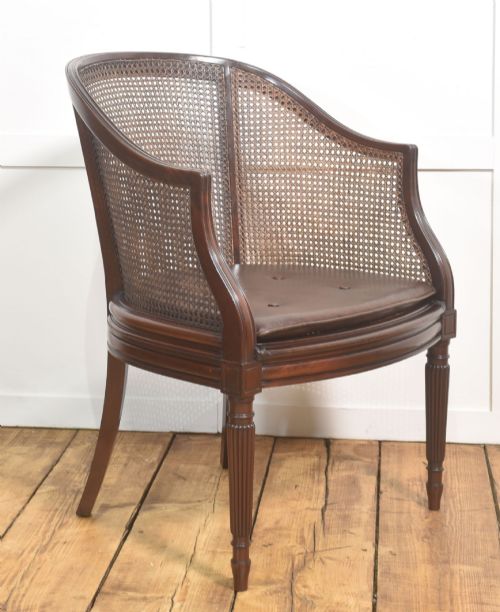


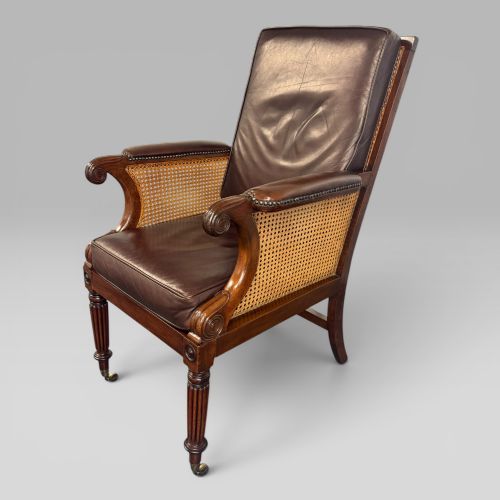
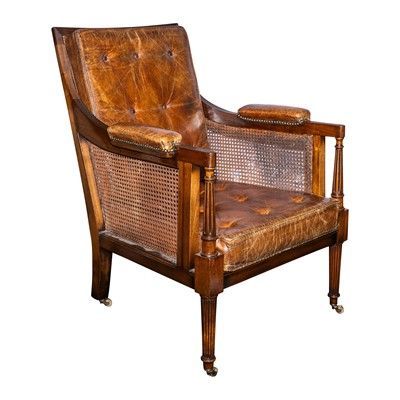
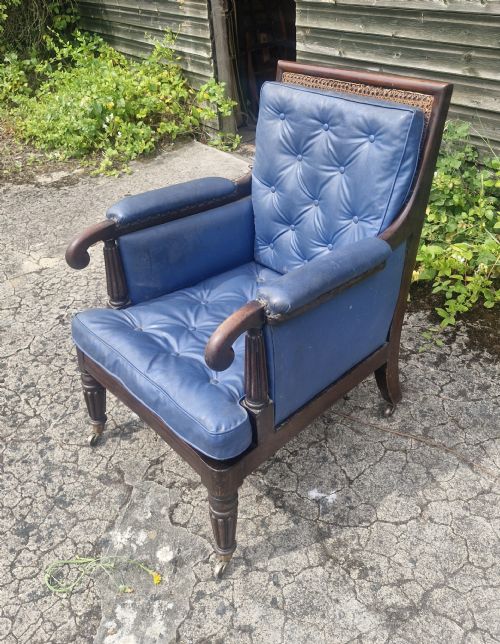


Caned Leather Armchair
These caned leather armchair pieces offer comfortable seating through traditional wood frames and woven mesh.
Caned Leather Armchair
A caned leather armchair combines a rigid timber frame with woven panels and upholstered elements, providing a distinct seating form for libraries and studies. The selection spans periods from the Georgian era through the Regency and William IV years into the Edwardian period, capturing various historical revivals.
Most examples you encounter take the form of library bergères, often fashioned in mahogany or oak with characteristic open arms. Alongside standard reading chairs, the listings include specialised variations such as metamorphic designs that convert into steps and reclining formats.
Origins stretch across English workshops and French provincial sources, introducing stylistic shifts like Arts and Crafts influences and Jacobean Revival details. Makers ranged from prominent firms like Gillows to anonymous regional cabinetmakers working within established vernacular traditions.
Assessing quality and craftsmanship
The standard of a caned leather armchair rests upon the precision of the timber carving and the tightness of the cane weave. Superior examples display smooth joinery and carefully selected mahogany or rosewood grain that has matured with age.
Mechanical complexity distinguishes standard seating from high-end pieces, particularly in metamorphic library steps and adjustable reclining mechanisms. The integration of brass hardware and the quality of the leather hide further define the upper tier of production.
The listings span the Georgian, Regency, William IV, 19th century, and Edwardian periods, utilising mahogany, rosewood, oak, cane, and leather.
Gillows·Richard Hicks Bridgens·Heals of London
The Caned Leather Armchair Glossary
- Bergère
- An enclosed upholstered armchair with wooden sides, frequently featuring cane panels in the back and frame. This French seating form became popular in British libraries during the Regency period.
- Metamorphic furniture
- Pieces designed to transform into alternative domestic objects, such as an armchair converting into a set of library steps. These clever mechanisms demonstrate ingenious 19th-century cabinetmaking.
- Caning
- A traditional technique of weaving rattan or split cane to create a resilient, open mesh for chair backs and seats. It requires considerable skill to tension evenly across a curved wooden frame.
- Faux rosewood
- A painted surface finish imitating the distinctive dark grain and rich tones of genuine rosewood. Cabinetmakers utilised this decorative graining on alternative timbers during the Regency era.
Caned Leather Armchair: Frequently Asked Questions
What is a bergere armchair?
A bergère is an enclosed upholstered armchair characterised by wooden framing and woven cane panels along the back and sides. Originating in France, this seating form became a staple of Regency and 19th-century British libraries.
The design prioritises comfortable reading posture, often accompanied by loose leather or fabric cushions. The combination of timber structure and breathable cane made it ideal for long hours of study.
How do metamorphic armchairs work?
Metamorphic armchairs are dual-purpose pieces engineered to transform from seating into practical household items like library steps. Clever concealed hinges and pivoting joints allow the frame to reconfigure smoothly.
These clever designs reflect 19th-century ingenuity, providing functional utility in compact spaces without sacrificing traditional cabinetmaking aesthetics.
How do I identify a Regency armchair?
Regency armchairs typically feature classical revival lines, sabre legs, and rich mahogany or rosewood timbers. Their proportions are refined, drawing inspiration from ancient Greek and Roman furniture forms.
Details often include carved arm supports and subtle brass mounts, distinguishing them from heavier Georgian or later Victorian interpretations.
How do I care for cane and leather?
Cane panels require occasional light dusting and should be kept from drying out completely to prevent snapping. A slightly damp cloth helps maintain the natural elasticity of the rattan mesh.
Leather upholstery benefits from periodic conditioning to preserve the hide's suppleness. Avoid placing these antique chairs near direct heat sources or strong sunlight.