
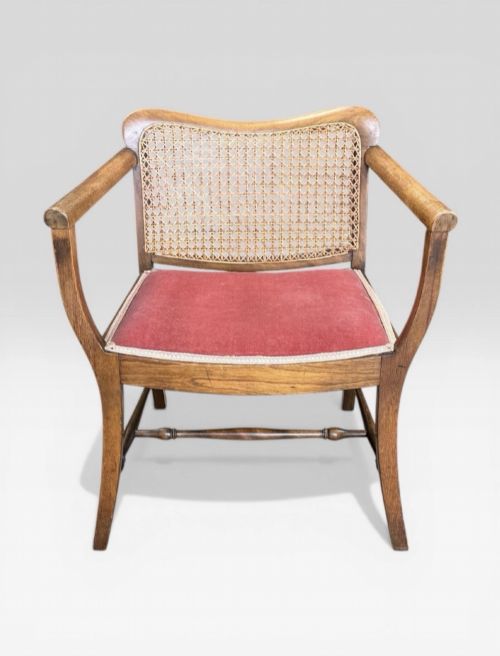


Caned Back Oak Seating
These caned back oak seating pieces bring together resilient wood frames and woven mesh panels for sitting rooms and dining spaces.
Caned Back Oak Seating
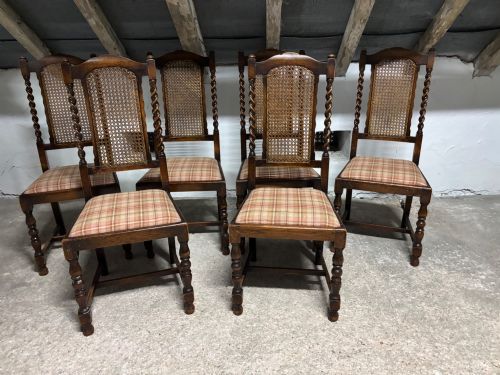
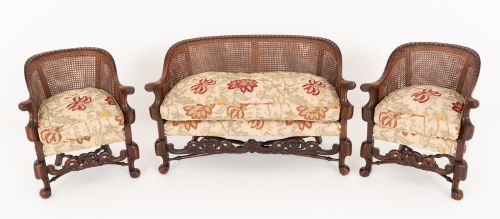
Caned back oak seating covers an array of armchairs, side chairs, dining sets, and settees that surface across nineteenth-century and early twentieth-century periods. Buyers seeking caned back oak seating frequently encounter Revival styles such as Jacobean and Carolean, alongside rustic country and bergere forms.
The inventory leans heavily towards matched dining sets and individual library armchairs, often incorporating woven cane panels into wooden frameworks. These items bridge formal historic revivalism and domestic comfort.
Origin variations span English country workshops and French provincial makers, offering everything from tall highback dining chairs to low tub chairs and childs bergere seats.
Materials and construction methods
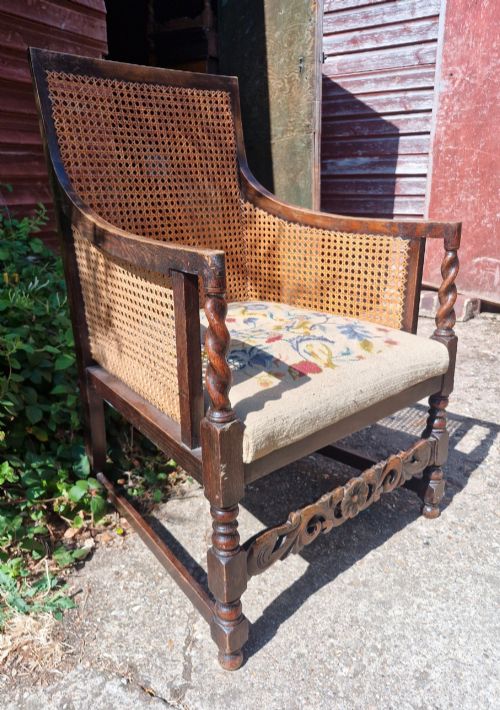
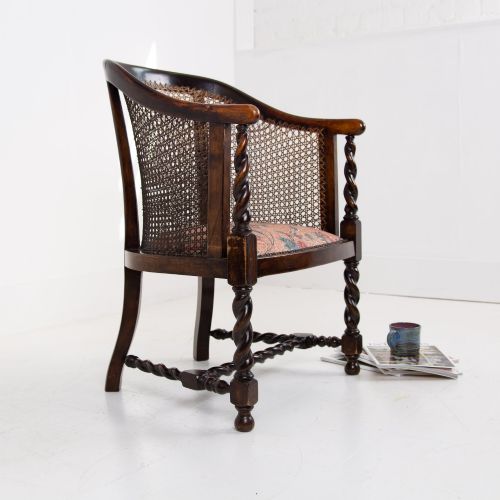
Makers utilised solid oak alongside supporting materials like walnut, brass, velvet, and leather, mounting woven cane and rattan panels directly into channeled wooden frames. Structural elements frequently display turned components such as barley twist legs and bobbin turnings.
Carpentry techniques relied on traditional jointing methods to support the tension of woven plant fibres. Carved ornamentation often accompanied revivalist aesthetics, integrating hand-carved motifs into the structural woodwork.
Even miniature occupants needed proper seating, as shown by surviving childs bergere chairs.
Assessing quality and craftsmanship
Quality rests in the crispness of the timber carving and the tightness of the woven cane mesh across the backrest and seat. Superior examples maintain structural integrity in the joints without excessive movement in the frame.
The refinement of the turning on legs and arm supports distinguishes workshop production, separating standard regional output from meticulously carved revival pieces.
James Shoolbred
The Caned Back Oak Seating Glossary
- Bergere
- An enclosed upholstered or caned armchair with wooden framing visible around the sides and back. These seats often include a loose fitted cushion.
- Jacobean Revival
- A nineteenth and twentieth-century interpretation of early seventeenth-century design. Pieces show heavy linear forms, rectangular paneling, and dark oak finishes.
- Barley Twist
- A spiral-turned wooden column used for legs and structural supports. This decorative turning method appears frequently on nineteenth-century seating.
- Rattan
- A climbing palm material utilised for weaving seats and backs. It provides flexibility and breathability within the wooden frame.
Caned Back Oak Seating: Frequently Asked Questions
How do I clean caned furniture?
Wipe the wooden frame with a damp cloth and mild soap, avoiding excess moisture near the woven mesh.
Maintain the cane by lightly dampening the underside occasionally to prevent the plant fibres from becoming brittle.
Can I reupholster a bergere chair?
Drop-in cushions and loose pads can be recovered easily in fabrics like velvet or leather without altering the frame.
Retaining the original cane backing preserves the historic integrity of the piece.
Are these chairs suitable for daily dining?
Dining sets and side chairs provide sturdy seating for regular meal use when the wooden joints remain tight.
Distribute weight evenly and avoid standing on seats to protect the woven mesh from sudden pressure.
How do I identify a revival style?
Look for turned stretchers, heavy carving, and specific proportions that echo seventeenth-century models.
Nineteenth-century reproductions often combine these historical motifs with later nineteenth-century framing techniques and hardware.