
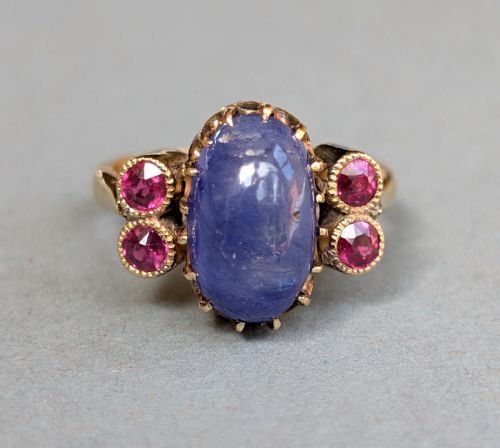


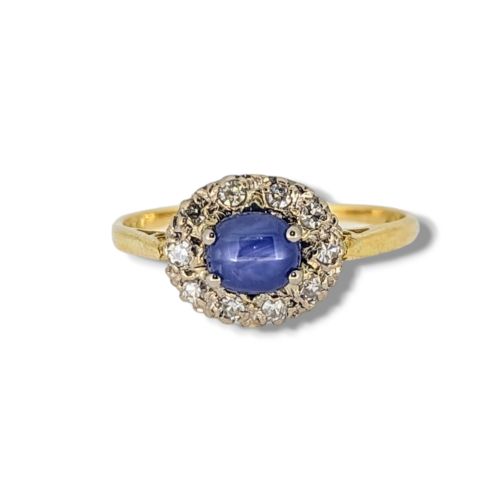


Cabochon Sapphire Cluster Ring
A cabochon sapphire cluster ring offers a smooth, polished dome of blue stone encircled by diamonds, bridging Victorian romance and Mid-Century geometry.
Cabochon Sapphire Cluster Ring
A cabochon sapphire cluster ring centres on an unfaceted, rounded sapphire stone surrounded by a border of smaller diamonds. This page focuses on finger rings spanning periods from the Victorian era through Art Deco and Mid-Century design.
The materials paired with these central stones include platinum, white gold, yellow gold, and occasional alternative pairings like opal or ruby. Formats range from traditional low profiles to raised cluster constructions.
Buyers encounter variations originating from the nineteenth century, Edwardian workshops, and 1960s studios. The overarching design remains consistent in placing the smooth dome at the focal point.
What varies in quality
Quality rests in the optical depth and polish of the central cabochon sapphire, where smooth domes without surface flaws command greater attention. The saturation and natural origin of the stone, such as Burma sources, heavily influence the overall character.
The standard of surrounding metalwork and the matching clarity of the diamond border dictate the refinement of the piece. Superior examples display balanced proportions between the central dome and the encircling geometric or floral cluster.
Some star sapphires possess tiny needle-like inclusions that catch the light to display a floating six-rayed star across the polished dome.
The Cabochon Sapphire Cluster Ring Glossary
- Cabochon
- A gemstone shaped and polished with a smooth, rounded dome rather than faceted surfaces. This traditional cut highlights the inner depth and colour of sapphires.
- Cluster ring
- A ring design featuring a prominent central stone surrounded by a border of smaller gems, typically diamonds. This layout maximises visual impact on the hand.
- Old cut diamond
- An early form of diamond cutting featuring a small table, high crown, and large culet, common in antique jewellery before modern standards developed. These stones exhibit a softer, candlelit sparkle.
- Platinum
- A dense, durable, and naturally white precious metal favoured in Edwardian and Art Deco jewellery for securing intricate settings. Its strength allows for fine wirework without risking structural failure.
- Rose cut diamond
- A vintage diamond cut with a flat base and a faceted dome resembling an unopened rose bud. This style produces subtle flashes rather than intense brilliance.
Cabochon Sapphire Cluster Ring: Frequently Asked Questions
How do I clean a cabochon sapphire cluster ring?
Warm soapy water and a soft brush will remove daily oils from the smooth surface of the sapphire and the surrounding diamond settings without risking damage.
Avoid harsh chemical dips or ultrasonic cleaners, especially if the piece incorporates softer gems or older foil-backed elements.
Are these rings suitable for daily wear?
Sapphire ranks very high on the hardness scale, making a cabochon sapphire cluster ring durable enough for regular use when set in robust metals like platinum or 18ct gold.
Prongs and settings should still be checked periodically by a jeweller to ensure the central dome and surrounding diamonds remain secure.
How can I tell an Art Deco ring from a Victorian one?
Art Deco pieces generally feature geometric platinum settings, sharp lines, and strong symmetrical layouts that contrast with the softer floral motifs of earlier eras.
Victorian and Edwardian versions often utilise yellow gold bands, organic daisy clusters, and rose cut diamonds rather than the precise step cuts seen later.
What is the difference between a faceted sapphire and a cabochon?
A faceted sapphire has flat geometric planes cut across its surface to maximise brilliance and light return, whereas a cabochon is polished into a smooth, rounded dome.
Cabochons are chosen to showcase the deep colour, star phenomena, or natural optical qualities of the mineral rather than sharp sparkle.