
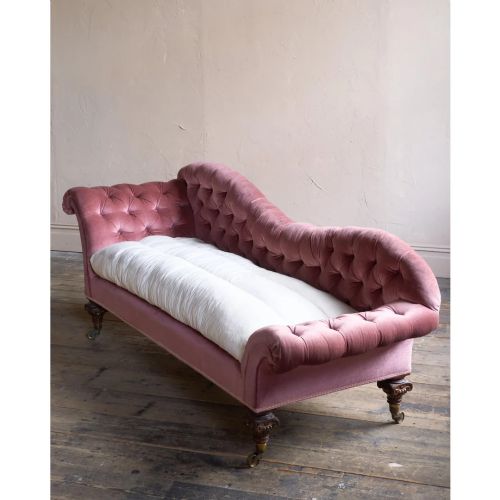
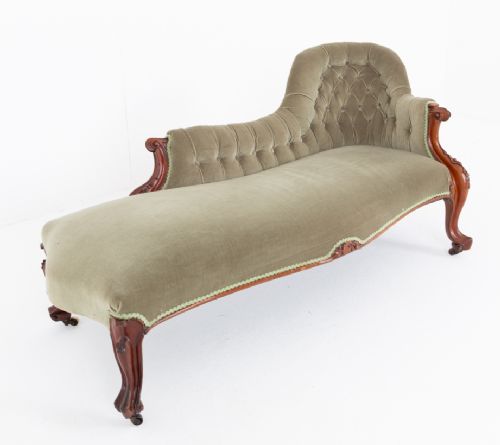
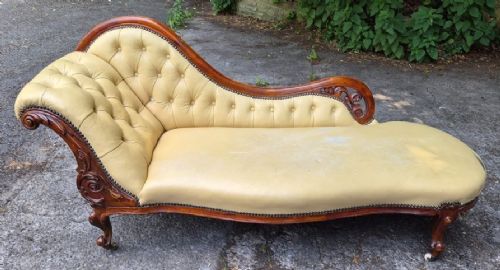


Button Tufted Chaise
A button tufted chaise offers reclining elegance, combining rich upholstery with classic wooden frames for traditional interiors.
Button Tufted Chaise
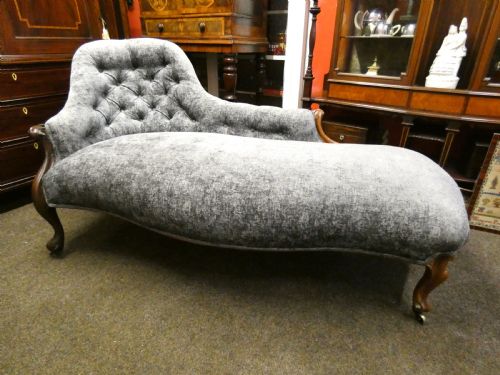
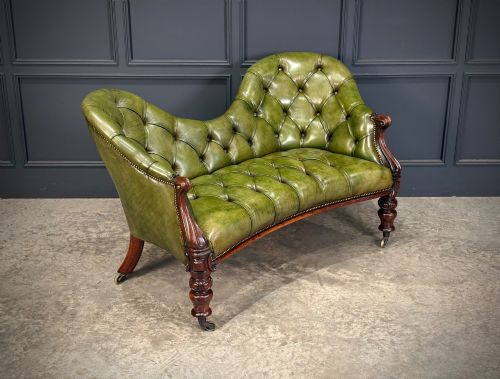
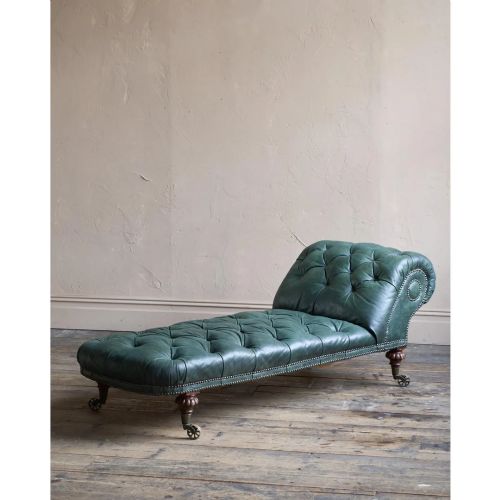
A button tufted chaise serves as an elongated seat designed for semi-recumbent relaxation, taking various forms across the Victorian and Regency periods. These pieces appear in configurations such as double spoon-back settees, scroll-end day beds, and traditional lounge designs.
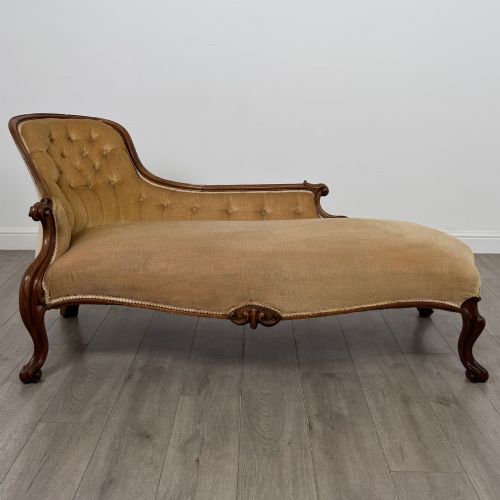
Victorian examples dominate the selection, featuring robust wooden frames paired with deep buttoning and tailored upholstery. Buyers frequently encounter rosewood, mahogany, and walnut structures supporting velvet, leather, or damask surfaces.
Originating primarily from nineteenth-century English workshops, these day beds and settees function as statement furniture for drawing rooms and large bedrooms. The combination of scrolled ends, carved woodwork, and tufted padding defines the visual character of the category.
Materials and construction methods
Cabinet makers built the structural frames using dense hardwoods like mahogany, rosewood, and walnut, often shaping them with elaborate carvings, barley twist turnings, or ionic column legs. These timbers provide the rigid skeleton required to support continuous lounging and heavy fabric tension.
Upholsterers secured textiles including velvet, leather, and damask directly to the internal padding using deep button tufting techniques that create a uniform diamond pattern. This method distributes tension evenly across the seat and backrest while securing the internal stuffing.
Listings feature woods including mahogany, rosewood, walnut, and brass, spanning the Regency and Victorian periods.
Assessing craftsmanship and finish
The precision of the wood carving and the depth of the frame joinery dictate the baseline quality of each piece. Superior examples exhibit crisply detailed foliage, robust structural timber, and well-balanced proportions without sagging.
Upholstery execution separates standard output from exceptional workshop pieces, particularly in the regularity of the button tufting and the selection of high-grade leather or heavy velvet. Maker attribution also influences standing, with documented pieces carrying distinct regional provenance.
Howard and Sons·H Goodall and Sons·Holland and Sons·Jas Shoolbred·Miles and Edwards
The Button Tufted Chaise Glossary
- Button tufting
- A traditional upholstery technique where twine pulls fabric deep into the stuffing, secured with buttons to form a geometric pattern. This method keeps internal fillings from shifting over time.
- Chaise longue
- An upholstered sofa shaped like a chair with a long seat for reclining. The form combines seating and day bed functions within a single piece.
- Spoon-back
- A padded chair or settee back shaped like the bowl of a spoon, curved to fit human posture. Victorian seating frequently utilises this ergonomic contour.
- Day bed
- A long couch used for resting during daytime hours. These items bridge the gap between chairs and full beds.
- Scroll end
- A wooden or upholstered armrest curving outward and downward in a spiral profile. This detail appears frequently on Regency and Victorian frames.
Button Tufted Chaise: Frequently Asked Questions
How do I style a chaise in a modern room?
Place the piece against a neutral wall to let the carved wooden frame and buttoned upholstery stand out as a focal point. Pair it with minimal surrounding furniture to maintain balance.
Ensure adequate clearance around the scrolled ends and long frame so the silhouette remains unobstructed and accessible from the room.
Were these day beds meant for sleeping?
Victorian households utilised these lounging seats primarily for daytime resting, reading, or receiving visitors in a semi-reclined posture. They provided a comfortable alternative to full beds during afternoon hours.
The shortened length and raised headrests indicate they were designed for supporting the upper body rather than overnight sleeping.
How do I care for antique leather upholstery?
Apply specialised leather balms periodically to keep the material supple and prevent cracking across the buttoned surfaces. Keep the furniture away from direct sunlight and heat sources.
Dust the deep folds regularly with a soft brush to prevent grit from accumulating in the tufted depressions.
What distinguishes Victorian from Regency frames?
Regency frames tend to display cleaner classical lines influenced by ancient Greek and Roman designs, often utilising mahogany with restrained ornamentation. Victorian iterations introduce heavier carvings, rosewood or walnut timbers, and more exuberant profiles like spoon backs.
The earlier Regency examples prioritize architectural symmetry, whereas the later Victorian pieces favor ornate detailing and voluptuous curves.