


Button Backed Leather Couch
A button backed leather couch brings deep-buttoned comfort and rich heritage into a room, offering the sturdy elegance that collectors prize.
Button Backed Leather Couch
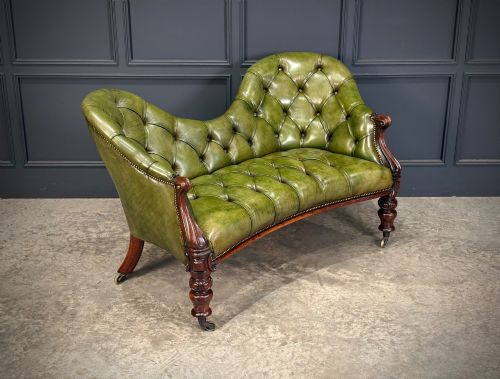
When you search for a button backed leather couch, you encounter a robust selection of Victorian, Edwardian, and mid-century seating designed for endurance. The material evidence on this page centres primarily on traditional Chesterfields, corner sofas, and chaise longues from the nineteenth century onward.
The dominant forms are generous chesterfield sofas featuring deep buttoning, alongside occasional variations like double spoon-back settees and conversational swivel pieces. These seating options emerge from periods spanning the 1800s to the 1930s, constructed predominantly in walnut, mahogany, and hardwood.
Buyers meet examples finished in raw leather, hand-dyed shades, or untouched original patinas that reflect their long histories. Such furniture serves as a focal point in a study or drawing room, combining substantial timber frames with resilient upholstery.
How they were made
The construction of a button backed leather couch relies upon a solid internal timber framework built from mahogany, walnut, or general hardwood and timber. Artisans formed the foundational skeleton to support heavy daily use, employing sturdy joinery that withstands centuries of pressure.
Upholstery techniques combined durable leather hides with meticulous brass detailing, securing the surface through deep buttoning methods. Workshops applied hand-dyed finishes or left the hides in their original state, pairing metal springs and hardware with dense padding.
Some Victorian models include clever swivel mechanisms, allowing two people to gossip back-to-back without twisting their necks.
What varies in quality
The standard of a button backed leather couch rests on the integrity of its carved wooden frames and the depth of its upholstery work. Pieces constructed from dense hardwoods like walnut or mahogany demonstrate superior structural resilience compared to lighter timber variants.
Quality also appears in the treatment of the hide, whether the leather retains an untouched original character or receives careful hand-dyeing. The precision of the deep buttoning and the soundness of the internal support dictate the enduring value of each sofa.
Howard And Sons·Hampton And Sons
The Button Backed Leather Couch Glossary
- Chesterfield
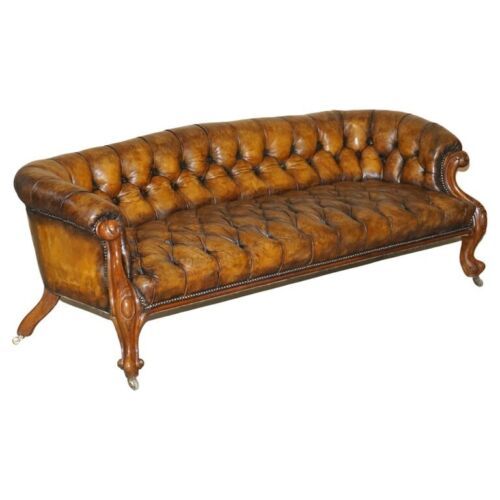
- A large upholstered sofa with deep buttoning and arms of the same height as the back. This form is the most common archetype found among nineteenth-century seating.
- Chaise Longue
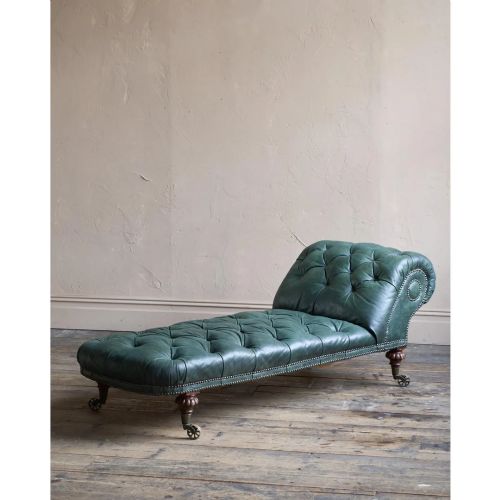
- An upholstered sofa in the shape of a chair with a long seat large enough to support the legs. These pieces appear frequently in Victorian collections alongside traditional couches.
- Spoon-Back
- A chair or sofa back shaped like the bowl of a spoon, featuring padded upholstery surrounded by a carved wood frame. This style provides distinct ergonomic support.
- Serpentine Front
- A furniture front that curves inward centrally and swells outward at the sides in a gentle wave. This contour adds visual movement to heavy wooden frames.
- Show Frame
- A structural wooden frame left visible around the upholstered portions of a seat to display carved detailing. Walnut and mahogany were frequently utilised for this purpose.
Button Backed Leather Couch: Frequently Asked Questions
How do I identify a Victorian chesterfield?
Victorian chesterfields are identified by their heavy timber frames, deep buttoned leather upholstery, and traditional proportions typical of the nineteenth century. They often feature hand-dyed brown or green leather hides and robust wooden legs.
Makers from this era utilised sturdy hardwoods like mahogany and walnut to build internal structures that survive today. Examining the joinery and the wear on the leather helps confirm the nineteenth-century origins.
How should I care for antique leather?
Antique leather requires gentle maintenance to preserve its natural oils and prevent the hide from drying or cracking over time. Regular dusting and occasional application of suitable leather balms keep the surface supple.
Avoid placing these sofas in direct sunlight or near heat sources which can damage fragile nineteenth-century hides. Preserving the original patina involves minimal intervention and careful cleaning.
What distinguishes a chaise longue?
A chaise longue is characterised by an elongated seat designed for reclining, paired with a single raised backrest or armrest end. They appear in nineteenth-century listings alongside standard multi-seater sofas.
These items served as places of rest in formal rooms, combining timber frames with buttoned leather or fabric. Their asymmetric form sets them apart from traditional symmetrical chesterfields.