
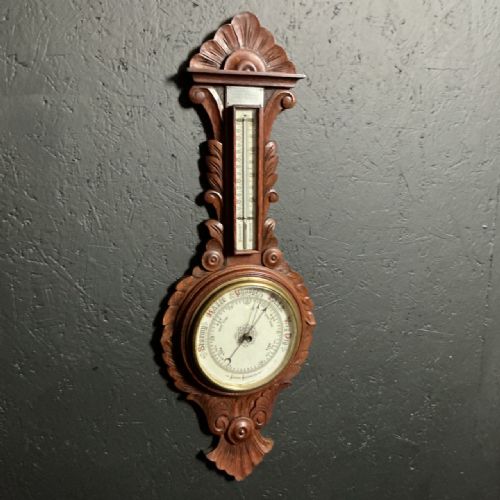
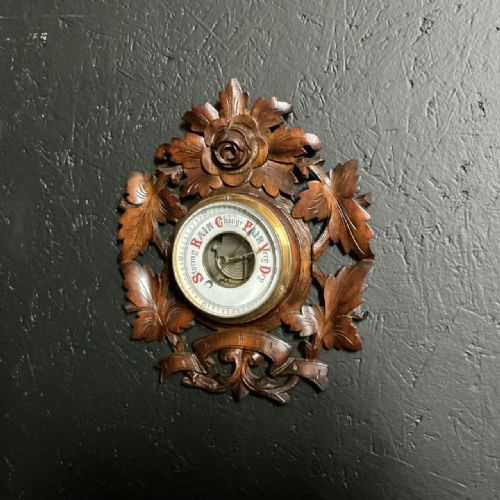
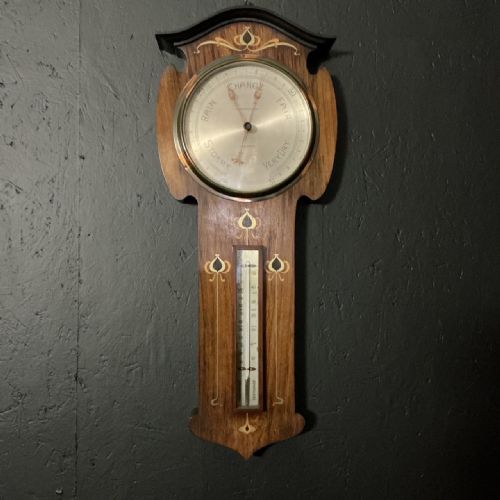
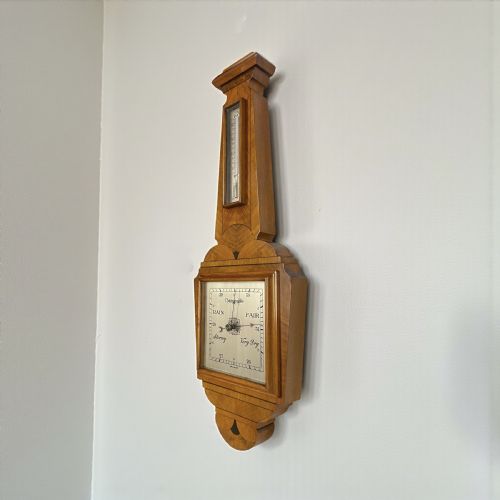
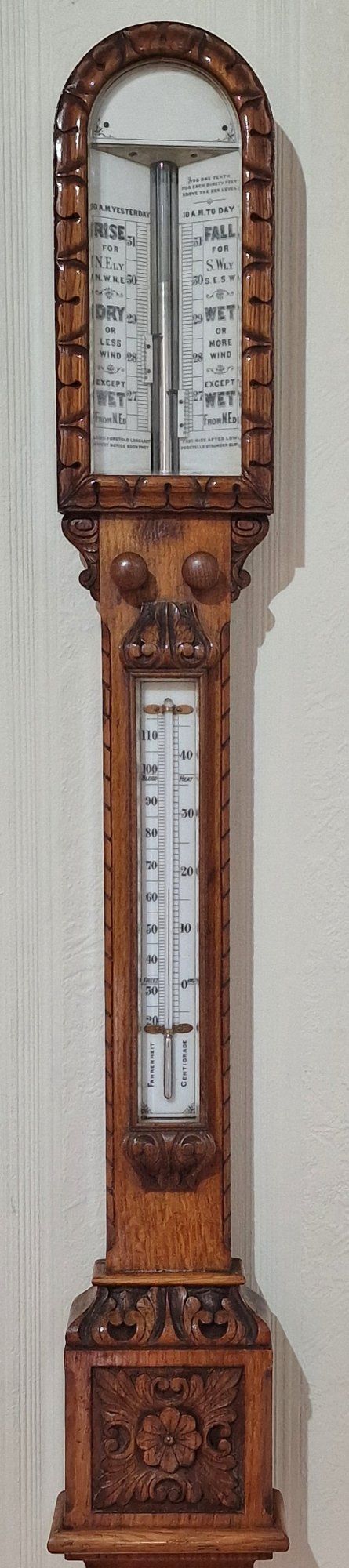
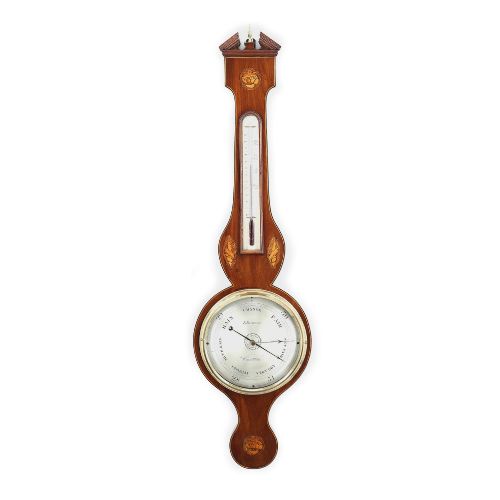

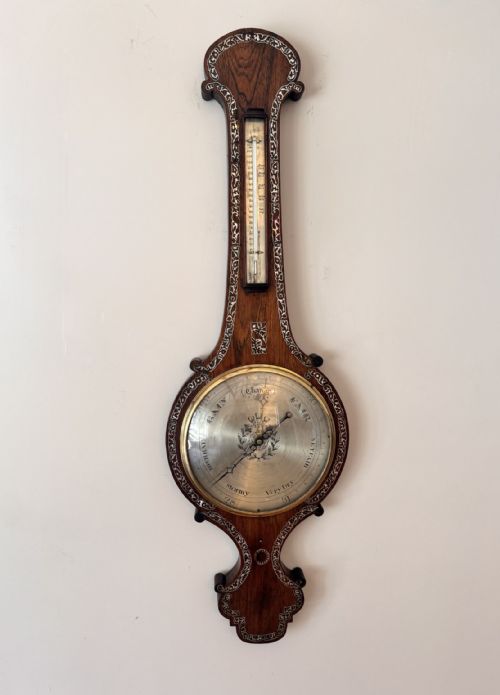


Brown Wooden Wall Barometer
A brown wooden wall barometer tells atmospheric pressure while anchoring a room with period timber and brass.

Brown Wooden Wall Barometer
A brown wooden wall barometer combines practical weather observation with the decorative furniture styles of the nineteenth and twentieth centuries. These instruments hang on domestic walls, taking forms from simple stick barometers to elaborate carved banjo and wheel designs.
The pieces appearing here span the Georgian, Regency, Victorian, Edwardian, and Art Deco periods, alongside specific years such as eighteen ninety and nineteen thirty. Buyers regularly encounter mahogany cases with string inlay alongside carved oak and walnut examples from the Black Forest style.
Makers ranged from provincial watchmakers to city opticians, often signing the silvered brass dials set into the timber frames. Many instruments integrate thermometers or spirit levels alongside the primary pressure dial to provide complete domestic meteorological stations.
Materials and construction methods
Cabinetmakers utilised solid timbers such as mahogany, oak, walnut, beech, and birds-eye maple to build the housing cases. These woods were frequently carved by hand, turned on lathes, or decorated with contrasting string inlay and mother-of-pearl accents.
Internal mechanisms rely on sealed aneroid capsules or mercury columns connected to delicate brass linkages and pointers. Glass bezels protect the engraved or silvered dials, while brass suspension rings secure the heavy wooden frames to the wall.
Listings feature mahogany, oak, walnut, beech, and glass across Victorian, Edwardian, Regency, and Art Deco periods.
Quality factors in wooden barometers
The standard of a brown wooden wall barometer rests on the depth and crispness of the timber carving and the sophistication of the case geometry. Highly regarded examples display figured grain patterns, such as flame mahogany or rich walnut, shaped into pediments and onion tops.
Horological and scientific quality depends on the clarity of the engraved brass dial and the reputation of the maker inscribed upon it. Signed instruments by known opticians or instrument makers command greater interest than unsigned factory pieces.
B. Besozzi of Weymouth·Molton of Norwich·Jenkins Of Old Swindon·L Casatelli of Liverpool·W.E. Pain of Cambridge·J Groce, York·J Hicks of London·Malacrida of Dublin
The Brown Wooden Wall Barometer Glossary
- Aneroid barometer
- An instrument measuring atmospheric pressure without liquid, using a flexible metal box that expands or contracts.
- Stick barometer
- A tall, narrow instrument containing a vertical column of mercury to register barometric changes.
- Wheel barometer
- A round dial instrument where pressure changes drive a pointer via a pulley and weight system, often housed in a banjo-shaped case.
- Admiral Fitzroy barometer
- A large storm barometer featuring twin thermometer tubes and detailed weather prediction guidelines printed on the paper register.
- Silvered dial
- A brass dial treated with silver powder to create a matte finish that highlights the engraved numbers and inscriptions.
Brown Wooden Wall Barometer: Frequently Asked Questions
How do I read a barometer?
A barometer tracks changes in air pressure by moving a needle across a graduated dial, where rising pressure indicates improving weather. Most instruments feature a manual set hand that you align over the main pointer to monitor daily movement.
Reading the instrument requires checking whether the pointer moves toward stormy or fair conditions compared to your previous observation.
Where should I hang a wall barometer?
Barometers need stable interior wall locations away from direct sunlight, radiators, and heavy drafts that cause artificial temperature fluctuations. Kitchens and damp spaces can damage the internal brass mechanisms and paper register scales.
Secure the hanging bracket directly into wall studs or use appropriate masonry fixings to support the substantial weight of hardwood cases.
How do I tell Victorian from Georgian barometers?
Georgian and Regency barometers typically favour tall, slender mahogany stick or banjo formats with simple architectural lines and dampener boxes. Victorian pieces introduce heavier carved oak, walnut, and rosewood cases featuring geometric mouldings, crests, and enriched ornamentation.
Examining the dial signature, glass bezel construction, and timber finishing helps confirm the period of manufacture.
Can antique barometers still predict weather?
Many surviving barometers retain functional mercury or aneroid movements that respond accurately to local atmospheric pressure changes. Mechanical calibration against a known local reading allows you to adjust the internal linkage for current altitude.
Regular care ensures the delicate glass tubes and brass pivots continue to operate smoothly after a century or more.