
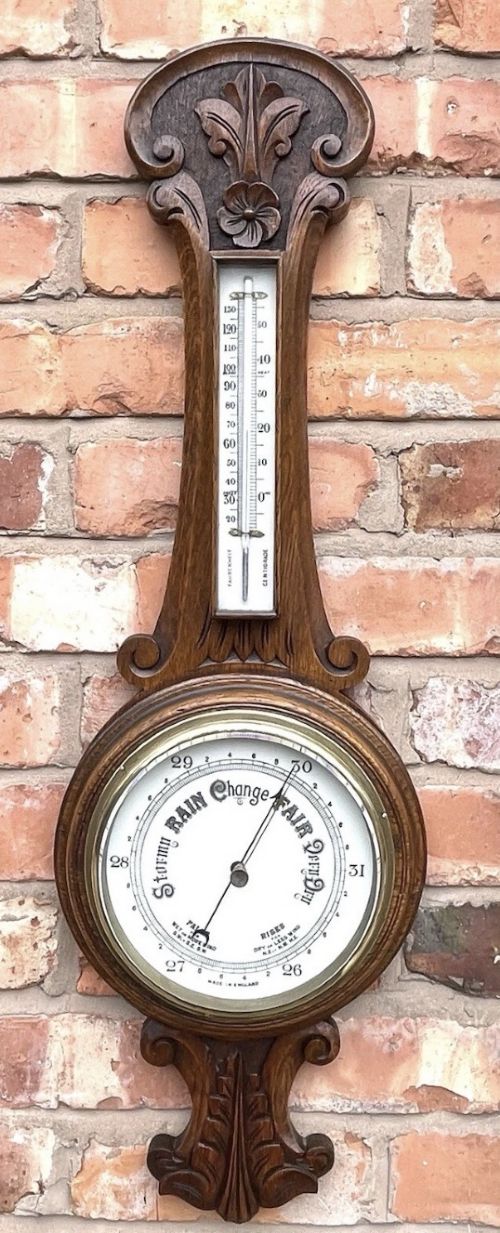


Banjo Barometer Clock
These banjo barometer clock pieces combine timekeeping and atmospheric pressure measurement in striking wall-hung instruments.
Banjo Barometer Clock
A banjo barometer clock merges a traditional timepiece with weather recording equipment inside a distinctively shaped wooden wall case. You meet these pieces most frequently in 19th century forms, spanning Regency, Victorian, and Edwardian periods.
Originating predominantly from British workshops, these instruments also appear in American walnut variations from the same era. Each piece serves simultaneously as a functional household utility and a prominent wall decoration.
How they were made
Cabinetmakers shaped dense hardwoods including mahogany, oak, walnut, and rosewood into the sweeping profiles characteristic of the form. Many examples display detailed hand carving along the wooden frames.
Dial faces incorporate glass and silvered metal components to display atmospheric readings and time clearly. Brass fittings secure the inner mechanisms and exterior bezels within the wooden housing.
Listings feature woods such as mahogany, oak, walnut, and rosewood paired with brass and silvered metal dials.
What varies in quality
The refinement of the woodwork dictates much of the visual distinction, with deeply carved oak and figured mahogany representing the upper tier. Plain cases indicate simpler domestic production rather than high-end commission work.
Signed movements by known makers carry greater distinction than unsigned or anonymous examples. The clarity of the silvered metal dials and the preservation of original glass further separate standard pieces from superior specimens.
Ganthony of London·H Marks High Street Bloomsbury·Russell of Liverpool
The Banjo Barometer Clock Glossary
- Aneroid barometer
- An instrument that measures atmospheric pressure without using liquid, relying instead on a flexible metal box. This mechanism allowed barometers to be built into wall clocks of various shapes.
- Silvered metal
- A metallic dial face treated with a silver compound to produce a bright, legible surface for numerals and graduations. It reflects light gently behind the glass cover.
- Regency
- A British design period spanning the early 19th century, known for classical restraint and elegant proportions. Pieces from this era often utilise rich mahogany veneers.
- Thermometer
- A secondary instrument mounted onto the trunk of the case to measure ambient temperature alongside pressure and time. It sits beneath a protective glass pane.
Banjo Barometer Clock: Frequently Asked Questions
How do I date a banjo barometer clock?
Dating relies on stylistic clues within the woodwork and the materials used for the case. Regency and George III pieces display different proportions compared to later Victorian or Edwardian examples.
Makers' signatures and the specific type of barometer movement also provide clues to the decade of manufacture. Comparing the carved details helps place the instrument within the nineteenth century.
Where were these instruments placed?
These wall clocks hung in prominent reception rooms and halls where guests could check the time and weather simultaneously. Their vertical shape suited narrow wall spaces between doorways or windows.
Domestic interiors of the Victorian and Edwardian eras utilised them as both practical tools and decorative furniture.
What woods were used for the cases?
Cabinetmakers selected dense hardwoods that could withstand carving and hold a stable structure over time. Mahogany, oak, and walnut appear frequently across British and American examples.
Rosewood also provides a darker, highly figured alternative on select period pieces.
Are the clock and barometer separate?
Some designs incorporate both timekeeping and atmospheric recording into a single combined housing, while others focus on one primary function supported by subsidiary dials. The banjo shape accommodates multiple instruments along its vertical drop.
Viewing the individual dials reveals whether the piece operates as a clock, a barometer, or both.