
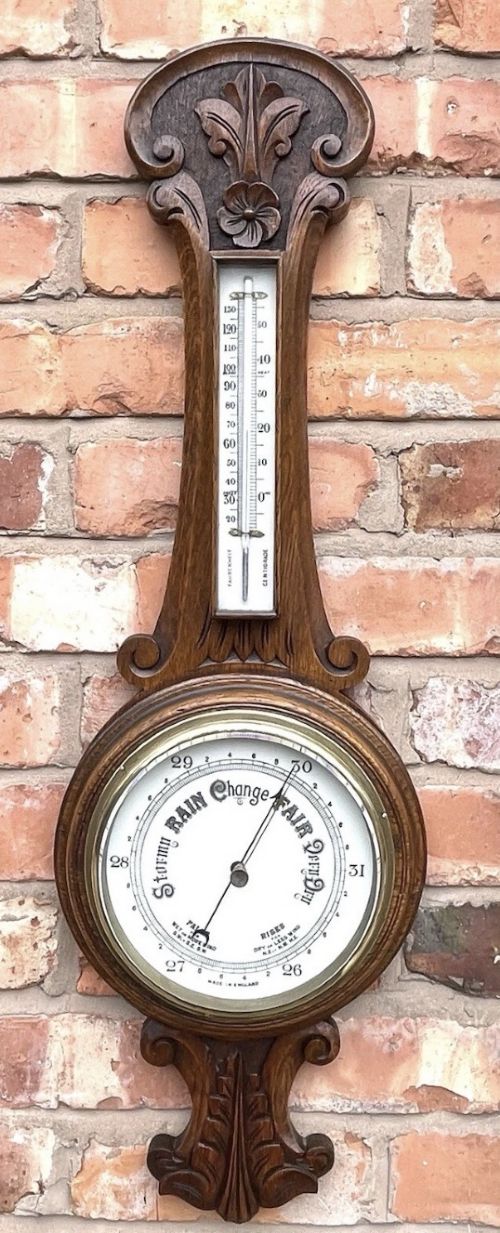


Oak Barometer Wall Clock
An oak barometer wall clock brings period timekeeping and atmospheric pressure tracking together in timber cases.

Oak Barometer Wall Clock
An oak barometer wall clock combines timekeeping and meteorological measurement in a single timber housing designed to hang directly on a wall. Buyers searching this phrase encounter banjo configurations, bulkhead pairings, and carved cases spanning the Victorian and Edwardian eras.
The versions most frequently met on this page feature carved oak surrounds, white ceramic or metal dials, and aneroid mechanisms housed together. Examples range from Dutch Art Nouveau designs to English banjo styles bearing thermometers alongside the clock face.
Materials and construction
Makers utilised solid and carved oak for the primary housing, often shaping the timber into banjo profiles or structural frames that support glass viewing panels. Brass bezels enclose the dial faces, while ceramic or metal components display the calibrated scales.
Internal aneroid movements rely on sealed metal capsules responding to barometric pressure changes, linked mechanically to indicator needles. Wood carving techniques define the exterior decoration, displaying leaf motifs or geometric patterns typical of late nineteenth and early twentieth century workshops.
Current listings span the Victorian, Edwardian, and Art Nouveau periods, constructed primarily in oak alongside brass, glass, and ceramic elements.
Judging quality in these pieces
Quality rests upon the crispness of the timber carving and the architectural proportions of the case. Sharply defined foliage and balanced banjo shapes distinguish superior examples from plain or heavily worn housings.
The integration of the dual dials and the finish of the brass bezels indicate the standard of production. Finer instruments retain clear dial markings and well-fitted glass covers over the movement scales.
Hyde & Sons Sleaford·Negretti & Zambra
The Oak Barometer Wall Clock Glossary
- Aneroid barometer
- A barometer that measures atmospheric pressure using a flexible metal box rather than liquid mercury. This sealed capsule expands and contracts with pressure shifts.
- Banjo barometer
- A wall-mounted instrument shaped like a stringed musical instrument, featuring a circular dial at the top and a longer body tapering downward. This layout accommodates both a thermometer and humidity indicators.
- Bulkhead clock
- A maritime timepiece built into a heavy metal housing designed to mount on ship walls. These robust items often pair with matching barometers.
- Bezel
- The metal ring that holds the glass cover in place over the dial face. Brass is the predominant material for this element.
- Caduceus
- A staff entwined by two serpents, sometimes utilised as a decorative motif or overall shape for wall-mounted scientific instruments.
Oak Barometer Wall Clock: Frequently Asked Questions
What is an aneroid barometer mechanism?
An aneroid mechanism relies on a sealed corrugated metal box that contracts or expands as air pressure changes.
This movement transfers mechanical motion to the dial needle without employing liquid mercury.
How do I date an oak barometer?
Dating relies on stylistic clues such as carving depth, dial materials, and the overall silhouette of the wooden case.
Victorian examples often display heavier carving, while Edwardian pieces lean toward refined proportions.
How do I maintain the oak case?
The timber housing benefits from occasional light dusting and treatment with appropriate furniture wax to preserve the grain.
Keep the instrument away from direct heat sources and damp environments to protect the wood and internal brass components.