


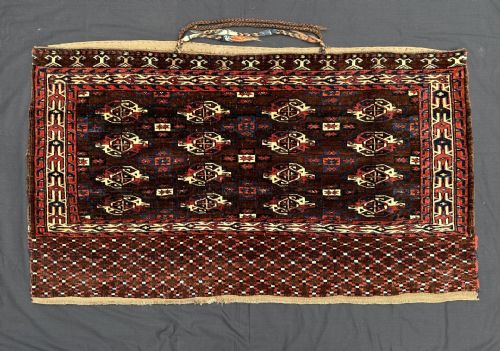


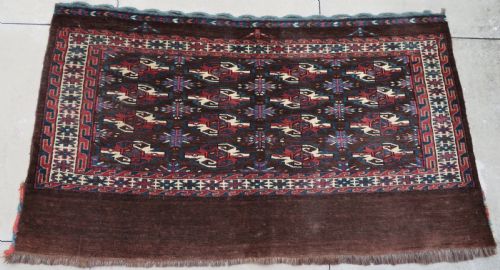
Brown Turkmen Rug Bag
These brown turkmen rug bag examples bring authentic Central Asian tribal weave history directly into your home.
Brown Turkmen Rug Bag
The pieces listed on this page showcase distinct tribal identities, notably Saryk, Yomut, and Chodor traditions. Each object reflects the practical nomadic lifestyle of the Trans-Caspian steppes through durable construction and functional pocket or bag forms.
Buyers will encounter both complete bags retaining their original flatweave backs and individual bag faces adapted for display. These textiles range from compact spindle bags to larger storage sacks featuring characteristic gul motifs and banded flatweave designs.
Distinguishing quality in tribal weavings
Quality in a brown turkmen rug bag is defined by the clarity and precision of traditional motifs such as the kepse gul, aishk gul, and ertmen gul. Finer examples display meticulous execution in the repeating patterns that denote specific tribal groups.
The survival of original structural elements, including plain weave backs and complete borders, elevates the integrity of the piece. Superior craftsmanship is also evident in the handling of hand-spun wool and the depth achieved through natural dyes.
Nomads wove special tent-pole bags simply to keep stray tent struts from poking everyone during tea time.
Saryk Turkmen·Yomut Turkmen·Chodor Turkmen
The Brown Turkmen Rug Bag Glossary
- Torba
- A small Turkmen storage bag traditionally hung inside a tent to store household possessions. These pieces usually feature a wide horizontal format with prominent gul motifs.
- Chuval
- A large Turkmen tent-storage bag designed for blankets and heavier household goods. They rank among the larger domestic weavings produced by nomadic tribes.
- Mafrash
- A rectangular storage bag or bedding sack often constructed in mixed technique structures. They served vital organisational roles within the traditional nomadic household.
- Gul
- A repeating medallion or octagonal motif central to Turkmen tribal design. Each pattern traditionally identified the specific tribe or clan that wove the textile.
Brown Turkmen Rug Bag: Frequently Asked Questions
What is a brown turkmen rug bag used for?
These textiles served as practical storage containers inside nomadic tents, holding bedding, clothing, and household items during seasonal migrations.
Today, collectors appreciate them as wall hangings or decorative accents that bring rich tribal history into modern interiors.
How do I identify a Yomut piece?
Yomut textiles often feature distinct geometric patterns, banded flatweaves, and specific guls like the kepse or aishk design.
Examining the structural details and wool quality helps connect the weaving to the Yomut tradition of the Trans-Caspian steppes.
Are these bags complete with backs?
Some listings preserve the original plain weave or flatweave back, while others consist solely of the decorative bag face.
Both complete sacks and individual faces offer authentic examples of nineteenth-century nomadic textile artistry.
How should I display a textile bag?
Many collectors mount these flatweaves and bag faces securely on walls as textile art to protect the wool from heavy floor traffic.
Ensuring proper support across the top edge prevents distortion and preserves the historical structure of the piece.