
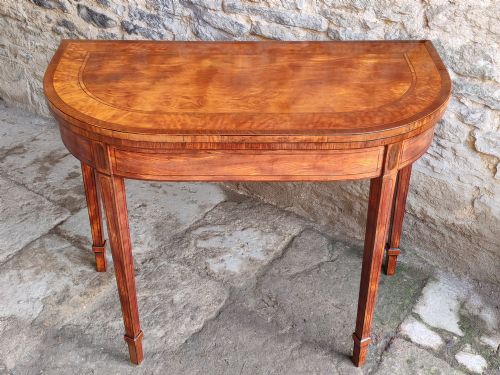
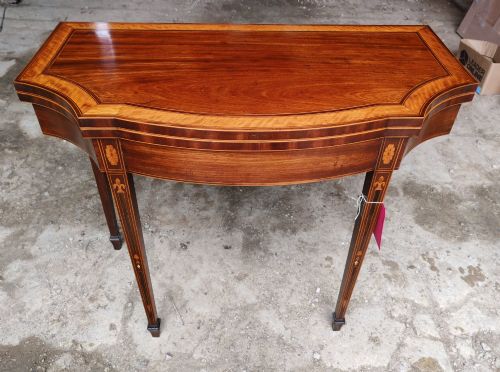

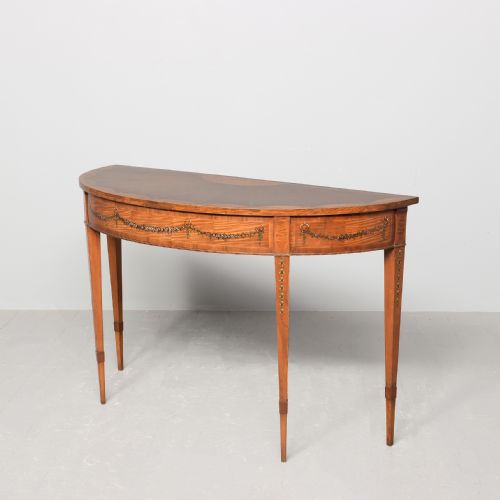


Brown Satinwood Console Table
A brown satinwood console table brings tactile warmth and refined timber figuring into a room.
Brown Satinwood Console Table
A brown satinwood console table sits flush against a wall, combining the golden-yellow warmth of satinwood with richer contrasting timbers.
The selections span multiple periods, from eighteenth-century George III pieces to nineteenth-century Victorian and Edwardian revivals, showing how cabinet makers continually returned to lighter decorative woods.
Beyond strict console forms, the inventory includes related demi-lune shapes, card tables, and serving tables that share the characteristic surface veneers and inlay.
Materials and construction
Craftsmen built these tables using foundational carcase woods like mahogany, applying fine satinwood veneers to the visible surfaces.
Decorative detailing relied on precision inlay and banding, incorporating contrasting ebony, boxwood, and rosewood to frame the main timber panels.
Hand painting and parquetry further embellished the tops, while drop-leaf, fold-over, and pivoting mechanisms provided functional versatility.
Listings feature satinwood combined with mahogany, ebony, and boxwood across periods ranging from the Georgian era to the Edwardian revival.
Assessing quality and execution
The standard of timber selection sets individual pieces apart, notably the tightness of the satinwood grain and the richness of the underlying mahogany.
Execution of the marquetry and stringing reveals the hand of the maker, where sharp alignment and tight joints separate master workshops from standard production.
Depth of hand-applied finish and the integrity of the original structural joints determine how well a table has survived the centuries.
Edward and Roberts·Maples of London
The Brown Satinwood Console Table Glossary
- Satinwood
- A dense, lustrous timber native to Ceylon and the West Indies, prized for its golden sheen and suitability for fine veneer work.
- Demi-lune
- A half-moon shape popular for console and card tables designed to stand flat against a wall.
- Parquetry
- Geometric mosaic woodwork formed by small veneer pieces arranged in patterns across a surface.
- Crossbanding
- A narrow strip of veneer laid around the border of a table top with the grain running perpendicular to the centre.
- Card table
- A fold-over or pivoting table designed for indoor gaming, often lined with baize or felt on the interior surface.
Brown Satinwood Console Table: Frequently Asked Questions
How do I style a brown satinwood console table?
Place the table against a plain wall in a hallway or reception room to let the contrasting timber grain stand out. Keep surface items minimal to avoid obscuring the marquetry or hand-painted details.
Pair it with a simple mirror or a single ceramic lamp. The reflective quality of polished satinwood complements both traditional interiors and simpler modern spaces.
Are these tables sturdy enough for daily use?
Most console and side tables are built to hold decorative objects rather than heavy loads. Fold-over card tables contain moving hinges that require careful handling when opening the top.
Avoid placing them in areas of direct sunlight or high humidity, as antique veneers can react to environmental shifts. Regular dusting with a dry cloth helps preserve the polished finish.
How can I tell an eighteenth-century table from a later revival piece?
Examine the underside and secondary timbers for tool marks and construction methods consistent with earlier hand-working. Eighteenth-century pieces often display subtle irregularities in hand-cut dovetails and timber seasoning.
Revival pieces from the Edwardian period or the late nineteenth century frequently use machine-sawn elements and standardised screws. Comparing the style of inlay to known period patterns also helps clarify the date.
What is the difference between a console table and a side table?
A console table is traditionally designed to stand against a wall, sometimes anchored to it for stability, featuring decorative work primarily on the front and sides. Side tables are generally free-standing pieces finished on all sides for placement anywhere in a room.
Many listings blur these lines by using demi-lune or serving formats interchangeably. Check the configuration of the legs and the finished surface areas to determine original placement.