
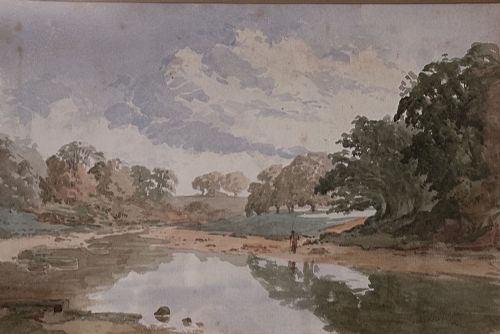


Brown Pastoral Watercolour
These brown pastoral watercolour works capture rural life on paper, offering a quiet window into the British countryside through earthy tones and traditional scenes.
Brown Pastoral Watercolour
A brown pastoral watercolour presents rural scenes, farming landscapes, and village views executed primarily in earthy pigments on paper. These original artworks span from the Georgian and Victorian eras into the twentieth century, recording shepherds, cattle, and riversides.
Most pieces encountered here date from the nineteenth century up to the nineteen-twenties, reflecting British realism and impressionism. Framed works often feature traditional wood or gilt surrounds that complement the muted palette of the paintings within.
Materials and technique
Artists painted these rural subjects using watercolour pigment applied to paper supports. Some compositions incorporate pastel or fine lines alongside the washes to build texture in cottages, foliage, and livestock.
Finished works received protection beneath glass and were set within wooden frames, occasionally embellished with gold leaf or gilt details. These traditional mountings preserve the delicate paper surfaces from atmospheric moisture and handling.
Listings feature works created across the nineteenth and twentieth centuries, using paper, watercolour pigment, gold leaf, and wood.
Evaluating quality and handling
The distinction between standard works and exceptional examples lies in the confidence of the brushwork and the management of light across the pastoral scene. Master hands render the movement of sheep or the atmospheric haze of a river valley with palpable depth.
Preservation of the paper and the integrity of the pigment also define the standard of a piece. Strong survival of original framing materials and minimal fading of the earthy tones maintain the visual balance intended by the artist.
Henry Charles Fox·James William Booth·Ernest Pile Bucknall·Helena Maguire·Alfred Grey·Harold Lawes·Edmund George Warren·Harry Sylvester Stannard·Robert Hollands Walker·Henry Birtles·Frederick Tucker·William Stephen Coleman·Frank Saltfleet·Angus Rands·John D Walker·John Joseph Cotman
The Brown Pastoral Watercolour Glossary
- Watercolour pigment
- Finely ground colour suspended in a water-soluble binder, used on paper to create translucent washes and fine details.
- Pastel
- A dry drawing medium composed of powdered pigment and a binder, sometimes combined with watercolour in landscape compositions.
- Gilt
- A thin layer of gold leaf or gold paint applied to wooden frames to provide a decorative metallic finish.
- British realism
- An artistic approach focusing on the truthful, unidealised depiction of everyday rural life and scenery.
Brown Pastoral Watercolour: Frequently Asked Questions
What is a brown pastoral watercolour?
It is an original painting on paper depicting rural life, farming scenes, or countryside views using earthy, brownish tones.
These works range from small sketches to large framed gallery pieces created during the nineteenth and early twentieth centuries.
How do I care for antique paper art?
Keep watercolours away from direct sunlight and damp environments to prevent fading of the pigments and foxing on the paper.
Display them on interior walls with stable temperature and humidity levels to ensure the long-term preservation of the artwork.
How can I tell the period of a piece?
Stylistic details such as the clothing of figures, the framing materials, and the handwriting of signatures or inscriptions provide clear dating clues.
Victorian and Edwardian works often exhibit specific approaches to realism and pastoral subject matter that distinguish them from earlier Georgian examples.