


Brown Mahogany Fire Screen
These brown mahogany fire screen pieces block hearth drafts and display needlework, oil paintings, and prints across Georgian, Regency, and Victorian rooms.
Brown Mahogany Fire Screen
A brown mahogany fire screen forms a decorative barrier placed before a fireplace to deflect the intense heat of an open fire when the grate is unlit. Buyers seeking a brown mahogany fire screen encounter forms ranging from freestanding pole screens with adjustable panels to folding tables and side tables with integrated screens.
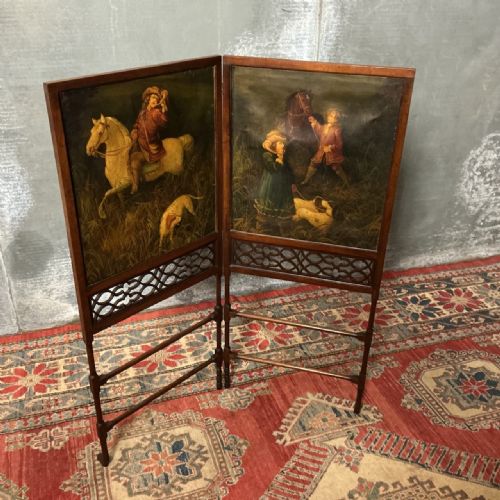
The selection spans periods from the eighteenth century through the Edwardian era, including Georgian, Regency, William IV, and Victorian examples. Many pieces incorporate textiles, needlepoint, tapestry, canvas, wool, embroidery, or framed satirical prints and oil paintings within the mahogany framework.
How they were made
Cabinetmakers constructed the frames using solid mahogany, frequently incorporating turned columns, bobbin turning, and inlaid details. Panels were designed to slide, pull out in sections, or adjust in height along a central pole.
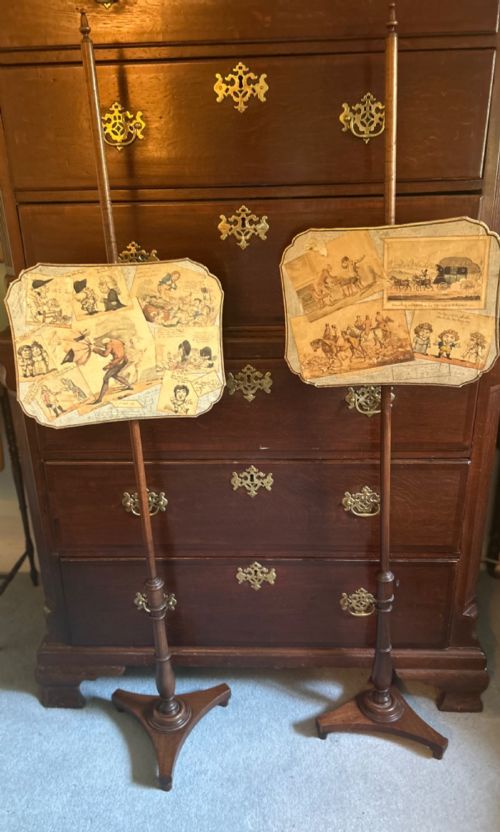
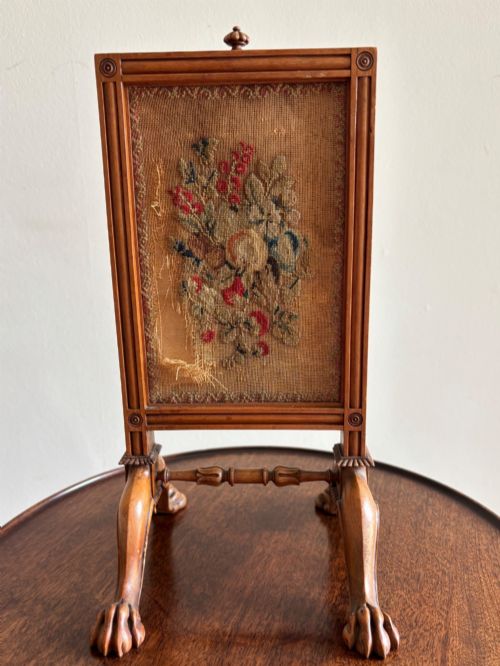
Makers integrated hand-woven tapestries, needlepoint samplers, and embroidered textiles directly into the wooden frames, occasionally protected by glass or mounted alongside satirical prints and oil paintings.
One unexpected variant houses witty satirical prints within its late George III pole screen frame.
What varies in quality
Quality rests in the crispness of the timber turning, the stability of the adjustable mechanisms, and the integrity of the integrated needlework or painted panel. Finer versions exhibit balanced proportions, refined carving, and well-preserved contemporary textiles.
Simpler iterations rely on plain mahogany uprights and standard canvas work, while more elaborate designs feature specialised writing desk combinations, bobbin turned decoration, or double-leaf pull-out panels.
The Brown Mahogany Fire Screen Glossary
- Pole screen
- A vertical freestanding firescreen featuring an adjustable panel that slides up and down a central wooden shaft on a tripod or pedestal base.
- Needlepoint
- A type of canvas work embroidery stitched by hand using yarn to create pictorial or geometric panels mounted within the wooden frame.
- Tapestry
- A heavy hand-woven textile depicting pastoral or figurative scenes, frequently utilised as the central decorative panel in nineteenth-century examples.
- Regency
- An English design period spanning the early nineteenth century characterised by classical restraint and polished mahogany surfaces.
- Bobbin turned
- A style of furniture turning that creates a series of rounded, spool-like shapes along the wooden uprights of the frame.
Brown Mahogany Fire Screen: Frequently Asked Questions
What is a pole screen?
A pole screen is a vertical firescreen mounted on a single turned shaft with a sliding panel that adjusts to block heat.
These pieces were positioned near hearths to shield the face from the direct glare and warmth of an open fire.
How were firescreens used?
Historically, occupants placed them between their seating and the fireplace during warmer months when fires were unlit or dampened.
The adjustable panels allowed users to control the amount of heat deflected away from the room's occupants.
What distinguishes a William IV screen?
William IV examples typically display robust mahogany framing, heavy pedestal bases, and distinct nineteenth-century turning characteristics.
They frequently house needlepoint, tapestry, or embroidered wool panels executed in traditional pastoral designs.
Are needlepoint panels original?
Many screens retain their hand-worked needlepoint, wool, or canvas panels dating from the Georgian, Regency, or Victorian eras.
Makers also incorporated framed oil paintings, printed textiles, and satirical prints into the wooden surrounds.