



Brown Cattle Landscape Art
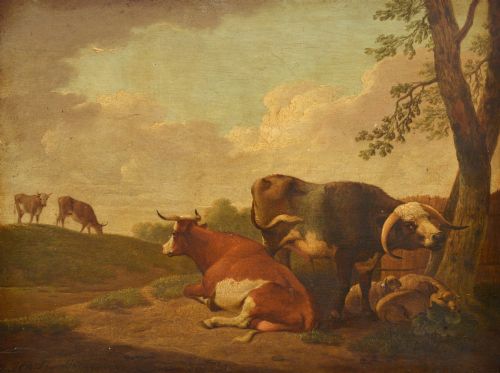
When you search for brown cattle landscape art, you meet nineteenth and early twentieth-century depictions of pastoral life.
Brown Cattle Landscape Art
These works comprise oil paintings and watercolour paintings depicting cattle within British, Scottish, and Irish landscapes, spanning the Georgian, Victorian, and Edwardian periods.
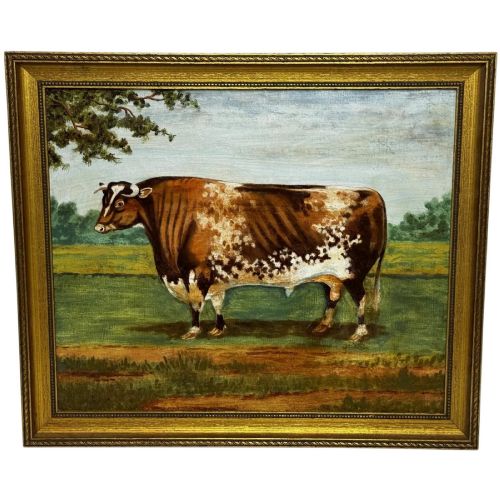
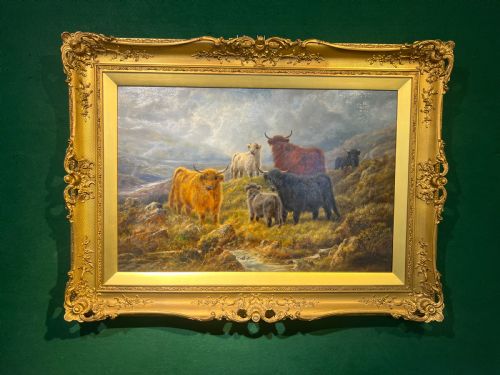
The subjects range from Highland cattle by lochs and rivers to dairy farm scenes, shorthorn bulls, and drovers crossing bridges in regions such as Yorkshire, Dartmoor, and the Lake District.
The selection includes framed wall art, wall plaques, and works executed in styles extending from realism and British Impressionism to naive or folk art.
How they were made
The majority of these pieces are executed in oil paint upon canvas or in watercolour upon paper, housed within wooden or giltwood frames.
Some works incorporate gold leaf accents or are presented in burr frames, reflecting the framing traditions of the nineteenth and early twentieth centuries.
Listings feature works spanning the Georgian, Victorian, and Edwardian periods up to the 1920s.
What varies in quality
Quality rests upon the handling of the medium, with finer oils and watercolours demonstrating precise draftsmanship in the anatomy of the cattle and the atmospheric depth of the surrounding landscape.
The distinction between works lies in the reputation of the artist, the specificity of the geographical setting, and the preservation of the canvas, paint surface, and original frame.
William H Myers·Hendrik Willem Schweickhardt·Henry Robinson Hall·Ernest Pile Bucknall·Samuel Joseph Clark·William Sydney Cooper·Pierre Emmanuel Dielmans·Harold Lawes·Arthur Charles Dodd·William Traies·John W Morris·W.A. Clark·Gustave De Brianski·JOHN PERCY COOKE·Frederick William Jackson·Henry Birtles·Owen Bowen·William Greaves·Sidney Richard Percy·Charles Jones·William Huggins·Louis Bosworth Hurt·Aster Richard Chilton Corbould·J Stinton·Thomas Creswick
The Brown Cattle Landscape Art Glossary
- Canvas
- A heavy woven fabric stretched across a wooden frame to serve as a support for oil paint. It provides a textured surface that absorbs and holds pigment over centuries.
- Giltwood
- Wood that has been coated with a thin layer of gold leaf or gold paint. This finish is commonly found on traditional frames from the Victorian and Edwardian eras.
- Watercolour painting
- Artworks created using water-soluble pigments on paper. This technique yields translucent washes of colour that capture light and atmosphere differently than oils.
- Impressionism
- A style of painting that focuses on capturing the visual impression of the moment, particularly shifting light and colour. In these listings, it appears through British interpretations of pastoral scenes.
- Gilder
- A craftsman who applies gold leaf or other metallic finishes to frames and surfaces. Their work protects the underlying wood and enhances the visual weight of the artwork.
Brown Cattle Landscape Art: Frequently Asked Questions
What periods do these paintings date from?
The listings span from the eighteenth century through the Georgian and Victorian eras into the early twentieth century, including Edwardian examples.
Most pieces originate from the nineteenth century, reflecting the period's widespread interest in pastoral and rural subjects.
Are these works signed by the artists?
Many of the pieces feature signatures or inscriptions by named painters, while others are attributed to specific schools or executed in the manner of well-known artists.
Signatures, dates, and inscriptions are often recorded on the canvas, stretcher, or frame.
What mediums were used for these artworks?
The works are created primarily in oil paint on canvas or watercolour on paper.
Supplementary materials include wood, giltwood frames, glass, and occasional gold leaf accents.
Where do the landscape settings originate?
The locations depicted include Welsh valleys, Scottish highlands and lochs, Dartmoor, Yorkshire pastures, and the Lake District.
These settings capture distinct regional topography alongside agricultural and farming scenes.