
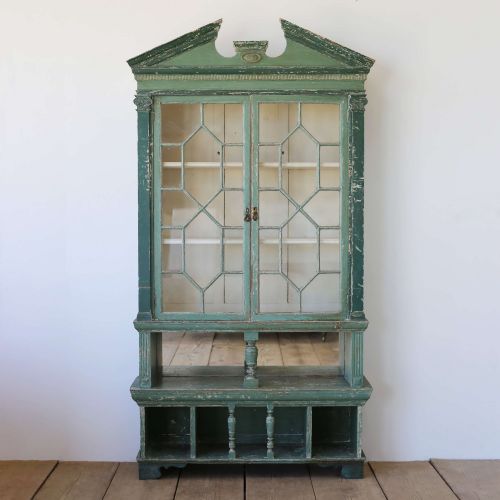


Broken Pediment Cupboard
A broken pediment cupboard brings architectural presence to a room, offering tall timber shelving topped by a swan neck or triangular broken arch.
Broken Pediment Cupboard
A broken pediment cupboard is defined by its architectural crown, featuring a split arch or triangular pediment that often frames a central plinth or finial. These storage pieces appear across several centuries and styles, spanning the seventeenth, eighteenth, and nineteenth periods.
The versions most commonly met on this page include corner cabinets, tall library bookcases, and linen presses. They derive from Georgian, Regency, and Edwardian workshops, with influences ranging from local Dutch country houses to Italian baroque architecture.
Makers utilised various forms to house books, linens, and display items, relying on sturdy standing frames and glazed or panelled doors. Each example reflects the prevailing taste of its period, whether through grand neoclassical proportions or later revival aesthetics.
Materials and construction
Cabinet makers constructed these pieces primarily in solid mahogany and oak, often applying delicate veneers of satinwood and boxwood. Inlays and marquetry frequently decorate the drawer fronts and door panels, adding contrasting tones to the timber surfaces.
Glazing bars divide the glass panes on bookcase doors, while brass hardware such as escutcheons and hinges secures the cupboards. Joinery techniques ensure stable housing for heavy shelves and tall architectural cornices.
Some corner cupboards were built so tall that reaching the top shelf required a sturdy pair of library steps and a steady hand.
Judging quality and proportion
Quality in a broken pediment cupboard rests on the harmony of its architectural proportions and the crispness of its carved or inlaid details. The joinery of the pedメント crown and the selection of figured mahogany or balanced marquetry distinguish finer pieces.
Subtle variations in the execution of the mouldings and the retention of original brass fittings alter the character of the piece. The skill of the cabinet maker shows in how cleanly the wood grain flows across the doors and drawers.
Giles Grendy
The Broken Pediment Cupboard Glossary
- Broken pediment
- An architectural gable or arch that is left open at the apex, frequently housing a finial or urn in the centre. This decorative crown draws the eye upward and defines the silhouette of tall cabinetry.
- Marquetry
- The art of applying pieces of veneer to a structure to form decorative patterns and pictorial designs. Craftsmen use contrasting timbers like satinwood and boxwood to achieve varied shades.
- Tabernacle
- A richly ornamented cabinet or architectural shrine, often featuring columns and pediments. Italian examples demonstrate complex structural woodwork.
- Glazed
- Fitted with glass panels to allow the display of books or porcelain behind protective doors. This technique lightens the visual weight of large bookcases.
Broken Pediment Cupboard: Frequently Asked Questions
What is a broken pediment?
A broken pediment is an architectural roofline or crown where the sloping sides do not meet at the apex, leaving a central gap. This gap is often filled with a carved urn, bust, or wooden finial.
Cabinet makers adopted this classical temple feature to lend height, dignity, and formal elegance to tall bookcases and corner cupboards.
Where should I place a corner cupboard?
Corner cupboards are specifically built to fit neatly into the ninety-degree angle of a room, making efficient use of otherwise neglected space. They suit dining rooms and sitting rooms where they can display porcelain or store glassware.
Ensure the wall angles are square and consider the swing radius of the doors relative to nearby furniture.
How do I care for mahogany furniture?
Mahogany requires stable indoor humidity levels away from direct heat sources and strong sunlight to prevent the timber from splitting or fading. Dust the surfaces regularly with a soft, dry cloth and apply natural beeswax sparingly when the wood appears dry.
Avoid silicone-based polishes which can penetrate the pores and damage antique finishes over time.
How do I distinguish eighteenth-century pieces?
Eighteenth-century pieces typically exhibit hand-cut dovetails, secondary timbers such as oak or pine in drawer linings, and pegged frame construction. The patination on the timber develops a deep, warm glow from decades of handling and waxing.
Stylistic cues from the Georgian period include restrained neoclassical lines or substantial Chippendale proportions.