



British Still Life Watercolour
British still life watercolour works capture domestic flora and fruit across Victorian, Edwardian, and mid-century movements on paper.
British Still Life Watercolour
A british still life watercolour typically presents composed arrangements of flowers, fruit, and household vessels rendered meticulously on paper. These paintings span from the nineteenth century through to the modernist and mid-century periods, reflecting shifting domestic tastes over decades.
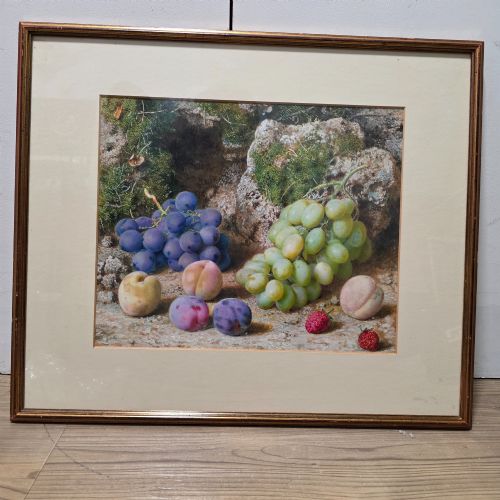
Victorian examples often favour dense fruit studies and botanical precision, whilst twentieth-century pieces lean towards looser floral compositions and muted wartime palettes. The works appear framed in wood and gilt wood, frequently protected beneath glass.
Materials and execution
Artists relied upon watercolour pigment applied directly to paper, sometimes supported by ink or pencil underdrawing to establish the geometry of jugs, bowls, and stems. The delicate nature of the medium required deliberate brushwork, as alterations were difficult to conceal.
Finished sheets found placement behind glass within wooden or gilt wood frames to protect the water-soluble pigments from moisture and light damage over time.
Apples, grapes, and wallflowers star in more still life scenes than nearly any other household objects.
Distinctions in quality
Quality rests upon the confidence of the brushwork and the precision of tonal control across petals, fruit, and reflective vessel surfaces. Stronger examples demonstrate a careful balance of negative space and vibrant pigment retention.
The sophistication of the composition and the handling of light distinguish ambitious gallery pieces from simpler decorative botanical studies.
John Sherrin·James Tower·William Edward Fox·Lester Sutcliffe·Edward Carter Preston·Edith Barrow·Rowland Henry Hill·Phyllis I Hibbert·Jabez Bligh·Alice Macallan Swan·Marion Broom·Edith Alice Andrews·James Kerr McArthur·Amy Reeve-Fowkes·Helen Cordelia Angell·Wiliam Stephen Coleman·Owen Bowen
The British Still Life Watercolour Glossary
- Watercolour pigment
- Finely ground colour particles suspended in a water-soluble binder, applied to paper surfaces in washes.
- Gilt wood frame
- A wooden housing treated with a thin layer of gold leaf or metallic gilt, commonly used to frame nineteenth-century and early twentieth-century works.
- Cubism
- An avant-garde art style originating in the early twentieth century that deconstructs subjects into geometric planes and fragmented angles.
- Victorian
- The period spanning the reign of Queen Victoria, characterised in painting by naturalistic detail and narrative depth.
British Still Life Watercolour: Frequently Asked Questions
How should I display a watercolour?
Keep watercolours away from direct sunlight to prevent the pigments from fading over time. Ensure they remain behind glass in stable room environments.
Avoid hanging them in damp spaces such as unventilated kitchens or bathrooms where moisture can damage the paper support.
What subjects do these paintings show?
The compositions focus primarily on domestic tabletop arrangements featuring cut flowers, potted plants, and bowls of fruit. Vases, jugs, and baskets frequently serve as the central vessels for these botanical studies.
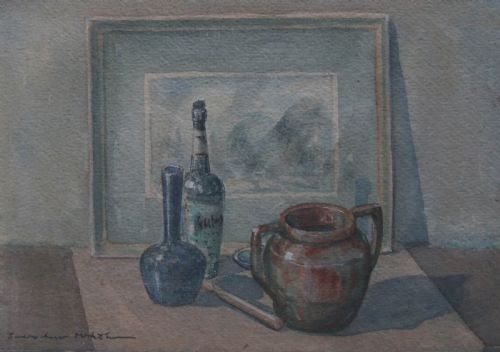
Occasional works incorporate broader kitchen geometry and modernist interior perspectives.
How do I date these paintings?
Dating relies on stylistic shifts, ranging from the tight botanical realism of the nineteenth century to the looser brushwork of Edwardian and mid-century modernism. Signatures, framing materials, and artist records provide further chronological markers.
Pigment vibrancy and paper ageing offer additional clues to the era of creation.
Are these works original?
The listings comprise original paintings executed by hand rather than mass-produced prints or mechanical reproductions. Each sheet bears the distinct brush marks and pigment variations of the individual artist.
Signatures from period painters frequently appear on the face of the paper.