


British Shipping Watercolour
A british shipping watercolour captures maritime commerce and coastal life through delicate washes on paper.
British Shipping Watercolour
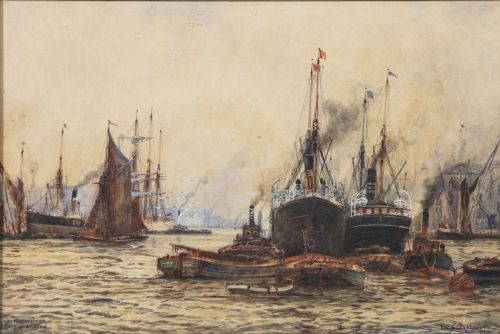
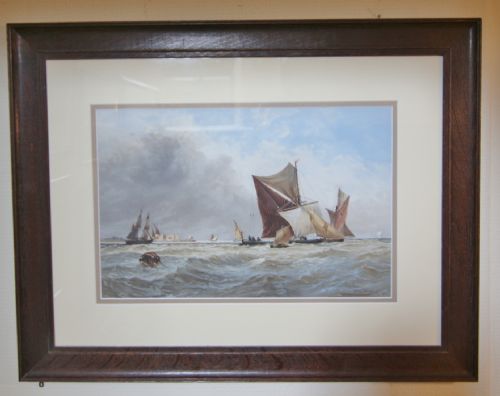
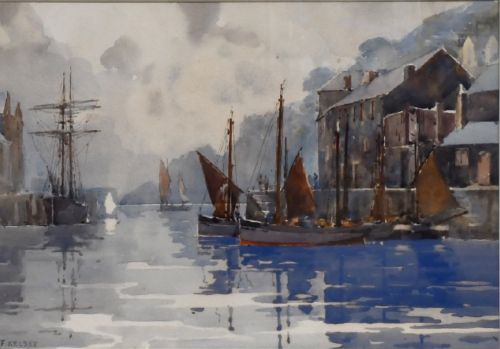
When you search for british shipping watercolour, you encounter maritime paintings executed on paper using pigment suspended in water. These works document vessels such as clippers, barques and sailing ships anchored in rivers, ports and coastal waters. The selection spans the nineteenth century through the Edwardian era and into the nineteen-twenties.
The most common examples you meet on this page date from the Victorian period up to the early twentieth century. Artists frequently depicted busy commercial waterways like the Thames, the Medway and the Humber, recording the daily movement of merchant shipping and local craft. These works typically arrive framed in wood behind glass to protect the paper surface.
Factors that separate the range
Quality rests upon the artist's ability to render maritime anatomy and perspective accurately, particularly the complex rigging of sailing ships and the movement of water. Skilled practitioners capture the atmospheric conditions of specific ports and estuaries with assured brushwork rather than rigid, mechanical lines.
The strength of the composition and the preservation of the paper surface determine the standing of an individual work. Pieces that retain their original pigment vibrancy without excessive fading or discoloration command greater appreciation among collectors.
Maritime artists occasionally added wandering seagulls to quiet harbour corners just to break a stubborn empty sky.
Thomas Bush Hardy·Frank William Scarbrough·William Frederick Settle·George Stanfield Walters·Henry Scott Tuke
The British Shipping Watercolour Glossary
- Barque
- A sailing vessel with three or more masts having the fore- and mainmasts square-rigged and the mizzenmast fore-and-aft rigged. This rig appeared frequently in nineteenth-century commercial shipping.
- Clippers
- Fast merchant sailing ships designed for narrow hull forms and large sail areas. They are often depicted navigating British coastal waters and international trade routes.
- Wash
- A thin, fluid application of watercolour pigment spread evenly across the paper to create skies, water or distant backgrounds. Controlling the water-to-pigment ratio defines the artist's skill.
- Estuary
- The tidal mouth of a large river where the tide meets the stream. Artists frequently painted shipping scenes in locations such as the Thames and Medway estuaries.
British Shipping Watercolour: Frequently Asked Questions
What subjects appear in these watercolours?
These works depict sailing ships, barques and merchant vessels operating in British rivers, estuaries and coastal ports. Common settings include London docklands, West Country harbours and northern shipping lanes.
Artists focused on the working life of the sea, recording specific vessel types against recognizable landmarks and changing weather conditions.
How should I display a watercolour?
Watercolours require protection from direct sunlight to prevent the pigments from fading over time. Framing behind glass with acid-free mount board preserves the paper support.
Keep these pieces in rooms with stable humidity and temperature levels away from direct heat sources to maintain the condition of both the paper and the frame.
How do I identify the period?
Dating relies on the style of the vessel rigging, the artist's active dates, and framing materials. Victorian works often show detailed commercial shipping with specific maritime architecture.
Edwardian and later pieces frequently adopt a softer palette influenced by British impressionism while continuing the focus on maritime trade.
Were these painted outdoors?
Artists typically made preliminary pencil or wash sketches on site at ports and riverbanks to capture accurate details of rigging and topography. They completed the finished watercolour paintings in the studio using these observations.
This method allowed painters to achieve precise control over transparent washes and complex nautical geometry.