
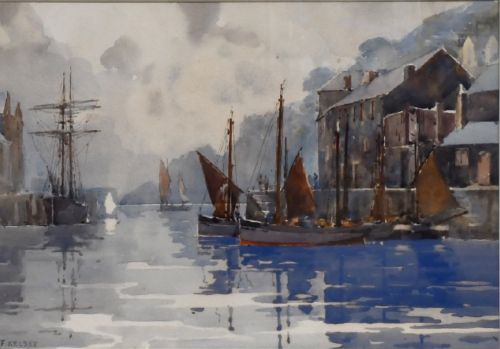


British Maritime Artist
These British maritime artist works capture coastal harbours, fishing communities and open waters across the nineteenth and early twentieth centuries.
British Maritime Artist
The british maritime artist category brings together watercolours and paintings focused on the sea, coastal settlements and estuary views. You will frequently encounter nineteenth century and early twentieth century watercolours depicting harbours, piers and shipping scenes.
Most pieces on display showcase coastal locations around Britain, from Cornish fishing villages like Newlyn and Looe to Scottish coastal waters and Yorkshire piers. Painters often recorded local working life alongside the changing light on the water.
Works span movements such as British Impressionism, the Newlyn School and Victorian marine art. These styles range in approach from precise topographical records to looser, atmospheric treatments of sea and sky.
How they were made
Artists worked primarily with watercolour pigment on paper, building up translucent washes to render the shifting tones of sea and sky. Many pieces are set behind glass within traditional frames, often complemented by gold mounts.
A smaller number of works utilise oil on wood or canvas to depict heavier shipping and wider coastal expanses. Painters captured the movement of water and atmospheric conditions through direct observation of the British coastline.
Listings feature works executed in watercolour on paper alongside oil paintings on wood from the Victorian and early twentieth century periods.
What varies in quality
Quality rests in the handling of light, atmosphere and medium. Stronger watercolours demonstrate confident brushwork and precise control over pigment, capturing the weight of the sea and the clarity of coastal air without overworking the paper.
Composition and historical detail further separate standard topographical views from accomplished artistic statements. The placement of shipping vessels, figures and architecture reveals the maker's command of perspective and local character.
Frank Kelsey·F J Aldridge·James Watson·John Mitchell·Ernest F Hill·George Stanfield Walters·Ralph Todd·William Lee Hankey·Rowland Henry Hill·George Stainton·James Aitken
The British Maritime Artist Glossary
- Watercolour pigment
- A colourant ground with a water-soluble binder, applied in washes to paper to create luminous effects. It allows artists to build up translucent layers representing water and sky.
- Gold mount
- A decorative border placed around a painting or watercolour within the frame. It adds warmth and frames the paper work effectively.
- Newlyn School
- An art colony based in Cornwall during the late nineteenth and early twentieth centuries. Painters associated with this group focused on naturalistic depictions of coastal life and local fisherfolk.
- British Impressionism
- A painting style emerging in the late nineteenth century characterised by visible brushstrokes and an emphasis on light and everyday subjects. Practitioners applied these principles to coastal and marine scenes.
- Estuary
- The tidal mouth of a large river where the tide meets the stream. These areas provided artists with complex subjects involving shipping, changing water levels and maritime architecture.
British Maritime Artist: Frequently Asked Questions
What periods do these paintings cover?
The selection spans the nineteenth century through to the early decades of the twentieth century. This encompasses Victorian marine art alongside later British Impressionism.
Dates on individual pieces often reflect the active period of the artist or specific exhibition years recorded on the mount.
How should I frame and display a watercolour?
Watercolours require conservation framing behind glass to protect the paper and pigments from atmospheric moisture and handling damage. Keeping them out of direct sunlight prevents the watercolour pigment from fading.
Use acid-free mounts so the paper does not discolour over time.
What subjects appear most frequently?
Harbours, fishing vessels and coastal towns dominate the imagery, reflecting the working maritime trade of Britain. Scenes often feature specific locations such as Cornish ports, Yorkshire piers and Scottish coastal waters.
Artists also recorded shipping on tidal estuaries and larger bodies of water.
How do I identify a Newlyn School painting?
Newlyn School works typically depict coastal scenes and local fisherfolk painted with a naturalist approach. The palette often reflects the soft, overcast light characteristic of the Cornish coast.
Signatures or inscriptions relating to Cornish locations frequently accompany these pieces.