
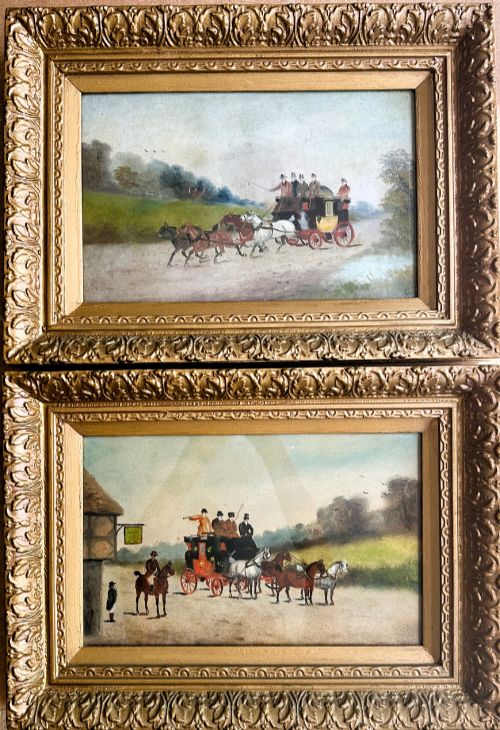


British Landscape Paintings Pair
British landscape paintings pair works offer balanced views of rural rivers, mountains and coastal scenes created to hang together in domestic rooms.
British Landscape Paintings Pair
British landscape paintings pair examples typically present complementary rural, coastal or river views created during the nineteenth and early twentieth centuries. These works appear most frequently in matching frames under glass or mounted on canvas, depicting subjects ranging from Welsh glens to Yorkshire rivers.
Makers produced these dual compositions to balance wall spaces in sitting rooms and studies, often capturing matching morning and evening light or contrasting seasonal weather. The grouping relies on identical framing and matched dimensions to create visual symmetry.
The subjects span moorland watercolours, coaching scenes, and pastoral oil paintings executed by regional artists and academy painters alike. Buyers encounter works labelled under styles such as Victorian Pastoral, Victorian Naturalism, and Edwardian realism.
How they were made
Artists painted these works using oil paint on canvas or board, and watercolour on paper, applying pigments with brushes to build up atmospheric skies and detailed foliage. Watercolour examples relied on paper supports protected beneath glass, while oil works utilised woven canvas stretched over wooden frames.
Makers housed these companion pieces within gilt wood or giltwood frames, sometimes incorporating tondo formats or matching rectangular proportions. The framing process unified the pair visually, securing the paper or canvas alongside protective backing boards.
Listings feature works created across the nineteenth and twentieth centuries, utilising oil paint, watercolour, and gilt wood framing.
What varies in quality
The skill of the brushwork and the precision of perspective separate standard decorative pieces from accomplished artistic achievements. Masterful handling of light and atmospheric depth distinguishes superior watercolours and oils from simpler topographical records.
The integrity of the original gilt wood framing and the stability of the paper or canvas support influence the overall preservation of the pair. Intact signatures, original artist inscriptions, and well-maintained paint surfaces elevate the standing of the works.
Philip Rideout·F.J. Snell·John Grenville Fennell·Alfred George Morgan·John Bell·Philip Henry Rideout·Clarence Henry Roe·Frank Hider·Frederick James Knowles·George Whyatt·George Dodgson Callow·William Mellor·Nora Cundell·Leslie Rackham·James H Hulse·Alfred Vickers Senior·Edgar Bundy·John James Wilson·John W Morris·Arthur Claude Strachan·Alfred Rimmer·Thomas Rose Miles·Frederick Henry Howard Harris·Samuel Hart Turpin·Godfrey Douglas Giles
The British Landscape Paintings Pair Glossary
- Diptych
- A painting or carving made of two panels hinged or hung together. In landscape art, this describes companion pieces designed to be viewed side by side.
- Tondo
- A circular painting or relief sculpture. These round formats appear frequently in mid-nineteenth-century landscape compositions.
- Gilt wood
- Wood decorated with gold leaf or gold paint. Frames of this material surround many nineteenth-century oil paintings and watercolours.
- Watercolour
- Artists' paint made with water-soluble binders and transparent pigments applied to paper. This medium defines many British topographical and rural landscape pairs.
British Landscape Paintings Pair: Frequently Asked Questions
Why were landscape paintings created in pairs?
Artists painted companion pieces to satisfy domestic interior design demands for symmetrical wall decoration. Two matching scenes provided balanced focal points above mantelpieces or along hallway walls.
This format allowed painters to explore contrasting weather conditions, different times of day, or complementary rural and coastal topographies within a single unified purchase.
How do I care for watercolour pairs?
Watercolour works require protection from direct sunlight to prevent the pigments from fading across the paper surface. Keeping them away from damp environments prevents foxing spots and paper deterioration.
Displaying the frames away from heat sources protects both the paper supports and the surrounding gilt wood mouldings from warping or cracking over time.
What subjects are most common?
Rural river valleys, mountainous backdrops, and coastal shipping scenes dominate the nineteenth and early twentieth-century listings. Artists frequently depicted specific British localities, including North Wales, Yorkshire rivers, and London landmarks.
Agricultural scenes featuring cattle herding, sheep grazing, and rural coaching activities also appear regularly across these paired compositions.
How can I identify the period?
Stylistic markers, such as Victorian Romanticism or Edwardian realism, offer initial clues to the decade of creation. Details in clothing, transport, and architectural elements provide further context for dating the paintings.
Artist signatures, framing techniques, and inscriptions on the reverse of the canvas or paper backing often confirm the exact nineteenth or twentieth-century era.