
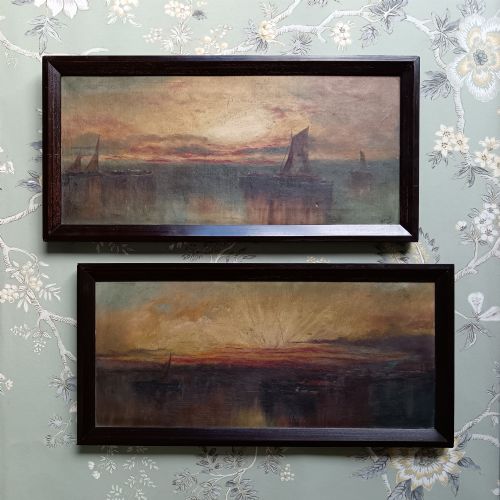
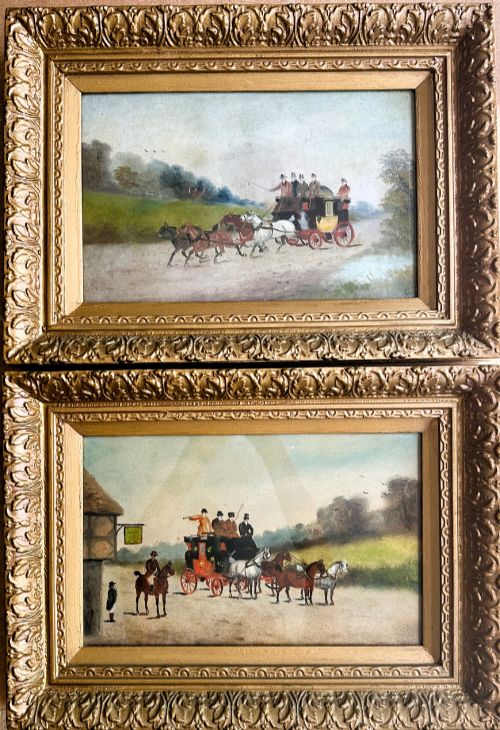


Edwardian Landscape Oil Pair
These edwardian landscape oil pair selections deliver matched artistic vision across twin canvases, offering buyers dual compositions to anchor a room.
Edwardian Landscape Oil Pair
An edwardian landscape oil pair comprises two related paintings created in tandem, often depicting complementary scenes of nature, pastoral life or maritime views. These pairings give collectors a balanced display unit designed to hang side by side or across a mantelpiece.
The selections on this page span the Edwardian era, the wider nineteenth century and the Victorian period, capturing rural vistas, coaching scenes, and coastal subjects. Buyers frequently encounter matched works by listed artists who painted companion pieces for domestic display.
How they were made
Artists applied oil paint using traditional brushes onto stretched canvas or prepared board, building up texture and depth through layered pigments. This technique allowed painters to capture subtle shifts in light during sunrise, sunset and daylight hours.
Frames utilised wood and gesso, often finished with gilt or giltwood to complement the rich tones of the oil paintings within. These gilded surrounds formed an integral part of the finished presentation, protecting the edges of the canvas and board.
Several artists clearly enjoyed watching cattle feed and geese wander just as much as painting grand royal castles.
What varies in quality
The handling of light, atmospheric perspective and brushwork distinguishes finer compositions from simpler decorative works. Master painters rendered water, sky and foliage with a sensitivity that creates genuine depth within the dual frames.
The preservation of the original giltwood and gesso frames also influences the overall integrity of the pair. Matching frames that retain their original gilding enhance the visual harmony between the two companion artworks.
B. Nash·Philip Rideout·Pieter Cornelis Dommersen·Philip Henry Rideout·Clarence Henry Roe·Frank Hider·Frederick James Knowles·Daniel Sherrin·Alfred Vickers Senior·John W Morris·Godfrey Douglas Giles·R. Allan
The Edwardian Landscape Oil Pair Glossary
- Oil on Canvas
- Pigment mixed with drying oil applied to a woven fabric support stretched over a wooden frame. This combination provides a flexible and durable surface favored by nineteenth and twentieth-century painters.
- Gesso
- A plaster-like mixture applied to wooden frames as a smooth base before gilding or painting. It allows craftsmen to carve crisp decorative details onto the border.
- Board
- A rigid flat panel used as a painting support instead of fabric. Artists utilised wooden or composition boards for smaller works.
Edwardian Landscape Oil Pair: Frequently Asked Questions
Why were oil paintings created in pairs?
Artists produced companion pieces to hang together, offering a balanced visual narrative across a wall or mantelpiece. The dual format allowed painters to explore contrasting times of day, such as sunrise and sunset, or complementary rural subjects.
Buyers acquired these matched sets to create symmetry in formal nineteenth-century and Edwardian interiors. The paired canvases share a consistent palette and hand, ensuring they complement each other visually.
How do I hang an oil painting pair?
Hanging twin artworks requires careful alignment at eye level, maintaining equal spacing between the two frames to achieve visual harmony. Placing them above a sofa, sideboard or fireplace creates a balanced focal point in the room.
Ensure both pieces receive indirect natural light to protect the oil pigments and gilt frames from fading. Matching the hanging hardware keeps the heavy giltwood frames secure and level.
How should I care for Edwardian oil paintings?
Keep the canvases away from direct sunlight, high humidity and dramatic temperature fluctuations to prevent cracking in the oil paint and gesso frames. Dust the giltwood gently with a dry, soft brush without applying liquid cleaners.
Professional conservators should handle any deep cleaning of the canvas or repair of the wooden frames. Regular inspection of the backing boards helps protect the structural integrity of the artwork.
How can I tell the period of a landscape pair?
The style of the brushwork, the clothing in figurative elements, and the construction of the wooden stretcher frames offer clues to the creation date. Edwardian works often feature brighter palettes and looser realism compared to earlier Victorian pieces.
Signatures, artist registry records, and the composition of the gesso frames further help verify whether the pair originates from the nineteenth century or the early 1900s.