
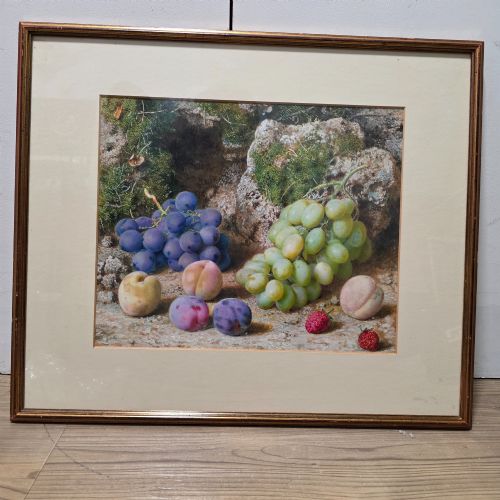


British Botanical Watercolour Painting
British botanical watercolour painting brings garden flowers and fruit onto paper through pigment and ink.
British Botanical Watercolour Painting
When you search for british botanical watercolour painting, you encounter original works depicting flowers, fruit and garden scenes. These pieces capture floral subjects from the nineteenth century through the mid-twentieth century.
The most common examples on this page are framed still life paintings and garden studies. Works range from Victorian botanical depictions to Edwardian realism and mid-century modern interpretations.
Artists record specific blooms such as anemones, roses, wallflowers and apple blossom. These watercolours document gardens and country houses across Britain in various periods.
How They Were Made
Artists apply watercolour pigment and ink onto paper surfaces to build up delicate floral subjects. Many of these works are housed in wood and glass frames that protect the delicate paper from damage.
The technique relies on transparent washes of colour combined with fine ink linework. Painters capture the natural tones of petals and leaves through layered watercolour paint.
Materials recorded across these artworks include paper, watercolour pigment, ink, wood and glass.
What Varies In Quality
The standard of a british botanical watercolour painting depends on the precision of the brushwork and the handling of light. Accomplished artists render the intricate details of petals and foliage with accuracy and balance.
Composition and colour harmony separate finer works from simpler student studies. Stronger pieces demonstrate a confident command of watercolour pigment on paper.
John Sherrin·James Tower·William Edward Fox·Lester Sutcliffe·Lilian Stannard·Edith Barrow·Rowland Henry Hill·Phyllis I Hibbert·Jabez Bligh·Owen Bowen·Arthur Wardle·Alice Macallan Swan·Beatrice Parsons·Marion Broom·Edith Alice Andrews·George Frederick Nicholls·Amy Reeve-Fowkes·Helen Cordelia Angell·William Stephen Coleman·Minnie Smythe
The British Botanical Watercolour Painting Glossary
- Watercolour
- A paint consisting of a pigment suspended in a water-soluble vehicle. It is applied to paper in transparent washes.
- Still life
- A painting featuring an arrangement of inanimate objects, such as cut flowers in a jug or a bowl of fruit.
- Edwardian realism
- An artistic style focusing on detailed and naturalistic representation popular during the Edwardian period.
- Pigment
- The natural or synthetic coloured material used to make watercolour paint. It is mixed with water before application.
British Botanical Watercolour Painting: Frequently Asked Questions
What is a british botanical watercolour painting?
These works are original paintings on paper depicting flowers, fruit and garden scenes by British artists. They capture floral subjects using watercolour pigment and ink.
Pieces range from nineteenth-century Victorian studies to mid-century modern compositions. Many are preserved in period wood and glass frames.
How were these watercolours used?
These paintings served as decorative wall art for homes, country houses and studies. They brought depictions of seasonal garden flowers indoors.
Collectors historically displayed them framed in living spaces and hallways. They continue to function as wall art today.
How do I live with watercolour paintings?
Watercolour paintings require protection from direct sunlight to prevent the pigments from fading over time. Hanging them away from bright windows preserves the colours on the paper.
Keeping them behind glass in stable indoor environments protects the paper substrate from moisture and damage.
How can I tell the periods apart?
Victorian and Edwardian works often display detailed realism in depicting flowers and fruit. Later twentieth-century pieces show looser brushwork and mid-century modern influences.
Signatures, framing styles and the specific varieties of flowers depicted often point toward the era in which the artist worked.