
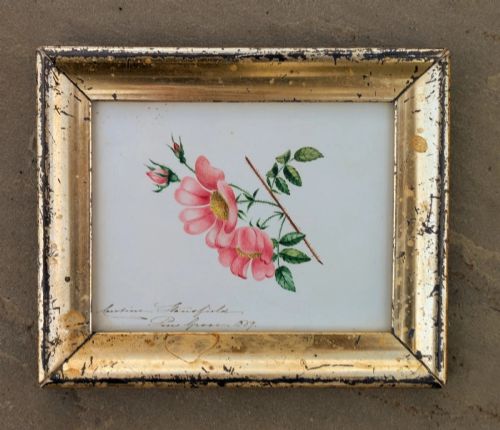


Original Floral Watercolour Study
An original floral watercolour study brings the garden indoors through pigment and paper, capturing delicate blooms with lasting immediacy.
Original Floral Watercolour Study
An original floral watercolour study represents an individual painting executed on paper using watercolour paint, pigment, or gouache. These works frequently depict botanical subjects, garden flowers, and still-life compositions.
The pieces available span from the Victorian period through the Edwardian era into the mid-20th century. Forms include framed artwork, wall art, and standalone paintings.
Subjects range from single specimen studies like fuchsias and wild roses to gathered arrangements of pansies, wallflowers, and cosmos flowers in jugs or baskets.
How they were made
Artists applied watercolour paint and pigment directly onto paper surfaces, often capturing botanical details with fine brushwork. Some French examples utilise gouache on paper to build denser opaque floral colour.
Finished works are typically housed in frames made of wood or gilt wood, frequently protected behind glass to preserve the delicate paper and water-soluble pigments.
Pansies, wallflowers, cosmos, and pelargoniums preserve their garden freshness permanently behind glass.
What varies in quality
Quality rests in the precision of the botanical observation and the fluidity of the brushwork on the paper. Stronger examples display confident handling of colour and light within the petals and foliage.
The character of the surrounding frame, whether simple wood or ornate gilt wood, contributes to the overall presentation and visual balance of the framed artwork.
Edith Barrow·Grace Hastie·Phyllis I Hibbert·Marian Chase·Charlotte Isa James·Alice Macallan Swan·Marion Broom·Annie Mary Youngman·M.K Rhodes·Minnie Smythe
The Original Floral Watercolour Study Glossary
- Watercolour paint
- A medium consisting of coloured pigments suspended in a water-soluble vehicle, applied to paper to create translucent layers of colour.
- Gouache
- An opaque water-based paint medium that includes a white pigment filler, resulting in solid, heavier passages of colour on paper.
- Botanical study
- A detailed artistic rendering of plant specimens, focusing accurately on the structure, leaves, and blossoms of specific flowers.
- Gilt wood
- Wood framing that has been coated with a thin layer of gold leaf or metallic gilt finish, adding reflective warmth around the artwork.
Original Floral Watercolour Study: Frequently Asked Questions
What is an original floral watercolour study?
It is a hand-painted artwork on paper capturing botanical subjects and flower arrangements using water-soluble pigments.
These pieces range from Victorian studies to mid-20th-century compositions created by named artists.
How should I hang these paintings?
Keep them away from direct sunlight to prevent the watercolour pigments and paper from fading over time.
Ensure the room maintains stable humidity because damp environments can harm historic paper.
Are these works framed?
Many examples come ready to hang in period frames made of wood or gilt wood, protected behind glass.
The framing materials often reflect the era in which the artwork was created.
How do I identify the period?
Dating relies on the artistic style, signature, framing materials, and paper characteristics typical of Victorian, Edwardian, or mid-20th-century work.
Many pieces include inscribed names or distinct botanical illustration conventions from their specific decade.