
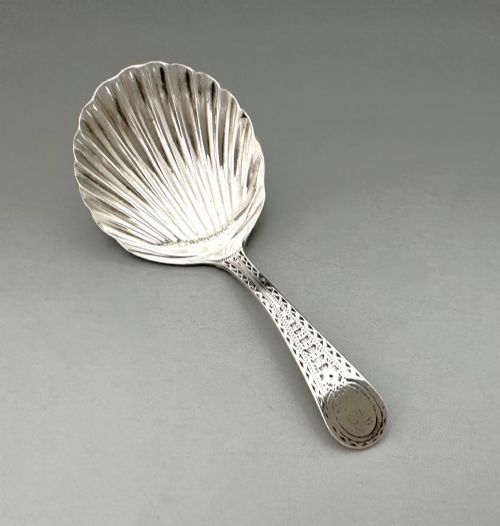
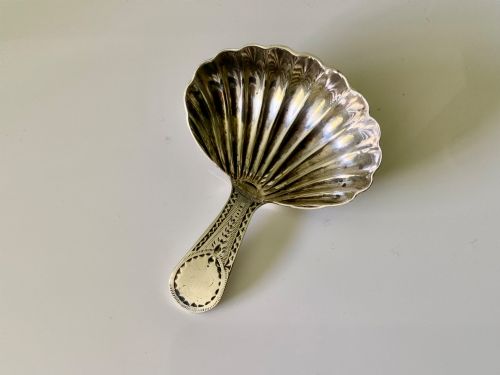


Bright Silver Caddy Spoon
A bright silver caddy spoon brings miniature scale and brilliant engraved pattern to the tea table, formed in sterling silver through the Georgian and Victorian eras.
Bright Silver Caddy Spoon
When you search for a bright silver caddy spoon, you encounter small serving implements designed specifically to measure dried tea leaves from a caddy into the pot. These charming domestic utensils appear frequently in Georgian and Victorian forms across the selection.
The objects span from the late eighteenth century into the nineteenth, originating primarily in English workshops. Shell bowls and intricately patterned handles distinguish the pieces you meet most often on this page.
How they were made
Silversmiths shaped these items from solid sterling silver using traditional hammering and piercing techniques. Makers employed specialised tools to form delicate bowls, often taking the shape of a scallop shell.
Craftsmen applied bright-cut engraving to the handles and stems, utilising faceted gravers to produce a reflective, shimmering pattern. This meticulous surface work catches the light, defining the character of the bright silver caddy spoon.
The selection includes sterling silver examples spanning the eighteenth and nineteenth centuries, featuring Georgian and Victorian stylistic influences.
What varies in quality
The crispness of the bright-cut engraving determines the visual success of the piece, as worn tooling softens the geometric sparkle. Sharp, deep facets reflect light cleanly and indicate skilled execution at the bench.
Proportion and weight also differentiate examples, with heavier gauge silver providing a more substantial feel in the hand. The distinctiveness of the bowl design, such as an embossed shell versus a plain shovel, shifts the aesthetic merit.
George Unite·Joseph Taylor
The Bright Silver Caddy Spoon Glossary
- Bright-cut engraving
- A surface decoration technique using faceted cuts made with a graver to create a sparkling, light-reflecting pattern. This ornamentation appears across many Georgian examples.
- Sterling silver
- The standard alloy of silver comprising parts of pure silver and copper for durability. This material forms the entirety of the pieces in the evidence.
- Caddy spoon
- A specialised small spoon created to scoop dry tea leaves from a storage canister. These utensils became popular as tea drinking grew in British society.
- Shell bowl
- A bowl formed in imitation of a natural scallop shell, frequently utilised by silversmiths for tea scoops. This shape provides both texture and visual interest.
Bright Silver Caddy Spoon: Frequently Asked Questions
How were these spoons used?
Owners kept these implements alongside tea caddies to transfer dried leaves into porcelain teapots during formal tea preparation. Their compact size allowed them to fit neatly inside or on top of tea storage containers.
Because tea was a valuable commodity, measuring portions accurately with a dedicated scoop mattered greatly in polite households.
How do I date a silver caddy spoon?
Dating relies heavily on hallmarks stamped into the metal, which record the assay office, date letter, and maker's mark. Stylistic indicators like bright-cut engraving patterns also help place a piece within the Georgian or Victorian eras.
Comparing the handle shape and bowl silhouette against documented examples narrows down the period of manufacture.
How should I display or store them?
These small items display effectively in shallow cabinets, flat trays, or specialised collectors' cases where their reflective silver surfaces remain visible. Proper spacing prevents scratching between individual pieces.
Occasional gentle cleaning with a suitable silver cloth maintains the polished finish without harming the historic engraving.