


Breakfront Chest of Drawers
A breakfront chest of drawers brings architectural presence to a room, offering grand proportions and deep storage through its projecting central section.

Breakfront Chest of Drawers
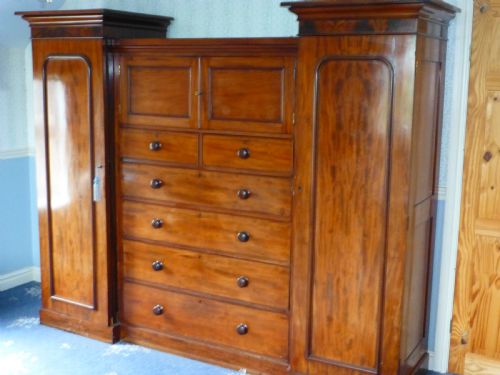
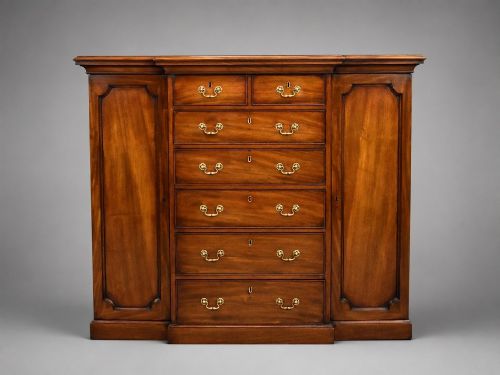
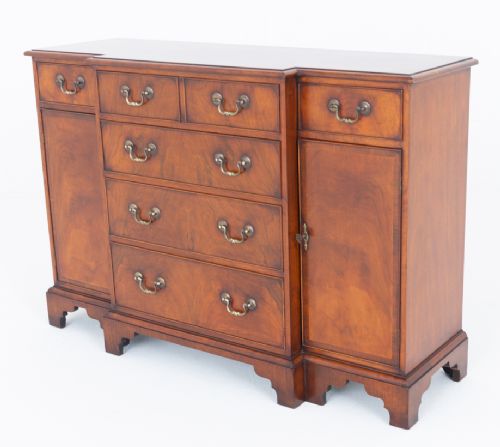
A breakfront chest of drawers projects forward in the middle section, creating a layered facade that catches the eye and breaks up the flat wall of a standard chest. You will encounter these pieces across multiple periods, including 18th century examples, the 19th century, and revival styles.
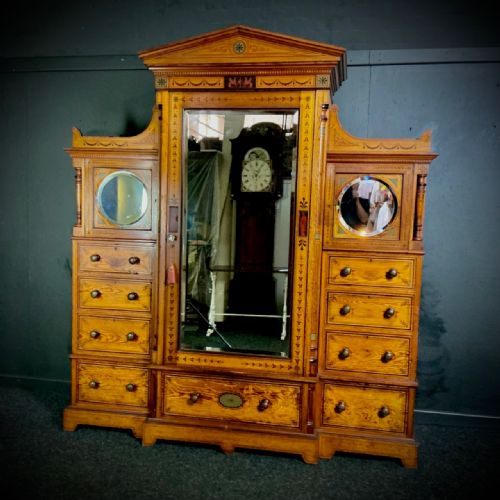
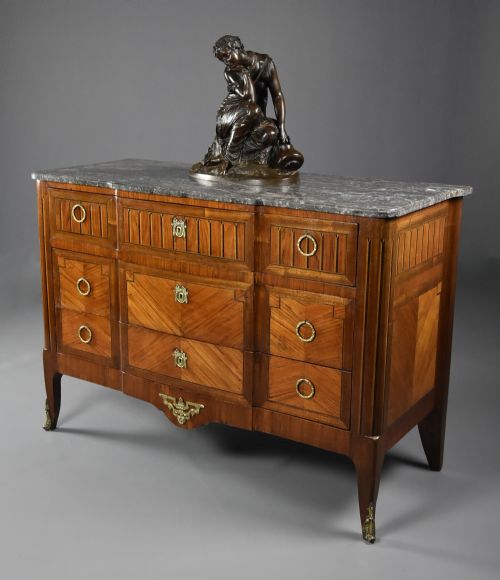
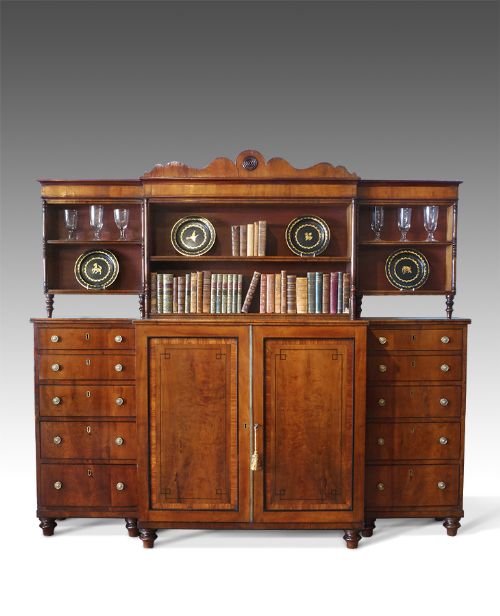
The form appears in various guises across the listings, spanning traditional chests of drawers, commodes, and grander hybrid forms like compactum wardrobes and sideboards. Walnut, mahogany, and cherrywood dominate the construction, often enhanced by distinctive marquetry or parquetry.
Makers and cabinetmakers from English workshops to French and Austrian studios shaped these pieces using regional timber selections. The aesthetic shifts from austere Georgian utility to ornate Louis XVI Revival and Dutch Neoclassical expressions.
Materials and construction
Cabinetmakers built the carcase using solid timbers like mahogany, walnut, and pitch pine, frequently applying figured veneers such as flame mahogany, tulipwood, and yew wood to the primary surfaces. Marquetry and parquetry patterns demand precise cutting of contrasting woods to form geometric or floral motifs.
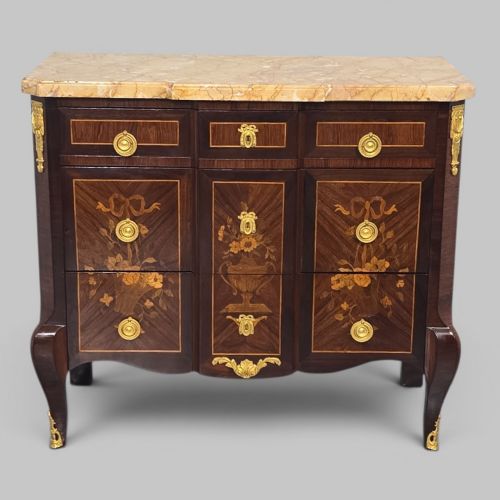
Original marble tops provide a heavy, cool contrasting surface on continental commodes, whilst cast brass and ormolu mounts accent key handles and corners. Glass elements and brass hardware finish the detailed construction across wardrobe and commode doors.
Some commodes secretly hide their structural secrets beneath elaborate French tulipwood parquetry.
Evaluating quality and finish
The tier of a piece rests upon the crispness of its veneering and the stability of the timber carcase. Finer examples display continuous grain matching across the protruding central breakfront and flanking drawers, showing deliberate planning by the maker.
Hardware integrity and the retention of original components, such as marble tops or ormolu mounts, elevate the standing of a commode or chest. The subtlety of marquetry inlay and the smoothness of drawer movement distinguish workshop production standards.
Gillows·Riesener
The Breakfront Chest of Drawers Glossary
- Breakfront
- A cabinet or chest whose central section projects forward from the flanking sides. This architectural arrangement creates depth and shadow across the facade.
- Commode
- A low chest of drawers or cabinet, frequently of French or continental origin. These pieces often feature decorative veneers and marble surfaces.
- Parquetry
- A geometric mosaic of wood pieces used for decorative floors and cabinet surfaces. It relies on contrasting timber tones to form repeating patterns.
- Marquetry
- The art of applying pieces of veneer to a structure to form decorative pictures or designs. Craftsmen use varied coloured woods to achieve pictorial depth.
- Ormolu
- Gilded bronze mounts applied to furniture for decoration. This technique was widely utilised on continental commodes and cabinets during the eighteenth and nineteenth centuries.
Breakfront Chest of Drawers: Frequently Asked Questions
What is a breakfront chest?
A breakfront chest is a storage piece where the central set of drawers pushes forward past the flanking sections, adding architectural depth.
This format provides a more substantial visual presence in a room compared to a flat-fronted chest.
Where were these chests used?
These pieces served primary reception rooms, formal bedrooms, and parlours where grand storage and display mattered.
Their striking facades made them statement furniture items designed to catch the eye of visitors.
How do I care for timber?
Keep wooden chests away from direct sunlight and sudden temperature changes to protect the delicate mahogany or walnut veneers.
Applying a traditional wax polish occasionally helps nourish the grain without building up heavy chemical residues.
Are marble tops original?
Many continental commodes feature fitted marble tops designed to sit securely within the wooden carcase.
Checking the underside and edges reveals how the stone integrates with the timber frame of the piece.