
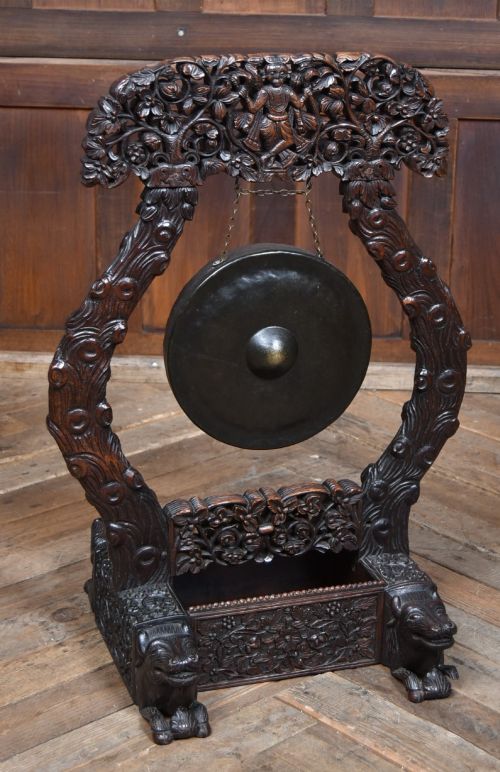
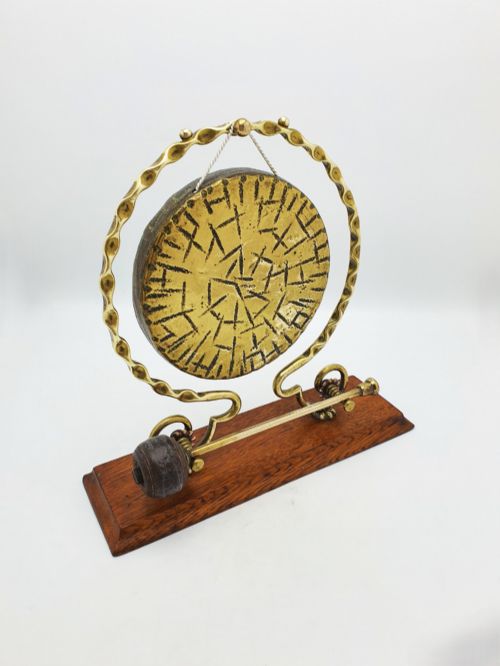


Brass Tabletop Gong
These brass tabletop gong pieces bring a resonant chime and striking decorative presence to a room, drawing collectors of Victorian and Edwardian curiosities.
Brass Tabletop Gong
A brass tabletop gong consists of a suspended metal bell or disc paired with a handheld striker, mounted in a supportive framework for domestic use. When collectors search for a brass tabletop gong, they encounter compact pieces designed to sit on furniture rather than hang from a wall or floor stand. These items function as decorative objects while retaining their capacity to produce a clear, resonant tone.
The examples found here span the Victorian, Edwardian, and early twentieth-century periods, showcasing styles that range from plain utility to elaborate Orientalist designs. You are most likely to meet pieces dated across the late nineteenth and early twentieth centuries, reflecting a period when such items were popular for domestic service or exotic display. Their forms vary from simple metal frames to intricately carved wooden structures.
Makers drew on diverse aesthetic traditions, resulting in pieces influenced by Anglo-Indian carving, Japanese Japonisme, Chinese motifs, and European Art Nouveau. These stylistic variations mean that a single category includes both austere industrial metalwork and heavily ornamented frames featuring symbolic carvings. Across all variations, the core function remains the suspension of a resonant disc or bell for striking.
Materials and construction
The construction relies on a combination of cast or beaten metal for the bell and supportive timber, metal, or horn for the frame. Materials recorded in the evidence include brass, bronze, and silver plate for the gongs themselves, paired with oak, walnut, hardwood, bamboo, and wrought iron for the stands. Cord suspends the metal element from the frame, allowing the gong to swing freely and vibrate when struck.
Wood elements often feature detailed carving, reflecting the influence of Eastern craftsmanship and domestic carpentry traditions of the nineteenth and early twentieth centuries. Metal frames utilise casting and forging techniques to create stable bases and curved hangers. The handheld striker is typically matched to the materials of the frame or the metal bell, completing the domestic assembly.
Several examples pair industrial metal with unexpected organic elements like cattle horn, proving Victorians loved an unconventional kitchen timer.
Distinctions in quality
Quality in these pieces is determined by the depth and precision of the carving on the frame and the purity of tone produced by the metal disc. Superior examples display harmonious proportions between the suspended gong and its supporting structure, with secure joints and durable suspension cord. The choice of materials, such as dense hardwood or substantial bronze, separates finer productions from simpler utilitarian items.
Artistic execution distinguishes mass-produced items from those featuring hand-carved details or distinct stylistic influences like Art Nouveau or the Victorian Aesthetic Movement. A well-preserved finish on both the metal and the wood indicates careful past handling and maintains the visual integrity of the design. The resonance and sustain of the sound when the striker hits the bell further indicate the metalworker's skill.
The Brass Tabletop Gong Glossary
- Brass
- An alloy of copper and zinc used extensively for the resonant bell or disc in these pieces. It provides durability and a bright tone when struck.
- Japonisme
- A late nineteenth-century artistic style reflecting the influence of Japanese art and design on Western decorative objects. Pieces in this style often incorporate distinct Oriental motifs.
- Aesthetic Movement
- A nineteenth-century movement that emphasised visual and material beauty over narrative or moral function in design. Items from this movement often display refined craftsmanship and stylized decoration.
- Bronze
- A copper alloy utilised for certain bells, offering a deeper and richer resonance than standard brass. It appears in several period examples on this page.
Brass Tabletop Gong: Frequently Asked Questions
How were these gongs used?
These gongs were traditionally employed in homes to announce the serving of meals or to summon household staff. Their resonant tone carried clearly through domestic rooms.
Over time, they transitioned from practical household signals into decorative interior objects valued for their craftsmanship and exotic appearance.
What materials make up the frames?
Frames are constructed from a variety of materials including oak, walnut, bamboo, wrought iron, and cattle horn. These materials were shaped to support the suspended metal bell securely.
Carved wooden stands often reflect specific period styles such as Anglo-Indian or Chinoiserie ornamentation.
How do I date a piece?
Dating relies on stylistic clues, construction methods, and materials associated with periods like the Victorian era or the Edwardian years. Details such as Art Nouveau curves or specific carving techniques point to particular decades.
Makers often incorporated design elements that correspond to documented periods of manufacture in the late nineteenth and early twentieth centuries.
Where were these items made?
Origin points vary, with some pieces created in Britain following contemporary European styles while others draw on Asian craftsmanship. Items described as Oriental or Burmese reflect imported goods and stylistic influences popular during the colonial period.
European workshops also produced pieces inspired by these global aesthetics, combining local timber frames with imported metal bells.
How should I display a tabletop gong?
Place the gong on a stable surface such as a side table, sideboard, or desk where its frame and suspended bell are clearly visible. Ensure there is enough clearance around the hanging disc for the striker to operate.
Keep the piece away from excessive moisture and direct sunlight to preserve the finish of the wood and metal components.