
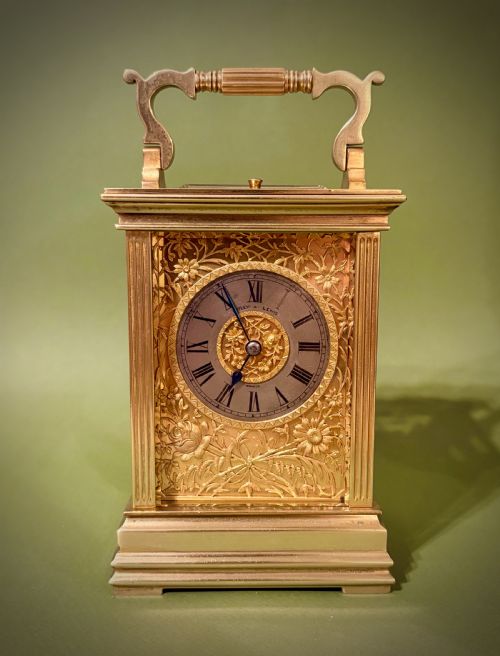
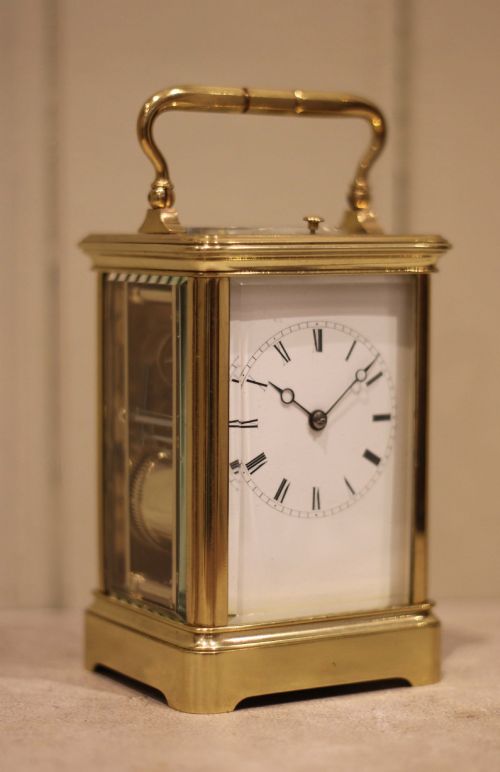
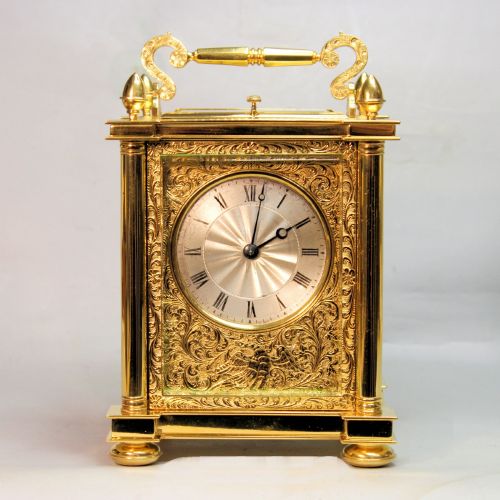
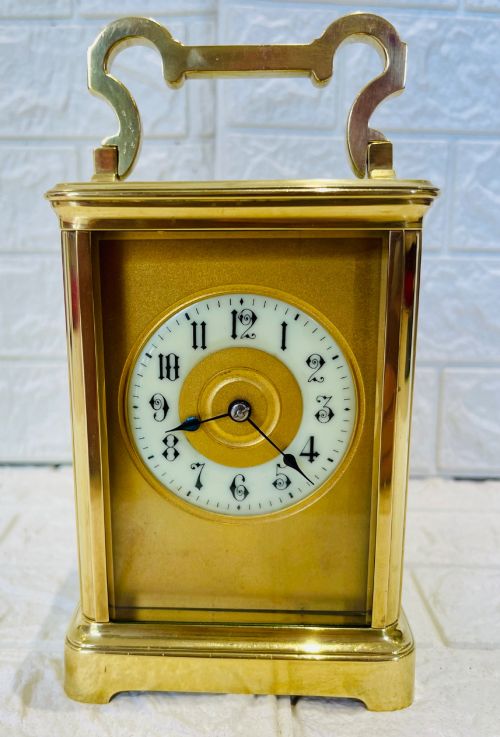


Brass Striking Carriage Clock
A brass striking carriage clock combines precision timekeeping with an audible hour or quarter-hour chime, built for travel during the nineteenth century.
Brass Striking Carriage Clock
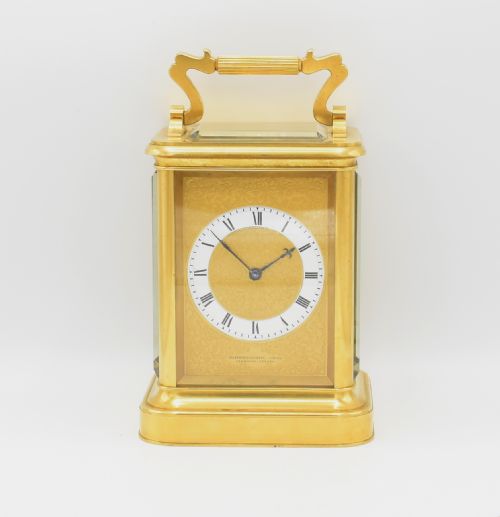
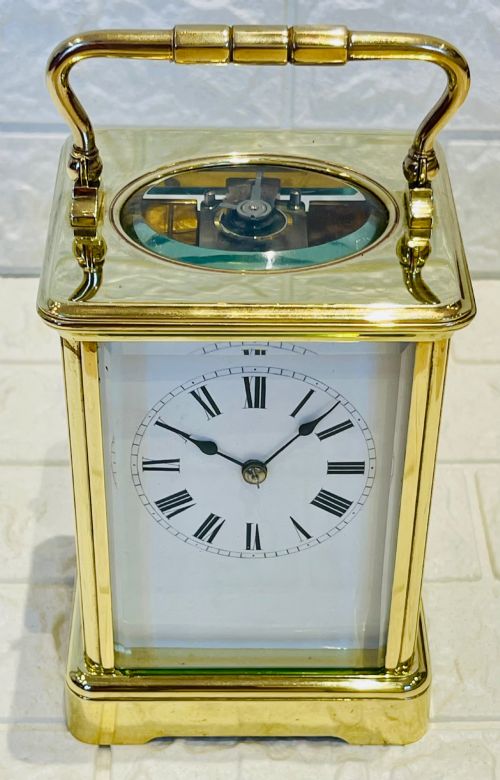
A brass striking carriage clock is a portable timekeeper enclosed in a glazed metal case, designed primarily by French and English makers during the Victorian era. Most examples seen here date from the nineteenth century, ranging from simple hourly bell-strikers to complex repeating models.
How they were made
The cases utilise heavy brass and gilt brass castings, often formed into specific architectural shapes such as gorge or doucine profiles, fitted with flat or bevelled glass windows. Movements incorporate steel gears and balance springs, while white enamel dials display Roman or Arabic numerals.
Secondary elements include silvered metal components and occasional leather travelling cases for protection. Gilded finishes and polished brass surfaces create the characteristic metallic lustre seen across these pieces.
Many of these sturdy little travellers survived centuries simply because their heavy leather outer cases took all the bumps.
What varies in quality
Quality depends upon the complexity of the movement and the weight of the brass casting. Examples featuring repeating mechanisms, alarms, or grand sonnerie strikes represent a higher standard of horological engineering than basic time-and-strike models.
The finishing of the case also dictates worth, with heavy mercury-gilt surfaces and flawless bevelled glass separating superior workshop production from standard commercial output.
Cousens & Whiteside·Goldsmiths Alliance Ltd·T. Martin & Co·C. Detouche·Henri Jacot·Paul Garnier·Drocourt·Luxor·Dwerrihouse & Bell·J. F. Bautte Et Cie·AD Mougin·Delépine-Barrois·Le Roy et Fils·SJ Rety
The Brass Striking Carriage Clock Glossary
- Carriage clock
- A portable spring-driven timekeeper originally made for travel. These clocks usually feature a glass-panelled brass case and a folding handle on top.
- Striking
- A mechanism that sounds the hours or half-hours automatically on a bell or gong. This function relies on a separate gear train within the movement.
- Repeating
- A mechanism activated by pressing a button or cord on the case, which causes the clock to sound the last elapsed hour or quarter-hour on demand.
- Gorge case
- A distinct rectangular brass case style featuring stepped mouldings beneath the top plate. It represents a traditional French housing for high-grade movements.
- Grande sonnerie
- A complex striking train that chimes both the hours and the quarters automatically as each quarter-hour passes.
Brass Striking Carriage Clock: Frequently Asked Questions
What is the difference between striking and repeating?
A striking mechanism sounds the time automatically at the change of each hour or quarter-hour. The gear train uses power from a dedicated barrel to ring the bell or gong.
A repeating function allows the owner to manually trigger the last sounded chime by pressing a plunger on top of the case. This was useful for checking the time in a dark room.
Why do some clocks have alarm functions?
Alarm variants include an extra hand on a subsidiary dial and a separate gear train to wake travellers at a set hour. The mechanism uses the same bell or gong as the striking train.
These models require an additional winding arbor specifically for the alarm power reserve.
How do I identify the maker?
Makers usually stamped their signatures, monograms, or serial numbers onto the brass backplate of the movement. Occasionally, retailer names appear on the white enamel dial face.
Matching the movement stamp with known nineteenth-century workshop records confirms the origin of the piece.