
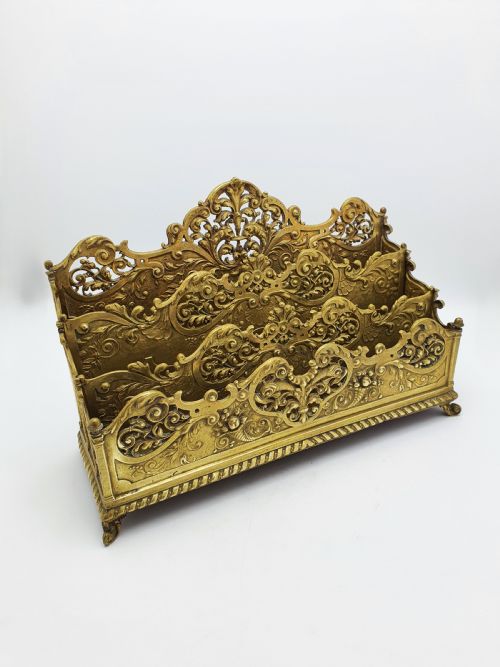


Brass Stationery Rack
A brass stationery rack brings order to a desk while showing the solid weight of nineteenth and early twentieth-century metalwork.
Brass Stationery Rack
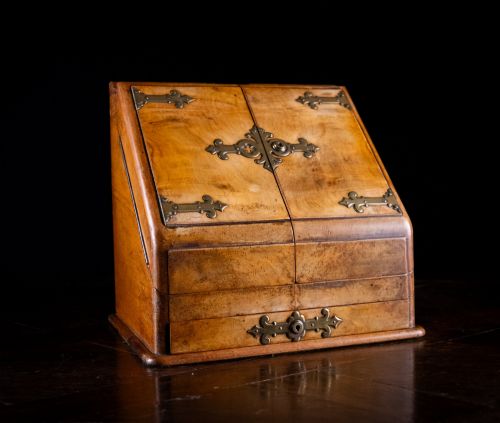
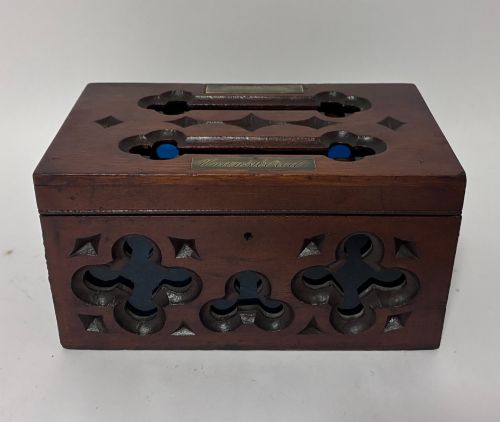
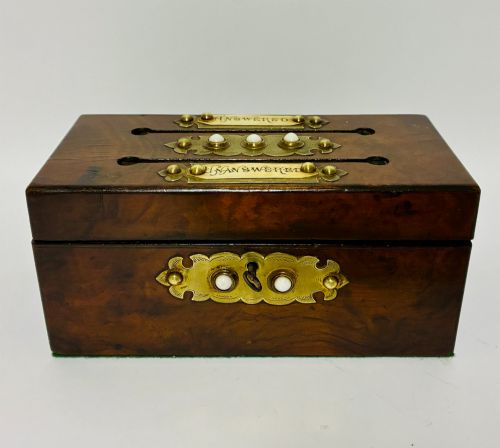
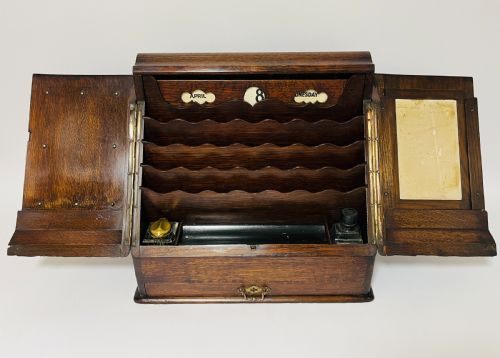
When you search for a brass stationery rack, you are looking at desk accessories designed to hold letters, envelopes, and paper tidy in domestic and office settings. These pieces appear in forms ranging from simple desktop letter holders to wall pockets and fall-front stationery cabinets.
The versions you meet most often on this page date from the Victorian and Edwardian eras, spanning from the late nineteenth century into the early decades of the twentieth. They combine metal framework with wooden carcases, or present entirely in cast and sheet brass.
Makers produced these items to suit various interior tastes, incorporating styles such as Gothic Revival, Rococo Revival, and Arts and Crafts. Their origins cross English and French workshops, utilising woods like oak, walnut, mahogany, and amboyna alongside copper and fabric elements.
What varies in quality
The standard of a brass stationery rack depends on the weight of the metal and the crispness of the casting. Heavier cast brass and well-defined detailing separate substantial desk furniture from lighter, pressed metal alternatives.
Quality also shows in the integration of materials, where solid oak, walnut, or mahogany carcases join seamlessly with robust brass dividers rather than thin plated fittings.
Listings feature items spanning the Victorian, Edwardian, and Arts and Crafts periods, incorporating materials such as oak, walnut, glass, bone, and copper.
William Tonks and Sons
The Brass Stationery Rack Glossary
- Stationery Cabinet
- A desk box featuring compartments or fall fronts designed to store paper and envelopes.
- Letter Box
- A container fitted with a slot or hinged lid specifically for incoming and outgoing post.
- Wall Pocket
- A hanging receptacle designed to mount on a wall and hold letters or small documents.
- Standish
- A traditional desk stand incorporating inkwells, pen trays, and stationery storage.
- Cast Brass
- Metal poured into a mould while molten to create three-dimensional decorative forms and structural frames.
Brass Stationery Rack: Frequently Asked Questions
How do I date a brass stationery rack?
Dating relies on stylistic clues and construction methods visible in the piece. Victorian examples often show Gothic or Rococo Revival influences, while Edwardian items lean towards simpler country house aesthetics.
The materials provide further guidance, as solid oak and walnut bodies dominate nineteenth-century pieces, whereas twentieth-century items occasionally show Arts and Crafts copper details.
Where were these pieces used?
These racks sat upon writing desks in libraries, studies, and country house drawing rooms. Wall-mounted versions hung near entrances or in private offices for quick sorting of daily post.
Their primary function was keeping correspondence organised before fountain pens and typewriters changed daily letter-writing habits.
Are these racks suitable for daily use?
Solid construction in brass and hardwood makes these pieces sturdy enough for modern desktop use. They accommodate contemporary envelopes and paper just as well as historical correspondence.
Care should be taken with older fabric linings and delicate wooden veneers to preserve their condition during regular handling.
What styles are most common?
Victorian and Edwardian designs dominate the selection, featuring plain golden oak or ornate cast brass work. You will also encounter specific decorative movements like Arts and Crafts copper or elaborate Rococo Revival scrolling.
French pieces from the turn of the twentieth century frequently pair mahogany with polished brass mounts.