

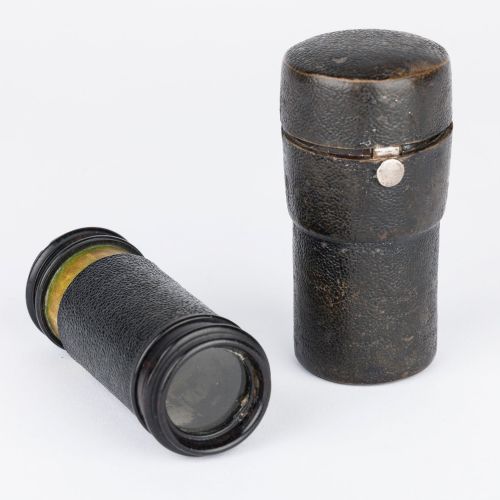


Brass Spyglass Monocular
These brass spyglass monocular pieces offer precision optics and portable magnification, prized for their maritime heritage and craftsmanship.
Brass Spyglass Monocular
A brass spyglass monocular is a portable optical instrument designed for distance viewing, commonly found in pocket sizes, multi-draw configurations, and marine formats. When you search for this phrase, you encounter instruments spanning the 18th century, Georgian, Regency, Victorian, and Edwardian periods.
The selection ranges from compact pocket spyglasses and leather-dressed explorer models to substantial naval telescopes and library instruments on stands. Many examples incorporate multiple draw tubes in brass, alongside specialised variations such as walking stick canes and opera monoculars.
Originating predominantly from English and German makers, these optical pieces serve both terrestrial and navigational purposes. You meet both day-or-night variations and single-draw hexagonal formats among the listed items.
Quality factors in optical instruments
The reputation of the maker and the complexity of the optical assembly dictate the standing of an instrument. Signed pieces from established workshops command attention for their precision engineering and engraved barrel details.
Choice of secondary materials alters the tactile quality, with fine hardwoods, stitched leather, and bone handles showing greater refinement than basic brass-only tubes. The number of draw tubes also affects the compactness and mechanical execution of the design.
Listings feature brass, leather, mahogany, and walnut across Georgian, Victorian, and Edwardian periods.
Nairne & Blunt of London·Ross of London·Voigtländer & Sohn AG·Richardson·Newton & Co·Chadburn Brothers of Sheffield
The Brass Spyglass Monocular Glossary
- Spyglass
- A small, handheld refracting telescope used for magnification at a distance. It typically consists of multiple sliding tubes.
- Draw
- A sliding section of a telescoping tube that extends to adjust the focal length. Multi-draw instruments collapse into shorter lengths for portability.
- Terrestrial telescope
- An optical instrument designed for viewing land objects rather than astronomical bodies. It includes erecting lenses to produce an upright image.
- Monocular
- A compact optical viewing scope designed for use with one eye. These instruments mirror the optics of larger telescopes in a pocket-sized format.
- Officer of the watch telescope
- A maritime viewing instrument utilised by naval personnel for watchkeeping duties at sea. These pieces emphasise durability and clarity in varying light conditions.
Brass Spyglass Monocular: Frequently Asked Questions
What is a brass spyglass monocular?
A brass spyglass monocular is a portable telescopic instrument designed for magnifying distant terrestrial or maritime views. These historical pieces utilise sliding brass tubes and glass lenses.
They reflect the optical technology and craftsmanship of periods ranging from the 18th century through the Edwardian era.
How do you use a multi-draw telescope?
To use a multi-draw telescope, you gently pull each nested brass section outward until fully extended. This action establishes the correct focal length for viewing.
Adjusting the final draw tube sharpens the image of distant objects before collapsing the sections back together for storage.
How can you tell the period of a spyglass?
Dating relies on materials, typography, and construction methods visible on the brass barrels. Georgian and Regency pieces often feature specific signature styles and wood pairings.
Victorian and Edwardian examples frequently incorporate marked draw tubes and standardised leather or brass finishes characteristic of later workshops.
Where were these telescopes made?
These optical instruments originated primarily in workshops across England and Germany. Prominent makers operated in London, Sheffield, and Braunschweig.
Makers stamped their names, locations, and military or naval designations directly onto the brass draw tubes or body surfaces.
How do you display a vintage spyglass?
Vintage spyglasses display well on desks, bookshelves, or dedicated stands alongside other scientific and maritime instruments. Some larger library models rest securely on their original wooden tripods.
Keeping them in cased formats or extended on flat surfaces highlights their brass and leather construction during everyday living.