
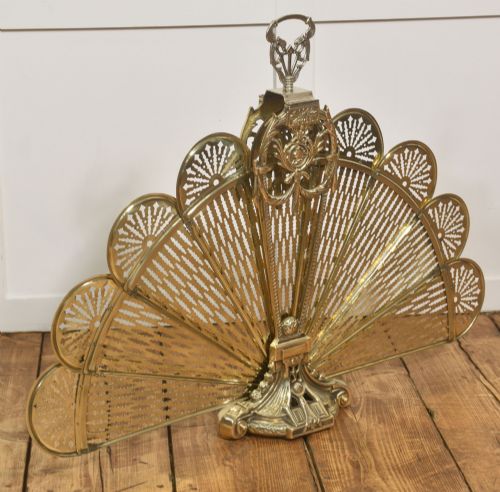
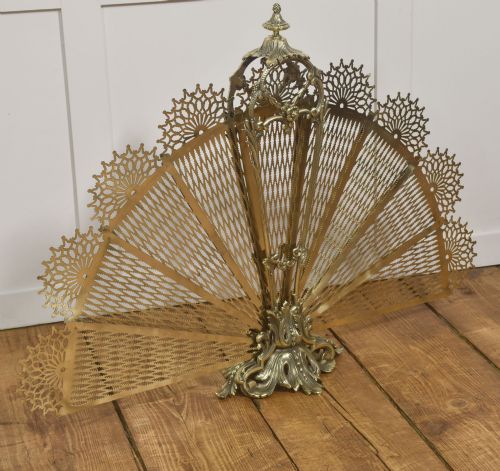
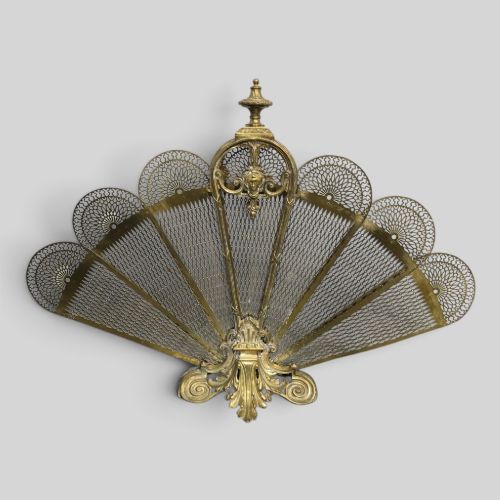
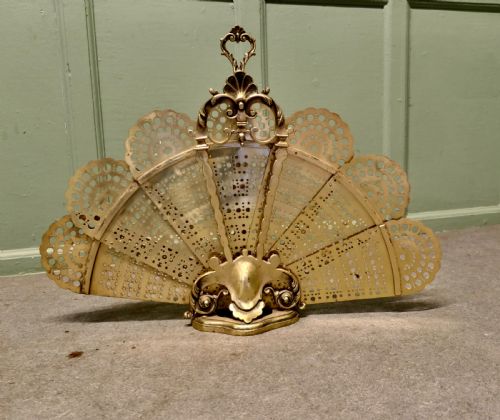
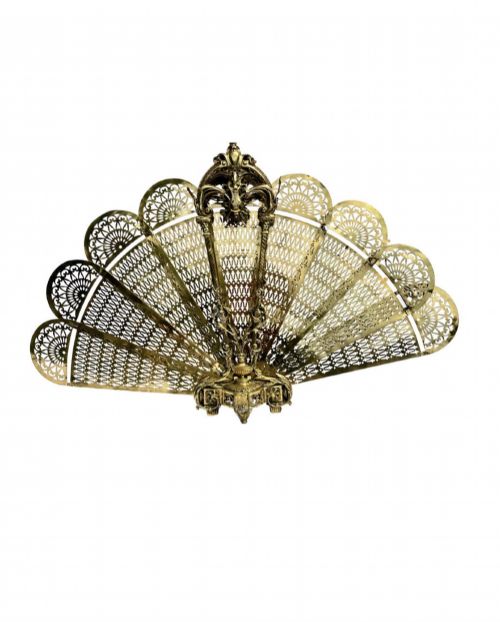

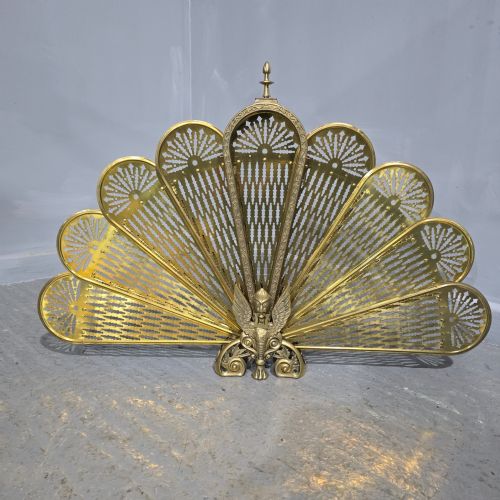


Brass Peacock Fan
A brass peacock fan is an expanding hearth guard that turns your inactive summer fireplace into a decorative focal point.
Brass Peacock Fan
A brass peacock fan takes the form of an expanding hearth screen designed to cover the fireplace opening when the grate is not in use. These decorative guards appear in Victorian, 19th Century, 1800, 1900, 1910, and 1920 forms, spanning styles from French Rococo Revival and French Chateau to classic Victorian designs.
Most examples function as folding fan screens or fireplace screens configured to save space while shielding the room from empty hearths. The prevailing format on this page is the folding brass fire screen, which opens outward into a dramatic tail shape reminiscent of a peacock.
Origins stretch across British and French workshops, encompassing utilitarian domestic items alongside highly ornate decorative accessories. Buyers encounter pieces fashioned as fire guards, folding fan screens, and pierced brass panels intended for both practical hearth protection and interior adornment.
How they were made
Construction relies heavily on brass, cast brass, and cast metal, often finished with gilt brass, ormolu, or gilt bronze to achieve a rich metallic lustre. Individual blades or vanes pivot from a central base, allowing the fan to expand and contract smoothly.
Surface ornamentation frequently incorporates pierced work, creating intricate openwork patterns along the individual metal blades. Artisans shaped the bronze and brass components through casting and hand-finishing, securing the pivoting segments so the guard maintains its fan shape when fully deployed.
This site's listings show pieces spanning from the 1880s through to the 1920s, dominated by brass and gilt bronze.
What varies in quality
Quality reveals itself in the crispness of the casting and the precision of the pierced work on each individual metal blade. Finer examples display deeply chased surface detail and substantial weight in the primary frame, whereas simpler pieces rely on thin gauge sheet metal with minimal decoration.
The mechanical action of the folding pivot points dictates the durability and daily usability of the screen. Superior pieces feature tightly engineered hinges that hold the fan securely at any angle of extension without sagging or binding.
The Brass Peacock Fan Glossary
- Ormolu
- Gilded bronze or brass applied to decorative objects, particularly popular in French furnishings. This finish provides a warm, golden sheen that resists tarnishing over decades of use.
- Fire screen
- A moveable guard placed before a fireplace opening during warmer months to hide the grate. These items transition from purely functional soot barriers into decorative room accents.
- Rococo Revival
- A nineteenth-century design movement favouring asymmetrical curves, scrollwork, and natural motifs like shells and foliage. This style heavily influences the ornate French iterations of hearth screens.
- Pierced brass
- Metalwork perforated with decorative holes to form patterns, lightening the visual weight of the panel. The technique allows light to filter through the fan blades.
- Cast metal
- Molten material poured into a mould to create complex three-dimensional shapes and sturdy structural frames. This method underpins the heavy base supports found on folding hearth fans.
Brass Peacock Fan: Frequently Asked Questions
How do I operate a folding fan screen?
Gently lift the retaining latch or pivot the individual metal blades outward from the base until the fan reaches its full semicircular span. The expanding segments lock lightly into place to present the decorative tail design across the hearth opening.
To store the screen, simply fold the blades inward together in a overlapping stack. This collapses the piece into a narrow, space-saving vertical profile that rests flat against the fireplace surround or chimney breast.
Were these screens used for active fires?
Hearth fans serve primarily as decorative summer guards to conceal dark or unlit fire grates when the heating season ends. Their expanding metal blades are engineered for visual effect and light room shielding rather than containment of roaring flames.
Using a folding fan too close to an active, burning fire can warp the delicate brass pivots and discolour the gilt or ormolu finish. They belong safely in front of dormant hearths.
How do I distinguish French styles from Victorian pieces?
French examples often embrace Rococo Revival or chateau aesthetics, featuring exuberant scrollwork, gilt bronze, and highly ornate pierced motifs on the outer guards. They lean towards theatrical, sculptural elegance in the metalwork.
Victorian pieces tend to balance decorative ambition with straightforward domestic utility, frequently utilising simpler cast brass frames and structured geometric piercing. The aesthetic focuses on neat folding mechanisms suited to standard nineteenth-century parlours.