
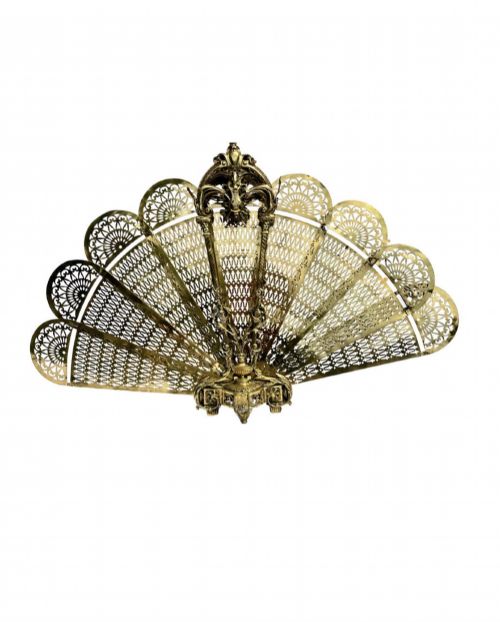

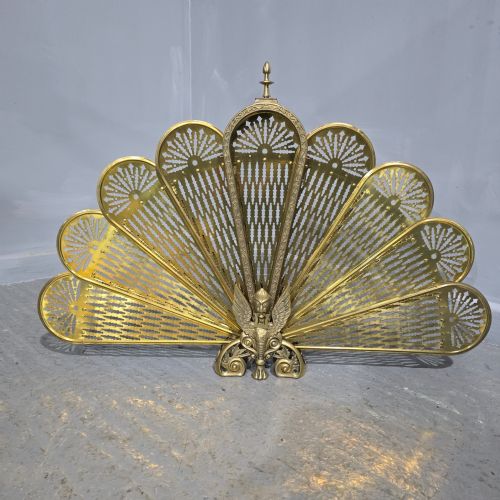


Brass Fireplace Fan
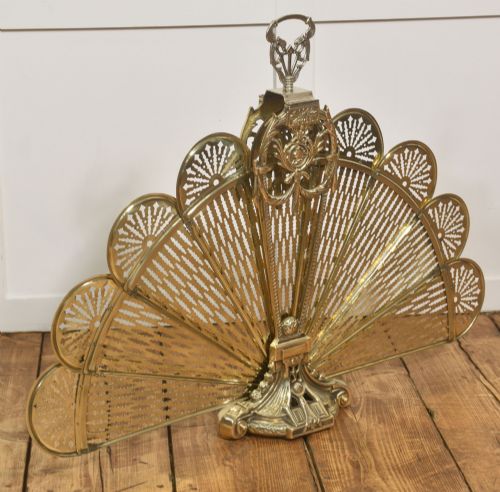
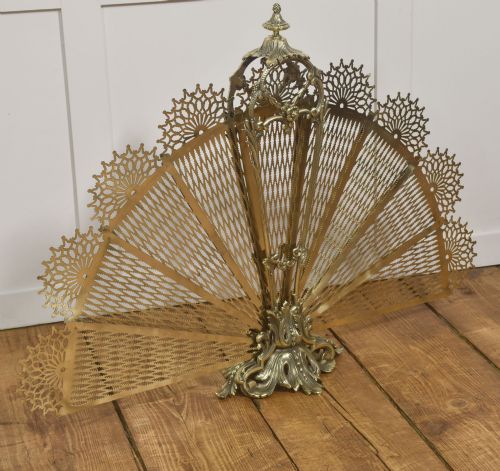
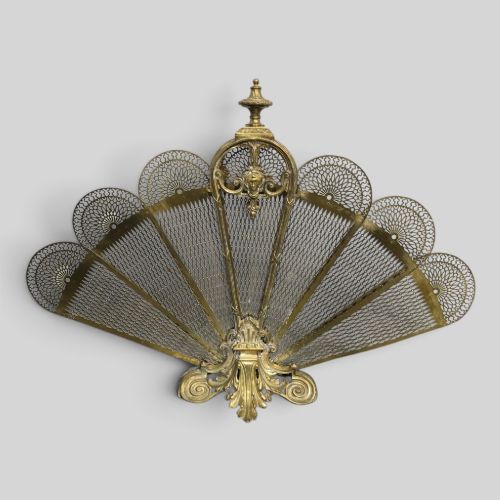
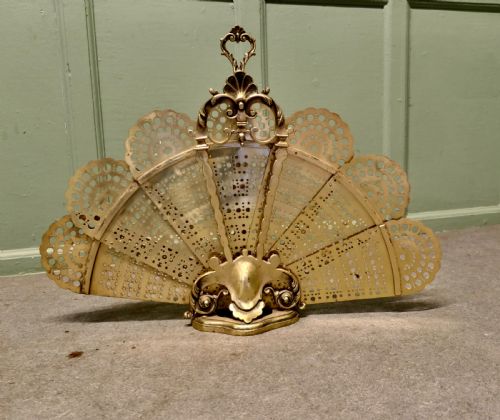
A brass fireplace fan brings the unfolding geometry of a peacock tail to the hearth.
Brass Fireplace Fan
A brass fireplace fan takes the form of folding metal blades designed to expand outward in front of an unused grate. These items function as decorative fire screens and fire guards, protecting the room from soot or simply dressing the hearth during warmer months.
Most examples encountered here belong to the Victorian era, the nineteenth century, and the early decades of the twentieth century. They adopt French Rococo Revival styles and Chateau aesthetics alongside straightforward Victorian designs.
The objects appear under various names including fire screens, folding fan screens, and peacock guards. Their primary purpose remains the same across all listed forms: a mechanical folding screen shaped like avian plumage.
Materials and construction
These pieces rely on brass, cast brass, and bronze as their primary structural metals. Individual blades or vanes are stamped or pierced before being joined at a central pivot to allow the fan action.
Finishes include gilt brass, ormolu, and gilt bronze, adding surface richness to the underlying cast metal. The engineering relies on simple mechanical hinges that let the metal feathers expand and contract uniformly.
Listed dates span from eighteen-eighty through the Victorian period up to nineteen-twenty.
Judging quality and finish
Quality reveals itself in the precision of the piercing work and the weight of the cast metal components. Finer pieces display crisp openwork patterns on each blade rather than plain sheet metal.
The smoothness of the folding mechanism and the richness of the ormolu or gilt bronze surfaces distinguish superior examples. Substantial construction prevents drooping when the fan is fully expanded.
The Brass Fireplace Fan Glossary
- Ormolu
- Finely ground high-carat gold applied to a bronze base using a mercury amalgamation process. This finish provides a warm, enduring lustre on French antique items.
- Peacock fan
- A folding hearth screen composed of articulated metal blades that mimic a bird tail in full display. The design became popular during the nineteenth century.
- Rococo Revival
- A nineteenth-century design movement favouring asymmetrical curves, scrollwork, and naturalistic motifs derived from eighteenth-century French art.
- Fire guard
- A protective barrier placed before a fireplace to catch sparks or conceal the grate. Folding fan versions serve primarily as decorative summer screens.
Brass Fireplace Fan: Frequently Asked Questions
How do these folding fans operate?
The individual metal blades pivot from a shared base station, allowing the screen to open and close like a hand fan.
Users simply swing the outer vanes outward until the full spread locks into position across the hearth opening.
When were these fireplace fans made?
The listings span from the late nineteenth century through to the nineteen-twenties. Victorian examples sit alongside French Rococo Revival pieces from around eighteen-eighty.
Earlier nineteenth-century pieces often feature heavier casting, while nineteen-twenties versions maintain the same traditional folding mechanics.
Where should a fan be placed?
These screens sit directly on the hearth floor in front of the fireplace opening. They fill the empty grate space when fires are not burning during warmer seasons.
The folding design allows the object to tuck away neatly against the wall when floor space is required.
Are these screens fragile?
The brass and bronze construction makes them sturdy, but the pivot joints require gentle handling. Forcing the blades beyond their designed arc can strain the metal.
Regular careful opening preserves the alignment of the individual vanes.