


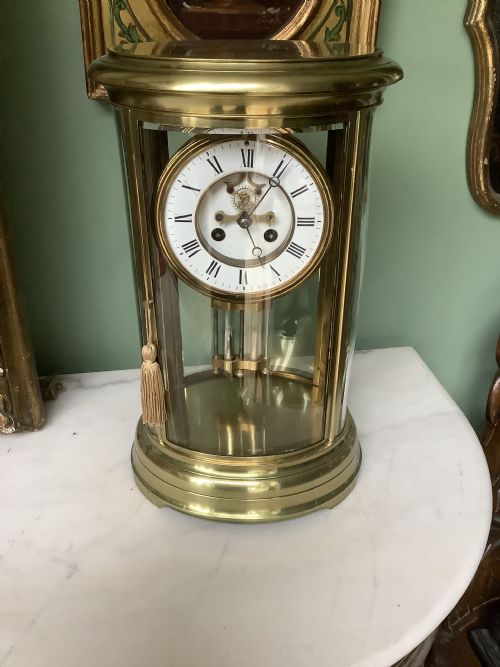


Brass Oval Table Clock
A brass oval table clock sits upright on a desk or mantel, bringing mechanical timekeeping and bright metalwork into a room.
Brass Oval Table Clock
A brass oval table clock takes many forms across the Victorian and Edwardian periods, including four glass mantel pieces, carriage clocks, and strut designs. These horological objects combine polished metal frames with bevelled glass panels that reveal the movement within.
Most examples originate from French workshops or London makers during the nineteenth century, showing influences from the Belle Epoque and Beaux-Arts styles. The oval footprint distinguishes them from standard rectangular or square models while maintaining a traditional upright stance.
The version most commonly met on this page is the French four glass clock featuring an enamel dial and brass housing. Such pieces range from miniature desk items to large mantel clocks with striking mechanisms.
How they were made
Construction relies heavily on cast and polished brass frames fitted with thick bevelled glass panes that protect the delicate internal gear train. Many models incorporate cloisonne enamel work or gilt surfaces to enrich the exterior profile.
Some models hide tiny diamontes around the dial, proving that even Victorian timekeepers enjoyed a subtle midnight sparkle.
What varies in quality
The refinement of the cast brass case and the crispness of any enamel or gilt decoration set finer examples apart from simpler production. Heavier frames with precise bevelling on all four glass panels indicate superior craftsmanship.
The complexity of the movement, such as repeating mechanisms or striking trains by notable makers, elevates the standard of a piece. Original components and undamaged enamel dials retain the integrity intended by the original workshop.
Howell & James London·Ad Mougin
The Brass Oval Table Clock Glossary
- Carriage clock
- A portable spring-driven timepiece originally designed for travel during the nineteenth century. These feature sturdy brass cases with carrying handles and glass panels.
- Four glass clock
- A mantel clock enclosed by glass on the front, back, and both sides to display the entire mechanical movement. The brass frame holds the panels securely in an upright position.
- Cloisonne enamel
- A decorative technique where metal wires form small compartments on the brass surface filled with coloured vitreous paste. Firing hardens the paste into vibrant decorative patterns.
- Repeater
- A mechanism that sounds the hours and quarters on demand when a lever or button is pressed. This complication added cost and utility to better quality clocks.
- Strut clock
- A timepiece supported by a hinged prop on the back panel for desk or table display. These smaller pieces often feature decorative brass or gilt frames.
Brass Oval Table Clock: Frequently Asked Questions
Where should I place a brass oval table clock?
These clocks suit stable flat surfaces such as mantelpieces, desks, or occasional tables where they remain level and secure. Placing them away from direct sunlight and damp environments helps preserve the brass finish and enamel dials.
Because many examples feature glass panels on multiple sides, positioning them where light passes through the case enhances the view of the moving parts inside.
How do I wind a mechanical table clock?
Winding requires a matching key inserted into the winding arbours on the dial or backplate, turning gently until resistance is felt. Care must be taken not to overwind the mainspring, which can cause internal damage.
Consulting the specific movement type ensures the correct tension is applied during routine maintenance and care.
What is the difference between a carriage clock and a four glass clock?
A carriage clock is designed for portability with a flat top plate and a carrying handle, typically enclosed in a heavy brass housing. It functions as a robust travel companion.
A four glass clock is stationary, intended for mantel or shelf display, utilising glass on all four main sides to showcase the pendulum or balance wheel mechanism.
How do I tell Victorian from Edwardian styles?
Victorian pieces often display heavier ornamentation, ornate cast brass framing, and traditional Roman numerals influenced by mid to late nineteenth-century aesthetics. They lean towards formal symmetry and rich decorative details.
Edwardian designs tend to introduce lighter proportions, refined gilt surfaces, and sometimes simpler geometric lines reflecting early twentieth-century tastes.