


Brass Navigational Instrument
These brass navigational instrument examples combine functional mechanics with historical precision, offering tangible links to maritime and scientific exploration.
Brass Navigational Instrument
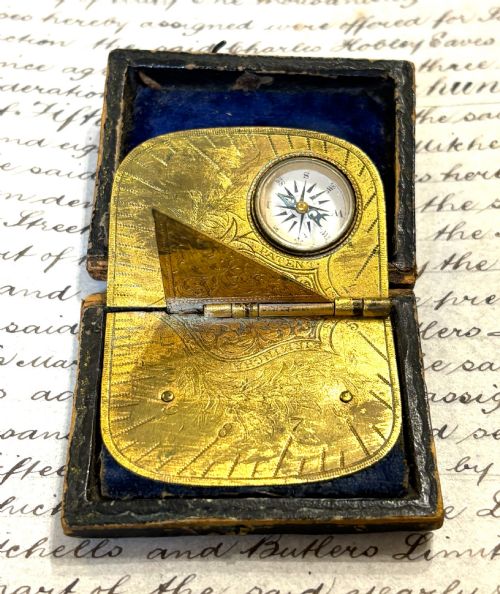
A brass navigational instrument serves as a practical tool for orientation, measurement, and calculation across land, sea, and air. These pieces originate from periods ranging through the eighteenth, nineteenth, and twentieth centuries, encompassing Georgian, Victorian, and mid-century eras.
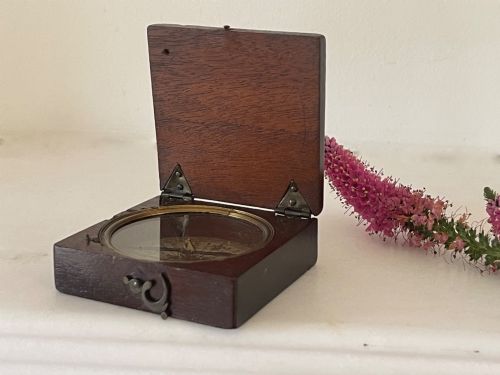
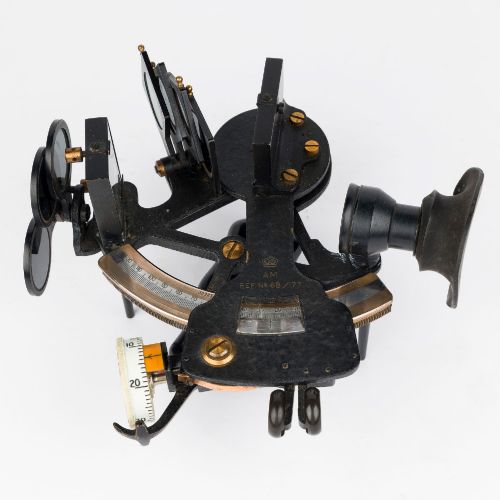
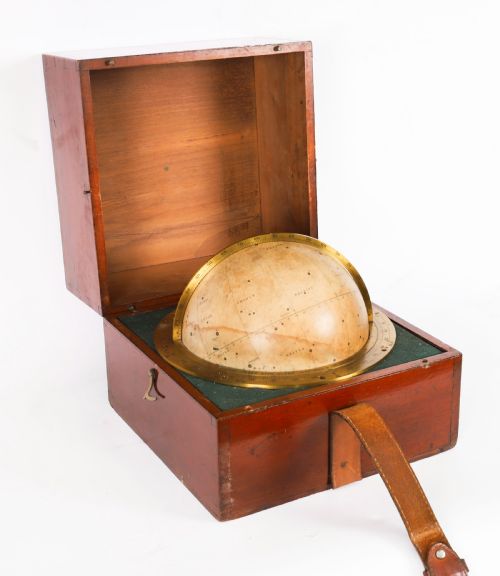
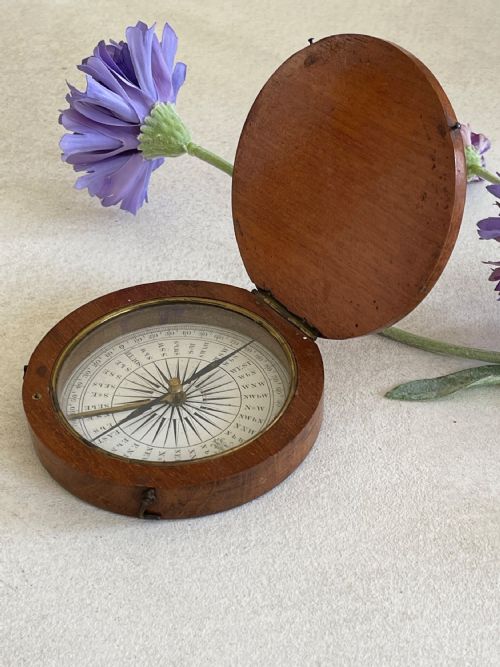
The selections available here include pocket compasses, telescopes, marine chronometers, sextants, and globes. Telescopes and compasses appear most frequently, often accompanied by fitted wooden or leather cases.
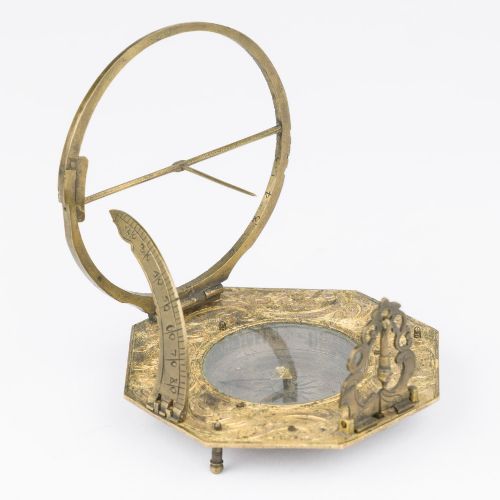
Makers and retailers from London, Liverpool, and international workshops produced these items for military, scientific, and commercial use. Collectors encounter items spanning simple pocket sundials to complex celestial globes and theodolites.
Materials and construction methods
Brass forms the primary structural material for bodies, dials, and fittings, occasionally complemented by nickel plating or silvered metal scales. Ebony, mahogany, and general wood feature in protective cases and specific instrument bodies, paired with glass for lens and dial covers.
Makers utilised turned and cast brass components, hand-engraved scales, and fitted wooden boxes lined with velvet or paper. Leather coverings provide additional protection for portable compasses and telescopes.
The documented periods span from the eighteenth century through the Georgian, Victorian, and mid-twentieth century eras.
Assessing build and execution
Quality rests in the precision of the engraved graduations, the smoothness of draw tubes in telescopes, and the clarity of the optics. Finer pieces demonstrate superior metal casting, crisp maker signatures, and robust mechanical assemblies.
The integrity of original cases, lenses, and supplementary components influences the overall standard. Pieces retaining their original fitted wooden boxes and signed dials reflect higher levels of original craftsmanship.
Andreas Vogler·Hughes and Son·Thomas Mercer·Litherland Davies Of Liverpool·Voigtländer and Sohn AG·W and T Gilbert·Henri de Magnac·Elliott Bros·W H Harling·G Adams·H Hughes·John Lilley and Son·John Newman·Barker and Son
The Brass Navigational Instrument Glossary
- Chronometer
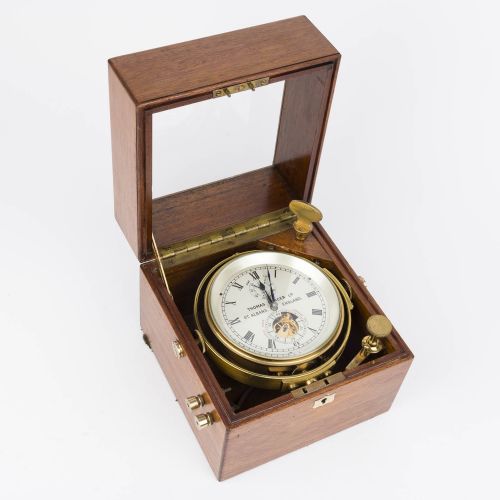
- A highly accurate timekeeper designed to determine longitude at sea. These mechanisms often rest in gimbaled mahogany boxes to maintain level positions.
- Sextant
- An instrument used to measure the angle between an astronomical object and the horizon for navigation. Navigators utilise this calculation to determine latitude and longitude.
- Clinometer
- A tool for measuring angles of slope or tilt relative to gravity. Ships and surveyors employ these devices to gauge inclination.
- Theodolite
- A precision optical instrument for measuring angles between designated points in the horizontal and vertical planes. Surveyors rely on these devices for mapping and construction.
- Artificial horizon
- A device used to determine the horizontal plane when the natural horizon is obscured. These sets often incorporate black glass and leveling screws.
Brass Navigational Instrument: Frequently Asked Questions
What is a marine chronometer?
A marine chronometer is a precision clock used aboard ships to determine longitude by means of celestial navigation. It remains stationary within a gimbaled housing to counteract the motion of the vessel.
These timekeepers were essential for safe oceanic travel before modern electronic systems. Collectors value them for their intricate escapements and fitted wooden cabinetry.
How do I care for brass instruments?
Brass instruments require a dry environment with stable temperatures to prevent tarnish and corrosion on the metal surfaces. Dusting with a soft cloth keeps the finish clean without removing historical patina.
Glass components and lenses should be cleaned with care using appropriate optical cloths. Wooden cases benefit from occasional treatment with suitable wax to preserve the timber.
How do I identify the date of an instrument?
Dating relies on maker signatures, patent numbers, style indicators, and materials used in the construction. Inscribed dates or addresses of known makers provide a reliable baseline for manufacturing periods.
Comparing the typography of signatures and the design of mounts against dated examples helps narrow the era of production. Documentation or original case labels also offer clues to the age.
Were these items used commercially?
Many of these pieces served military, maritime, and surveying operations worldwide. Navigators, explorers, and officers relied on them for daily calculations and charting.
Others were produced for scientific study or domestic display by affluent households. Their dual purpose as functional tools and precision instruments explains their widespread production.