


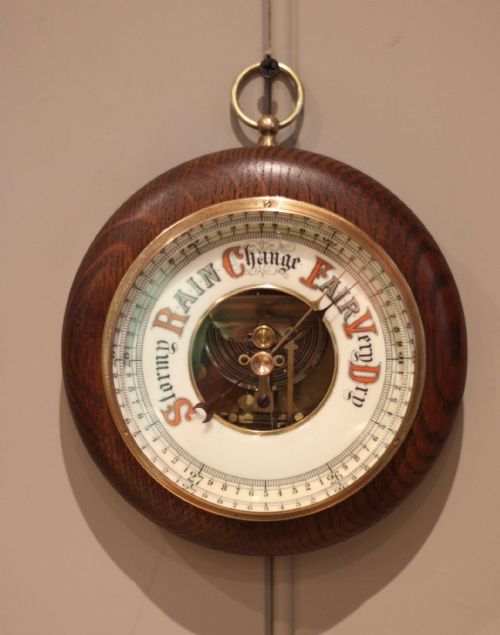


Brass Nautical Barometer
These brass nautical barometer pieces are solid maritime instruments housed in polished brass cases, designed to track weather changes at sea and prized by collectors for their historical utility.
Brass Nautical Barometer
When you search for a brass nautical barometer, you are looking at marine instruments designed for shipboard and coastal use. These pieces primarily date from the Victorian and Edwardian periods, alongside a few examples reaching back into the Georgian era and the early twentieth century.
The most common versions met on this page are ships barometers and marine stick barometers housed in sturdy brass frames. You will also encounter specialised items such as aneroid barometers, travelling barometers, and even a typhoon barometer.
Makers and retailers such as Elliott Brothers, Bate of London, Negretti & Zambra, James Murray, and Gowland London appear across the inventory. The forms range from circular wall-mounted aneroid dials to long wooden cased marine stick instruments.
Materials and construction
These instruments rely on heavy brass casings to withstand maritime environments, often paired with clear glass faces to protect the delicate dials. The structural bodies frequently utilise dense timbers such as mahogany, oak, and rosewood to mount the mechanism securely.
Dials and scales incorporate materials like enamel, bone, and ceramic for legible markings. Precision engineering inside the brass housings involves complex aneroid or mercury tube mechanisms assembled by specialist opticians and instrument makers.
Listings span the Victorian, Edwardian, and Georgian periods, utilising brass, glass, mahogany, oak, rosewood, bone, enamel, and ceramic.
Separating the ordinary from the exceptional
Quality in a brass nautical barometer rests on the precision of the maker and the grade of materials used in the casing and scale. Signed instruments by renowned scientific makers command greater interest than unsigned or generic workshop pieces.
The choice of housing timber also dictates the character of the piece, with richly grained rosewood and detailed mahogany mounting boards elevating the object. Furthermore, specialised meteorological complications like typhoon tracking scales separate standard domestic instruments from professional maritime apparatus.
Elliott Brothers·Bate of London·Negretti & Zambra·James Murray·Gowland London
The Brass Nautical Barometer Glossary
- Aneroid barometer
- An instrument that measures atmospheric pressure without liquids, using an expanding and contracting metal chamber. This mechanism allows the barometer to be mounted in various orientations without fluid spillage.
- Hypsometer
- A scientific instrument used to calculate altitude by measuring the boiling point of a liquid relative to atmospheric pressure. Some advanced meteorological pieces combine this function with standard barometric tracking.
- Barocyclonometer
- A specialised meteorological device used in tropical regions to locate the centre and path of revolving storms. These complex instruments are particularly associated with early twentieth-century maritime navigation.
- RNLI type
- A design pattern associated with the Royal National Lifeboat Institution for rugged coastal service. Such barometers were built to rigorous specifications for reliable performance in harsh weather.
Brass Nautical Barometer: Frequently Asked Questions
What is a brass nautical barometer?
A brass nautical barometer is a weather-measuring instrument housed in a durable metal case, originally built for maritime navigation on ships and in coastal stations.
These pieces combine functional meteorological mechanisms with traditional materials like mahogany, oak, and glass.
How were marine barometers used at sea?
Captains and officers monitored shifting atmospheric pressure to anticipate approaching storms and changing weather conditions while aboard a vessel.
Special gimbal mounts or restricted tube designs kept the mercury or aneroid mechanism stable despite the rolling motion of the ship.
How do I identify a Victorian barometer?
Victorian examples often feature maker signatures from established London firms, alongside traditional timber mounts like rosewood or oak.
The dating relies on recorded styles and maker addresses active during the nineteenth century, such as specific Strand locations.
Where should I place a barometer at home?
These instruments suit study walls, hallways, or library spaces where stable interior temperatures prevent unnecessary calibration drift.
Keep them away from direct heat sources and excessive moisture to preserve the brass casing and wooden mounts.