
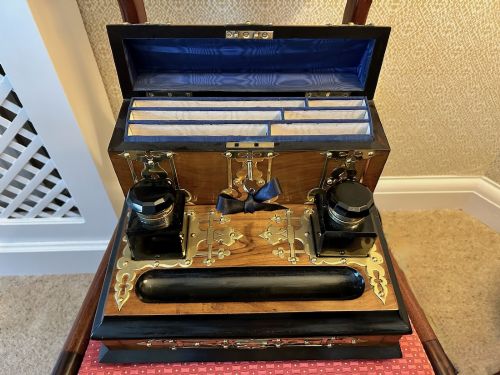


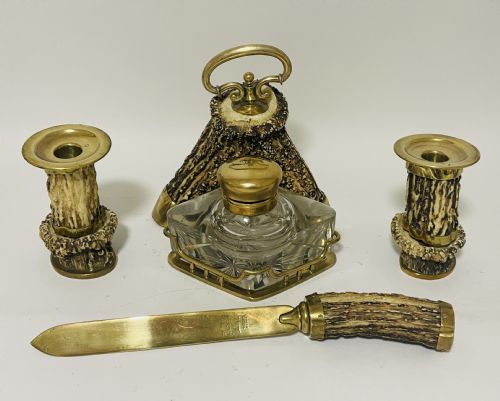


Brass Mounted Desk Companion
A brass mounted desk companion brings order to correspondence, combining rich timber with polished metal to anchor a nineteenth-century workspace.
Brass Mounted Desk Companion
When buyers search for a brass mounted desk companion, they encounter portable writing accessories designed to organise ink, pens, and paper upon a nineteenth-century table. These items include double-sided desk sets, inkstands, and cigar humidors created during the Victorian period.
The versions most commonly met on this page span the mid to late nineteenth century, rendered in timbers such as walnut, burr walnut, and coromandel wood. Ormolu and brass mounts provide structural reinforcement and decorative contrast to these fitted writing pieces.
Objects range from simple inkstands to complex four-piece desk sets and antler-decorated ensembles. Napoleon III and Gothic Revival styles appear among English and continental workshops of the era.
How they were made
Cabinetmakers used dense hardwoods like coromandel and walnut as foundations, applying veneers and brass inlay to the exterior surfaces. Ormolu mounts and cut-glass inkwells were secured to house writing equipment safely.
Metal components involved cast brass and ormolu, fixed with screws to timber bodies that often incorporated hinged compartments for stationery and cigars.
Victorian craftsmen occasionally incorporated wild antlers directly into desk sets, giving correspondence a rather rugged forest aesthetic.
What varies in quality
Quality rests upon the selection of timber veneers and the precision of the brass inlay work set into the wood. Burr walnut and coromandel bodies with well-fitted ormolu mounts represent the finer end of the range.
The complexity of the set dictates distinction, separating simple single-inkstand items from comprehensive four-piece collections with integrated clocks and barometers.
The Brass Mounted Desk Companion Glossary
- Ormolu
- Gilded bronze mounts applied to furniture and desk accessories for decorative effect. This technique was widely utilised during the nineteenth century.
- Coromandel wood
- A dense, dark exotic timber featuring distinctive contrasting streaks, favored by makers of luxury nineteenth-century boxes.
- Burr walnut
- Walnut timber taken from growths on the tree, showing intricate swirling grain patterns used on high-grade Victorian desk pieces.
- Napoleon III style
- A nineteenth-century French revival aesthetic incorporating rich inlays, tortoiseshell, and ornate brass mounts.
Brass Mounted Desk Companion: Frequently Asked Questions
What is a brass mounted desk companion?
A brass mounted desk companion is a nineteenth-century desk accessory, such as an inkstand, cigar humidor, or stationery box, decorated with metal mounts.
These pieces were produced during the Victorian era to organise writing equipment and correspondence on household desks.
How were these desk sets used?
Owners used them to hold ink, pens, stamps, and paper for daily letter writing in the home.
Some variations also functioned as cigar humidors or housed desk clocks and barometers for the library or study.
What materials should I expect?
Listings feature woods such as walnut, burr walnut, and coromandel, combined with brass, ormolu, and cut glass.
Unusual examples incorporate materials like tortoiseshell and natural antler into the nineteenth-century designs.
How do I identify the period?
Nineteenth-century pieces display construction methods, timber choices, and stylistic traits typical of the Victorian era and Napoleon III period.
Stylistic markers include Gothic Revival details and elaborate brass inlay work characteristic of 1860 to 1900 craftsmanship.