
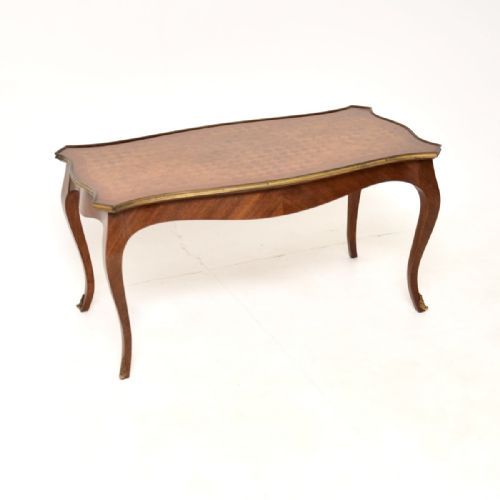
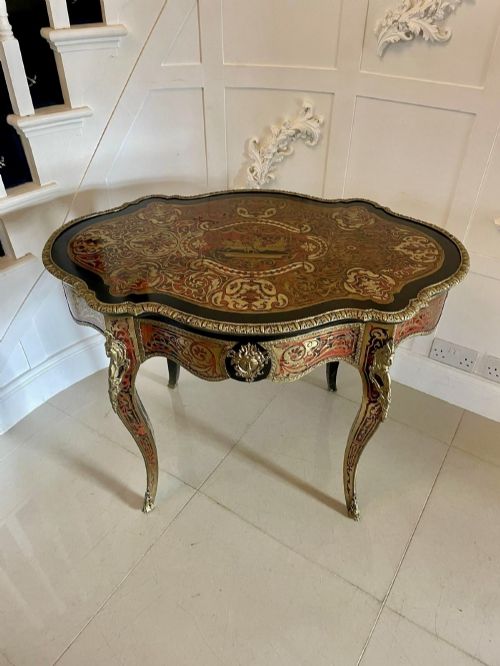
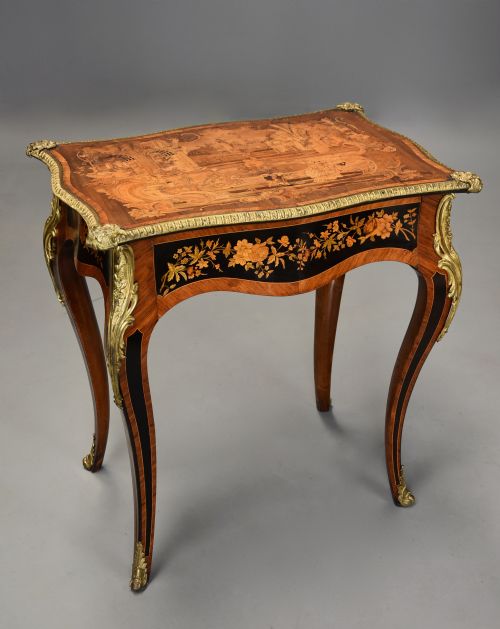


Brass Marquetry Centre Table
A brass marquetry centre table sits proudly in the middle of a room, catching the light and anchoring the entire space with classical elegance.
Brass Marquetry Centre Table
A brass marquetry centre table is a freestanding piece designed to be viewed from all sides, making it the focal point of a principal room. You will frequently encounter examples originating from the nineteenth century, particularly from Regency and Victorian periods, as well as French ateliers working in revival styles.
The form varies across the selection, ranging from traditional circular drum tables and occasional tables to larger breakfast, dining, and writing desks. Walnut, rosewood, mahogany, and ebonised wood provide the foundational timber structures for these decorative surfaces.
Makers often drew inspiration from French court aesthetics, producing Louis XV, Louis XVI, and Napoleon III designs. These pieces served both decorative and functional purposes in affluent homes, displaying intricate inlaid patterns intended to impress visitors.
What varies in quality
The distinction between standard execution and the finest work lies in the precision of the brass inlay and the selection of cabinet woods. Superior examples demonstrate microscopic exactness where metal meets timber, with zero filler used to bridge gaps in the marquetry.
Heavier, more finely chased ormolu mounts and substantial secondary timbers indicate superior workshop output. The overall balance of the proportions and the crispness of the hand-carved details elevate certain tables into the upper tiers of craftsmanship.
Listings feature brass marquetry centre tables spanning the Regency, Victorian, and Edwardian eras, executed in rosewood, walnut, and mahogany.
François Linke·Maison Millet·A. Beurdeley·Holland and Son·George Smith
The Brass Marquetry Centre Table Glossary
- Marquetry
- Decorative veneer applied to furniture in patterns or pictures using wood, metal, or shell. This technique allows intricate floral, geometric, or pictorial designs to adorn the table top.
- Boulle
- A style of marquetry using brass and tortoiseshell, developed in France during the reign of Louis XIV. The contrasting materials create a rich, shimmering surface texture.
- Ormolu
- Gilt bronze mounts applied to furniture for decoration and edge protection. This technique involves coating cast bronze with gold amalgam.
- Parquetry
- Geometric wood inlay forming patterns such as cubes, chequers, or stripes. It differs from marquetry by relying on repeating angular shapes rather than pictorial scenes.
- Drum table
- A circular table with a deep skirt containing drawers, resembling the shape of a drum. These pieces often feature leather-inset tops and rotate on a central pillar.
Brass Marquetry Centre Table: Frequently Asked Questions
Where should a centre table go?
These tables are designed to stand free in the middle of a room rather than pushed against a wall. They work particularly well in large entrance halls or principal reception spaces.
Ensure there is enough clearance to walk completely around the piece so the inlaid top remains fully visible from every angle.
How do I care for brass inlay?
Dust the surface regularly with a soft, dry cloth to prevent particles from settling into the fine crevices between the brass and the wood. Avoid commercial liquid polishes that might seep beneath the metal veneer.
Keep the timber nourished with appropriate wax and protect the surface from direct sunlight and excessive humidity.
What is the difference between Boulle and marquetry?
Boulle work specifically uses brass and tortoiseshell cut together in contrasting patterns, whereas general marquetry employs a wider variety of woods and metals to create pictorial scenes.
Both techniques require immense skill, but Boulle has a distinct reflective quality due to the metallic sheen against the dark shell.
Can I use a centre table as a desk?
Many nineteenth-century examples, particularly those styled as writing tables or desks, feature convenient drawers integrated into the frieze. These allow for light writing tasks while maintaining a decorative appearance.
Ensure the working height matches your chair if you intend to use it regularly for writing.