


Brass Library Clock
A brass library clock brings mechanical precision and warm timber or polished metal into a room, combining heavy brass framing with crisp enamel dials.
Brass Library Clock
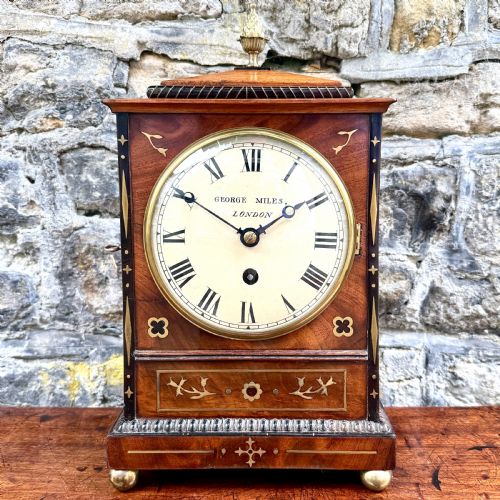
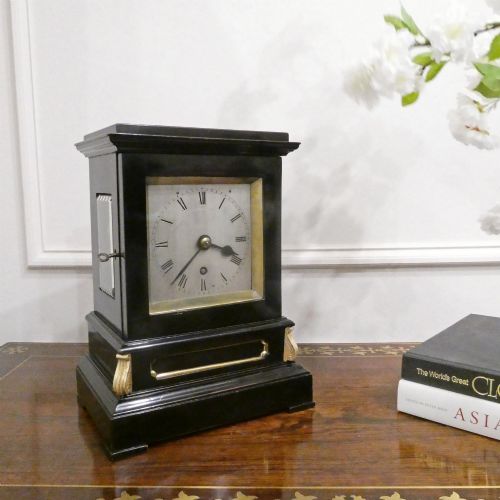
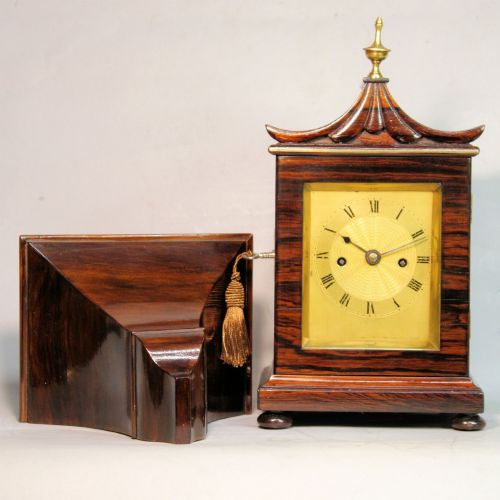
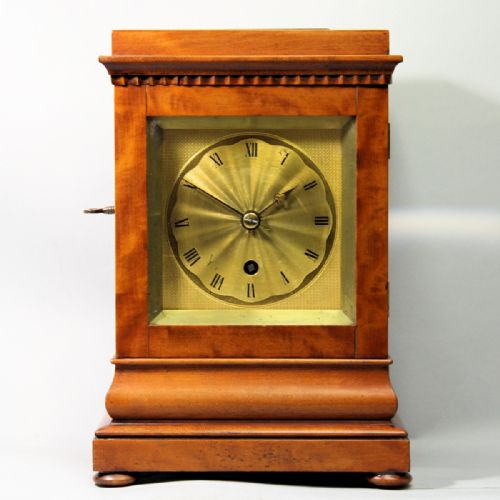
A brass library clock is a portable timepiece designed for desks, mantelpieces, and reading rooms, appearing frequently in robust mahogany, rosewood, and ebonised wood cases. Buyers encounter pieces spanning the Georgian, Regency, and Victorian periods, often housing precision fusee or platform escapement movements.
The form ranges from compact single fusee timepieces to striking five-glass models and campaign styles fitted with brass carry handles. Many examples feature exposed glass panels that reveal the intricate brass gear trains and oscillating pendulums within.
Origins stretch across English workshops in London alongside continental French makers, uniting heavy brass bezels with rich satinwood and marble accents. These clocks served both practical timekeeping duties and decorative roles within domestic studies.
What varies in quality
Quality rests upon the crispness of the brass castings, the precision of the engine turning on the gilded dial, and the integrity of the timber case construction. Finer examples display meticulous hand-finishing on the movement plates and unblemished glass panels secured within solid mahogany or rosewood frames.
The sophistication of the internal mechanism dictates the upper tier of the range, separating standard timepieces from complex year-going or striking movements signed by notable London makers. Superior execution involves harmonious proportions between the heavy brass components and the polished wooden housing.
Bush of London·Arnold and Frodsham·Samuel Marti·McCabe London·Plumbly and Tupman·Barraud and Lunds·John Massey·Leith of London·J.T. Bell
The Brass Library Clock Glossary
- Fusee
- A conical pulley used in clock movements to maintain an even pull on the gear train as the mainspring unwinds. This mechanical device ensures consistent timekeeping accuracy throughout the running cycle.
- Platform escapement
- A self-contained escapement unit fitted to smaller clocks that removes the need for a hanging pendulum. It allows portable desk and carriage clocks to keep accurate time in any position.
- Ebonised wood
- Timber treated with a specialised finish to imitate solid ebony. This dark, uniform surface provided a sharp contrast against polished brass bezels and white enamel dials.
- Engine turning
- A decorative mechanical technique that cuts intricate geometric patterns into metal surfaces. Gilded clock dials frequently display this meticulous patterning around the central chapters.
- Ting tang
- A striking mechanism that sounds two different notes on bells or gongs to mark the quarters or hours. It adds an audible dimension to the visual mechanics of a mantel clock.
Brass Library Clock: Frequently Asked Questions
What is a fusee movement?
A fusee movement uses a conical pulley and a chain to equalize the power delivered by the mainspring as it unwinds. This clever mechanical arrangement prevents the clock from losing speed as the spring runs down.
Such movements indicate high-grade English clockmaking from the Georgian and Victorian eras. They require careful handling during winding to preserve the original chain and gear teeth.
Where should I place a library clock?
These clocks suit stable surfaces away from direct sunlight, draughts, and dampness, such as a sturdy desk, bookcase, or mantelpiece. Their compact footprints allow them to sit comfortably among books and study accessories.
Placing the clock on a level surface ensures the pendulum or platform escapement beats evenly. Wall-mounted variants require secure fixings to support the weight of the timber case and brass movement.
How do I distinguish between Regency and Victorian models?
Regency clocks typically exhibit restrained classical proportions, dark mahogany or rosewood veneers, and subtle brass inlay. Victorian examples often introduce heavier ebonised cases, multi-glass panels, and more ornate industrial or Gothic Revival styling.
Examining the dial signature, timber grain, and movement construction helps clarify the period of manufacture. Surviving labels or maker signatures engraved on the brass backplate provide definitive guidance.