



Brass Gallery Oval Table
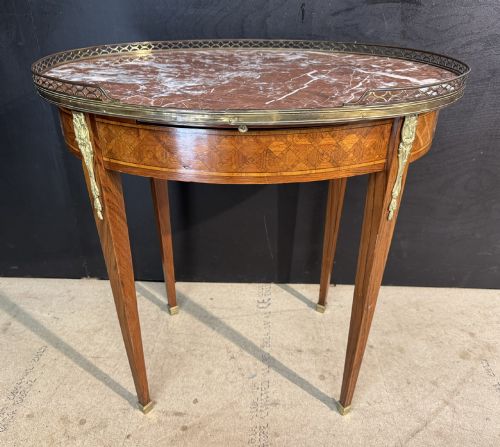
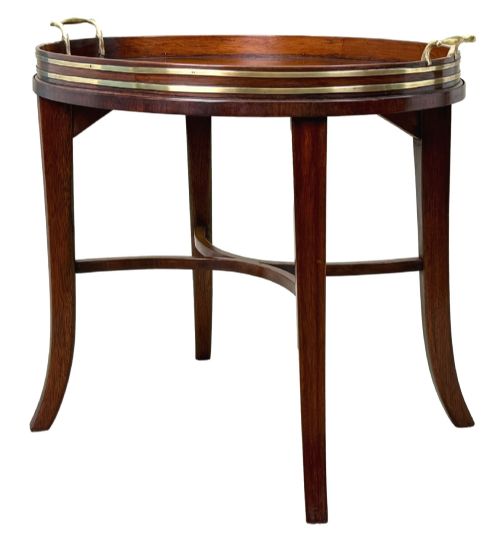
A brass gallery oval table brings refined French and Georgian design to a room, offering a decorative surface finished with a protective metal rail.
Brass Gallery Oval Table
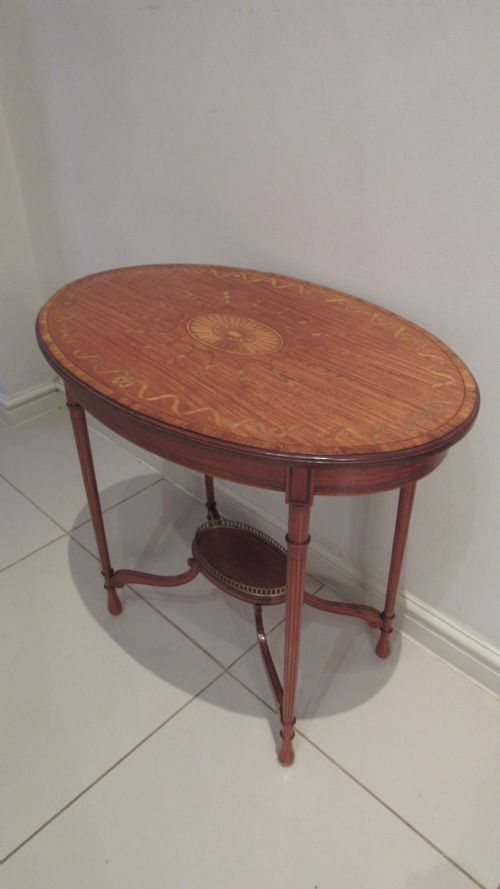
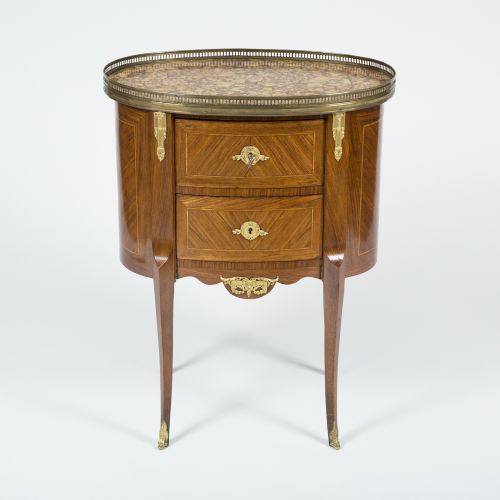
The versions you meet most frequently on this page originate from French workshops or British cabinet makers working in Georgian and revival styles. They appear in forms ranging from compact night tables and lamp stands to larger centre and side tables.
Makers utilised fine timbers such as mahogany, kingwood, rosewood, and satinwood, frequently embellishing the oval surfaces with marquetry and parquetry inlays. Each brass gallery oval table reflects the shifting tastes of the period, moving from geometric Georgian simplicity to ornate Louis XVI and Empire revivals.
What varies in quality
The distinction between standard examples and the finest pieces rests on the precision of the timber work and the crispness of the brass casting. Superior tables exhibit tightly fitted marquetry, seamless veneer matching across the curved oval top, and heavy, well-defined metalwork in the gallery.
Construction methods also separate the grades, as older pieces rely on traditional joinery that maintains structural integrity over centuries. The integration of the gallery into the top demonstrates the maker's skill, with better examples showing secure, flush mountings rather than simple surface attachments.
Listings feature mahogany, kingwood, rosewood, and satinwood across the nineteenth and early twentieth centuries.
Haentgos Freres Paris·Charles Topino
The Brass Gallery Oval Table Glossary
- Brass gallery
- A low raised railing of pierced or cast brass running around the edge of a table top to retain objects. This feature is particularly common on French and Georgian occasional tables.
- Marquetry
- Decorative patterns formed by fitting contrasting pieces of veneer into a wood foundation. Cabinet makers used this technique to create elaborate floral or geometric designs on table tops.
- Ormolu
- Gilded bronze applied as a decorative mount to furniture. French makers utilised this material extensively during the eighteenth and nineteenth centuries.
- Parquetry
- Geometric wood inlay laid down in repeating patterns such as cubes or chequers. It differs from marquetry by relying on angular shapes rather than pictorial motifs.
- Table en chiffonnière
- A small French bedside or utility table fitted with drawers and compartments. These pieces often feature an oval top with a brass gallery.
Brass Gallery Oval Table: Frequently Asked Questions
What is a brass gallery?
A brass gallery is a decorative metal railing fitted to the perimeter of a table top. Its original purpose was to stop small items like perfume bottles, writing instruments, or glassware from sliding off the edge.
Over time, it became a defining stylistic element of fine Georgian and French occasional tables. The metal is typically cast or pierced, ranging from simple wire designs to intricate openwork patterns.
Where should I place an oval side table?
An oval side table suits spaces where sharp corners would disrupt the flow of movement. Place one beside a sofa, between two armchairs, or as a lamp table in a corner.
The curved outline softens room layouts while the raised gallery adds a refined metallic accent to the setting.
How do I care for marble and wood tops?
Maintenance depends entirely on whether the surface is polished timber or stone. Wooden tops require occasional waxing with a suitable polish to nourish the grain, while marble benefits from gentle cleaning with a damp cloth.
Avoid placing untreated liquids directly onto wood veneers or acidic substances onto marble surfaces to preserve the finish.
How do I date a nineteenth century table?
Dating requires examining the construction methods, timber choices, and stylistic revival influences. Pieces from the later nineteenth century often display machine-assisted precision alongside traditional hand joinery.
Comparative study of maker labels, veneer types, and specific revival motifs helps narrow down the decade of production.