

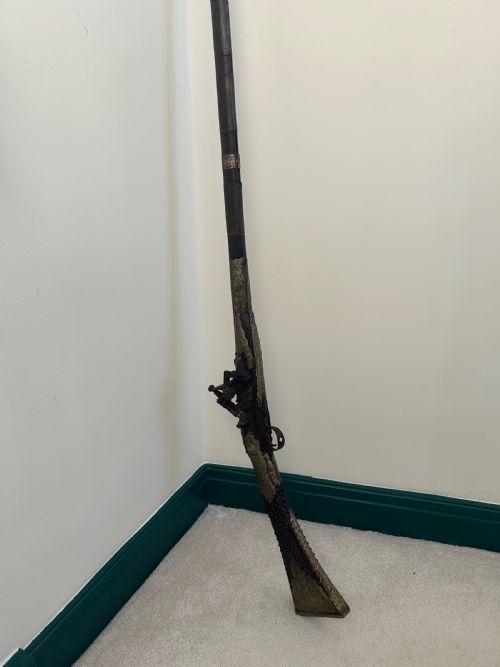


Brass Flintlock Firearm
A brass flintlock firearm combines the mechanical ingenuity of the flintlock firing system with the durability and distinct appearance of cast brass barrels and mounts.
Brass Flintlock Firearm
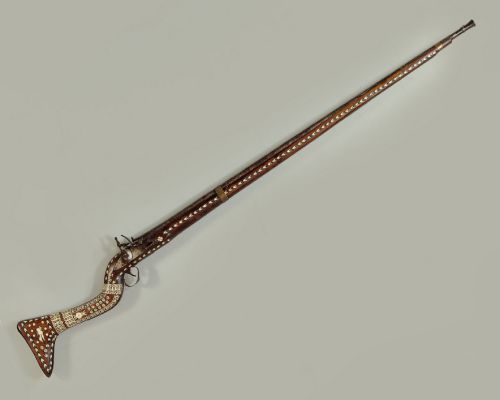
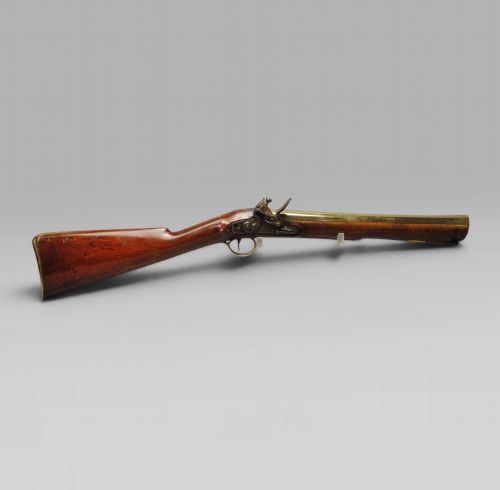
A brass flintlock firearm encompasses a range of military, naval and civilian arms produced primarily during the eighteenth and nineteenth centuries. The selection includes heavy blunderbusses, service pistols, pocket arms and long-barrelled muskets from English, European and Ottoman makers.
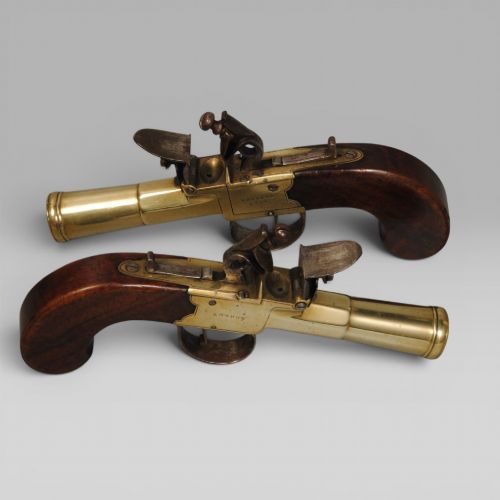
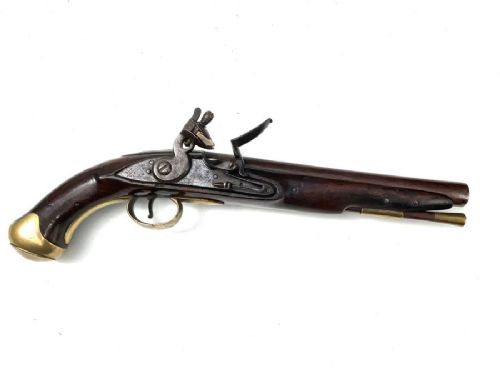
The most frequent examples encountered on this page are eighteenth-century pocket and holster pistols featuring brass barrels and furniture. These pieces reflect the transition from military ordnance to personal protection during the Georgian and Napoleonic eras.
Materials and construction
Makers utilised cast brass for barrels and sideplates to resist corrosion from black powder residue and marine environments. Walnut and other dense hardwoods formed the stocks, shaped to fit the hand or shoulder.
Internal lock mechanisms relied on forged steel components designed to generate a spark when the flint struck the frizzen. Decorative elements frequently incorporated silver inlay, bone and mother-of-pearl set into the wooden stocks.
Materials documented across the inventory include cast brass, forged steel, walnut, bone and mother-of-pearl.
Factors determining quality
The distinction between standard service arms and higher-grade pieces lies in the precision of the lock mechanism and the execution of metal engraving. Workshop signatures from known London or continental makers elevate the standing of a piece.
Overall condition and originality of the components dictate the integrity of the firearm. Stocks retaining their original finish without excessive timber replacement represent the upper tier of surviving examples.
Harrison of London·La Motte·Sargant and Son·Thomas Henshaw·H W Mortimer and Son·I Parr·John Rimes·J Robinson
The Brass Flintlock Firearm Glossary
- Flintlock
- A ignition mechanism that uses a piece of flint held in a cock to strike a steel frizzen, creating sparks to ignite the priming powder. This system dominated military and civilian firearms for over two centuries.
- Blunderbuss
- A muzzle-loading firearm with a flared barrel designed to scatter shot at close range. It was widely utilised by coach guards and naval personnel.
- Miquelet
- A distinct form of flintlock mechanism originating in the Mediterranean region, featuring an external mainspring and a combined steel and frizzen. It is commonly found on Ottoman and Balkan arms.
- Turn-off pistol
- A firearm featuring a barrel that unscrews from the breech to allow loading from the front of the chamber. This design eliminates the need for a ramrod.
- Frizzen
- The vertical steel plate struck by the flint to produce sparks and cover the priming pan. Its correct hardening is essential for reliable ignition.
Brass Flintlock Firearm: Frequently Asked Questions
How did a flintlock mechanism work?
The operator pulls the hammer back to the full-cock position, holding a piece of flint between its jaws. Pulling the trigger releases the hammer, causing the flint to strike the steel frizzen and scrape sparks into the priming pan.
The resulting flash travels through a small touchhole into the main barrel chamber, igniting the black powder charge and propelling the projectile forward.
Were brass barrels safer than iron?
Brass barrels offered superior resistance to the corrosive chemical residues left by black powder and moisture, making them particularly popular for naval and maritime use. They were cast rather than forged.
While strong, brass had different weight and thermal characteristics compared to steel, influencing the balance of the firearm.
How are these firearms dated?
Dating relies on proof marks, maker signatures, architectural changes in lock design and the presence of royal ciphers or military acceptance stamps. Style shifts in stock carving and brass mount decoration also provide chronological markers.
English pieces often feature London or Birmingham proof marks that correspond to specific legislative acts and testing periods.
What is the difference between a holster pistol and a pocket pistol?
Holster pistols were larger, heavier weapons designed to be carried in saddle holsters by cavalrymen and travellers on horseback. They required more space and provided greater range and stopping power.
Pocket pistols were smaller, often featuring turn-off barrels and concealed triggers for discreet personal defence in civilian attire.