

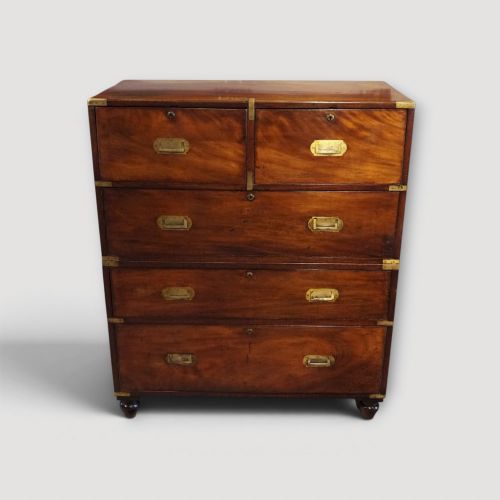
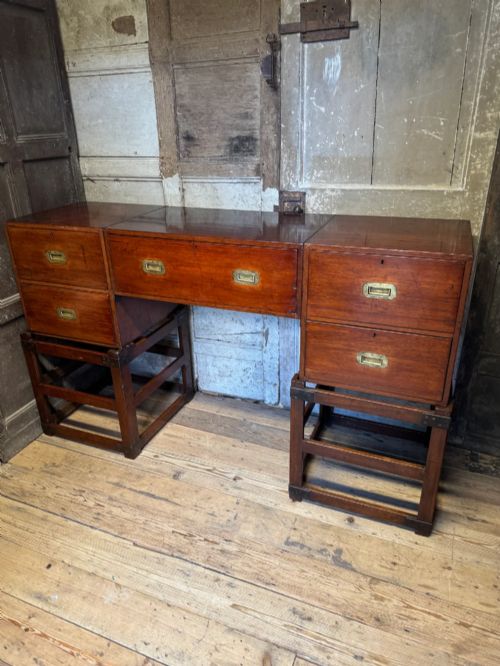

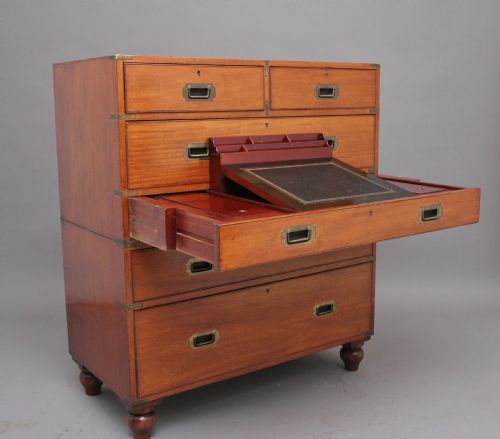


Brass Fitted Campaign Furniture
Brass fitted campaign furniture comprises portable travel pieces built for officers and travellers, offering clever storage and robust construction.
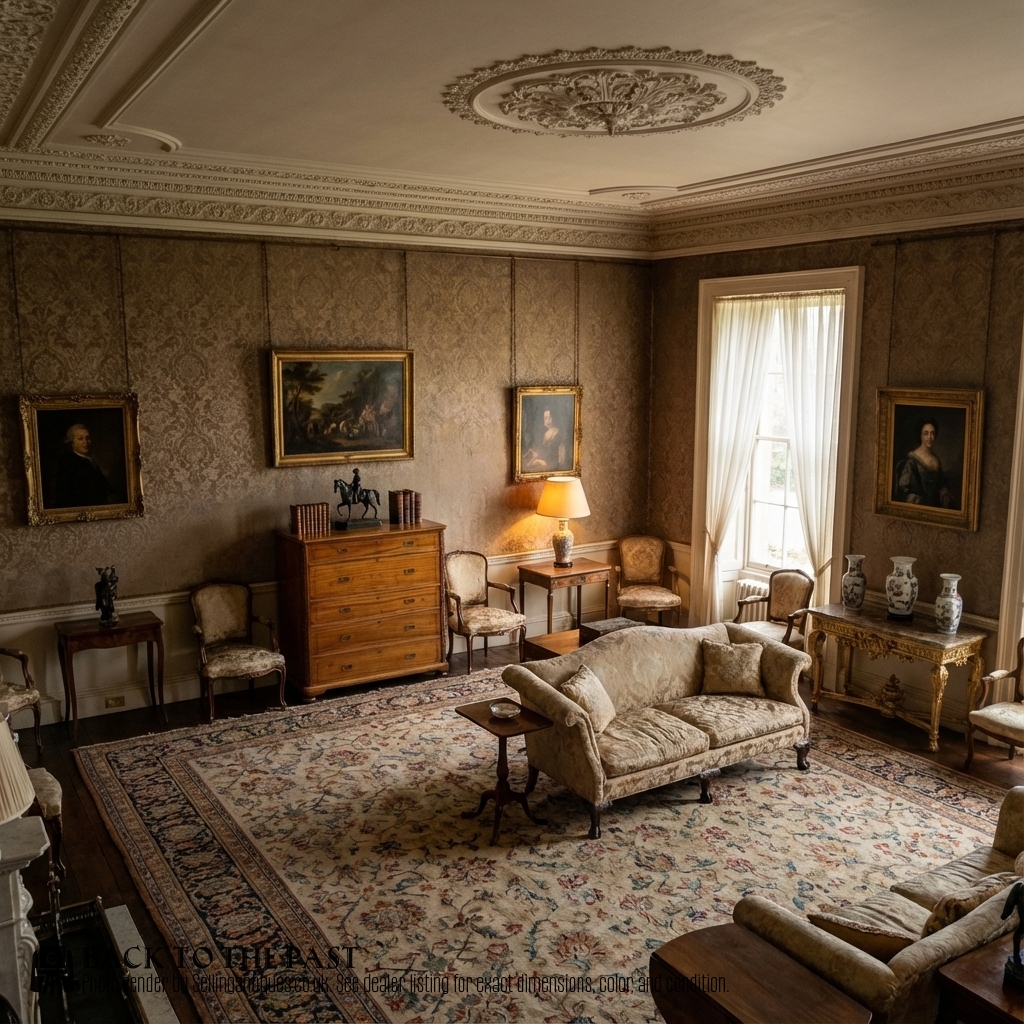
Brass Fitted Campaign Furniture
Brass fitted campaign furniture includes chests of drawers, secretaire chests, desks, washstands and trunks designed to dismantle or travel easily. When searching for brass fitted campaign furniture, buyers encounter items created for military officers, merchants and colonial travellers on the move.
The pieces on this page span the eighteenth, nineteenth and early twentieth centuries, featuring Victorian military styles, Anglo-Indian works and British colonial campaign designs. Mahogany, teak, camphorwood and oak form the primary bodies, whilst brass corners and recessed handles protect the timber during transit.
How they were made
Cabinetmakers constructed these travel pieces from dense timbers such as mahogany, teak and camphorwood, selected to withstand humidity and rough handling. Grain alignment and stable joints ensured the wood resisted warping during long journeys across land and sea.
Brass fittings, including corner braces, strapwork and flush handles, were inset into the timber to prevent snagging and reinforce structural stress points. Many examples utilised a two-part sectional design secured by internal pins or bolts for rapid assembly and dismantling.
Brass Fitted Campaign Furniture Retail Price Guide 2026
Typical asking prices for brass fitted campaign furniture among the pieces listed under this phrase on Sellingantiques today, from the lower quarter to the upper quarter. They describe what is for sale here now, not the wider market.
Current listings feature nineteen-century Victorian pieces alongside eighteenth-century Georgian works, utilising teak, mahogany, camphorwood and oak.
What varies in quality
Quality rests upon the selection of timber, the precision of the brass work and the integration of internal mechanisms. Superior pieces maintain tight tolerances in their sectional joints and drawer construction, ensuring stability when repeatedly assembled.
Finishing details such as secret drawers, fitted writing compartments and original recessed hardware distinguish finer workshop output from utilitarian transport trunks.
The Brass Fitted Campaign Furniture Glossary
- Campaign chest
- A chest of drawers built in two separate sections for ease of transport, featuring recessed brass handles and corner brackets. These pieces were essential luggage for British officers on active service.
- Secretaire chest
- A cabinet or chest incorporating a fitted writing drawer with a fall-front desk surface and small interior compartments. This hybrid form allowed travellers to manage correspondence while away from permanent quarters.
- Camphorwood
- An aromatic timber frequently utilised for nineteenth-century campaign trunks and chests to protect stored garments from insects. Its distinct scent remains noticeable in many surviving examples.
- Flush handle
- A metal handle inset into the surface of a drawer or door so that it does not project beyond the wood. This design prevented snagging during loading and transport.
Brass Fitted Campaign Furniture: Frequently Asked Questions
Why do these chests separate into two parts?
Two-part construction allowed heavy furniture to be divided into manageable loads for pack animals, wagons and ships during military deployment or colonial travel.
Once the destination was reached, the sections stacked securely together, often held by internal brass locking pins.
How do I identify a genuine period piece?
Authentic pieces exhibit period construction methods, hand-cut dovetails and heavy timbers suited to travel, accompanied by substantial inset brass hardware.
Inspect the interior joints and drawer linings for signs of age and traditional hand-tool work rather than modern manufacturing marks.
Which woods were most commonly used?
Mahogany, teak and camphorwood appear frequently in these listings, offering durability and resistance to climatic shifts during overseas service.
Oak, pitch pine and walnut also feature in specific regional workshops and domestic adaptations.
Were these items only used by the military?
Whilst many pieces served military officers on campaign, merchants, colonial administrators and travellers utilised similar portable furniture.
Merchants' trunks and travelling boxes served parallel functions for civilians navigating long trade routes.