



Brass Cornered Drawers
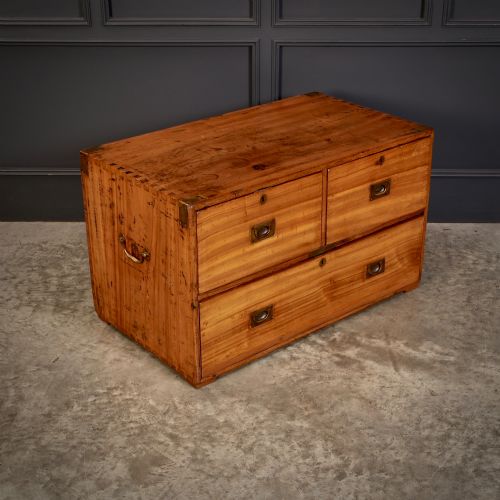
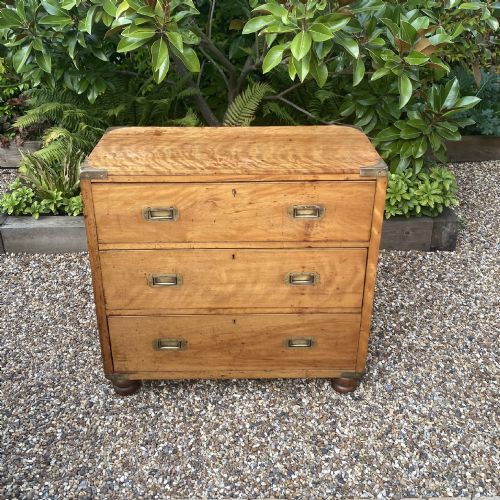
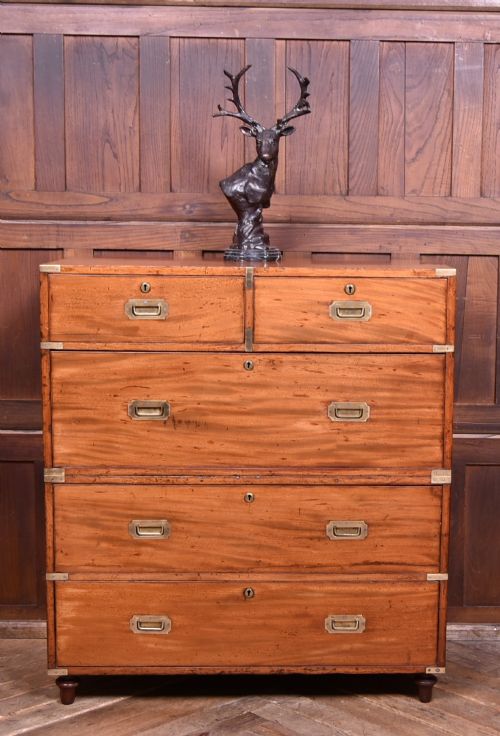
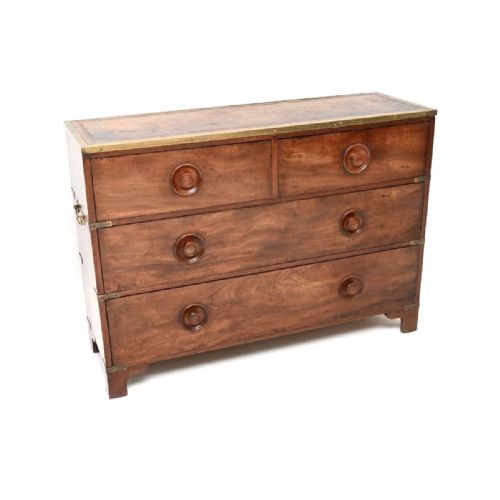
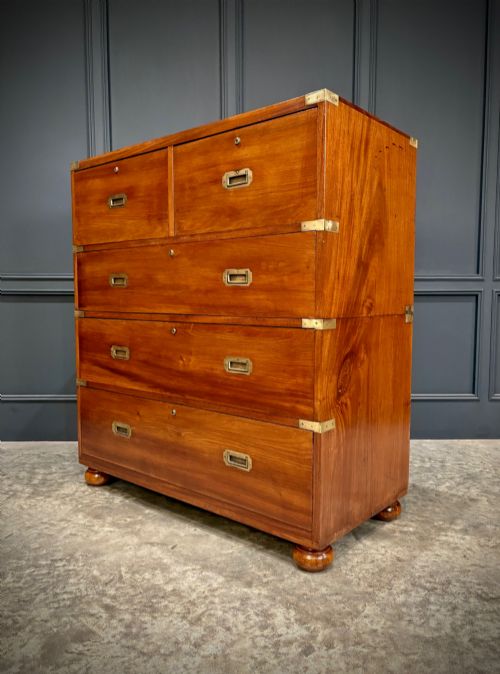
Brass cornered drawers are robust travel chests built with reinforced metal corners, designed for officers on the move during the nineteenth century.
Brass Cornered Drawers
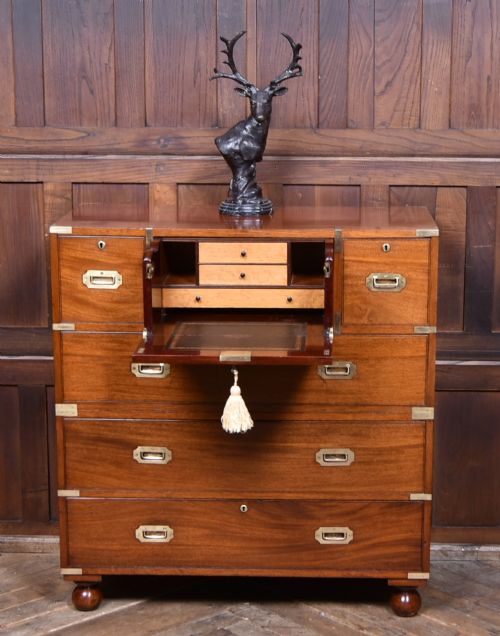
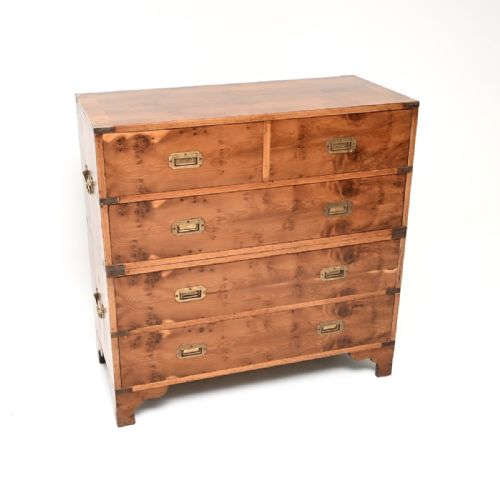
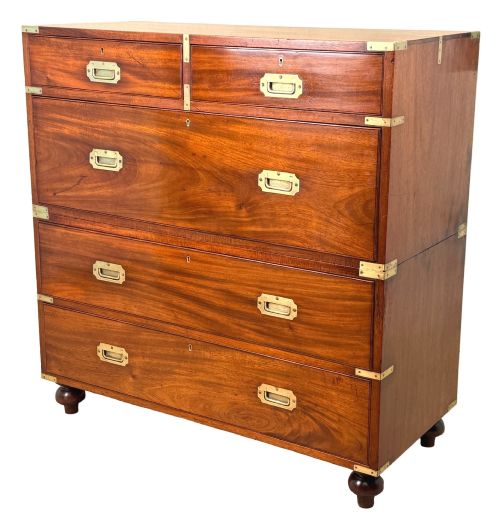
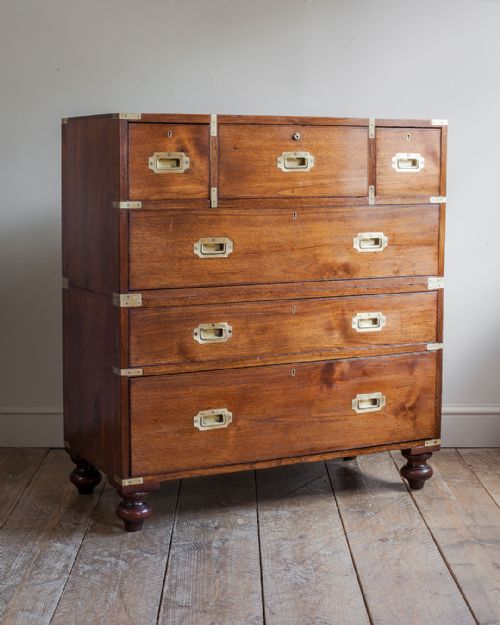
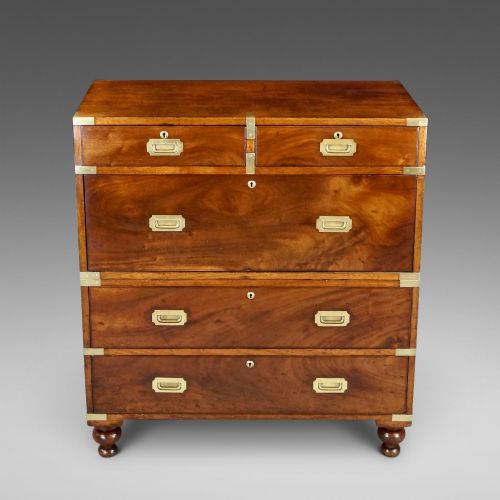
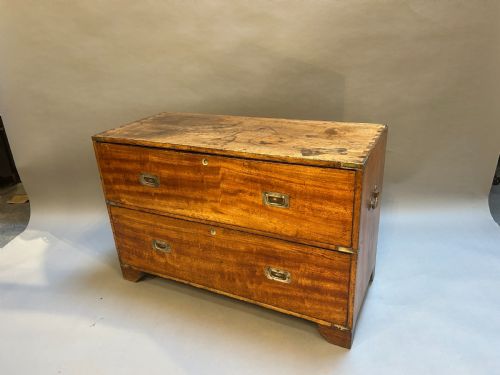
Brass cornered drawers primarily manifest as campaign chests designed for military transport during the nineteenth century. These items typically divide into two separate sections to ease movement on campaigns and voyages.
The form most frequently met on this page is the Victorian mahogany or teak military chest, fitted with flush brass handles and protective corner braces. Such pieces serve as practical storage units while retaining a distinct architectural authority.
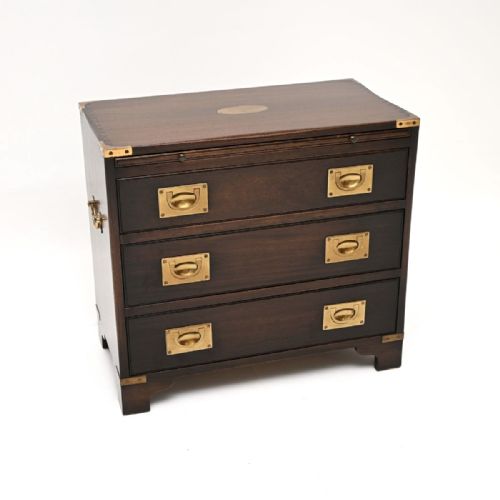
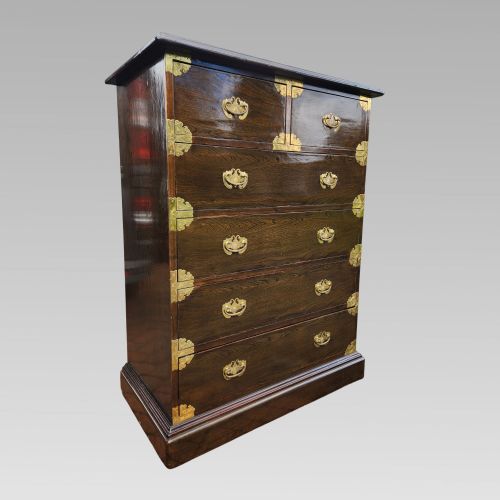
Occasional variations include writing slopes, side tables, and diminutive miniature chests of drawers constructed from timbers like camphor wood and elm. These diverse forms share the characteristic metal reinforcement that defines the search phrase.
Materials and construction methods
Cabinet makers utilised dense hardwoods such as mahogany, teak, and camphor wood to withstand the rigours of transit in the nineteenth century. These durable timbers resist warping and provide a stable foundation for heavy metal fittings.
Corner brackets, straps, and flush-fitting drop handles are cast or beaten from brass, then screwed securely into the wood to protect vulnerable edges from impact. Recessed pulls ensure the sides remain flat during packing and stacking.
Internal construction often incorporates secret compartments, secretaire drawers with fitted writing surfaces, and robust dovetail joints. Cedar and secondary woods support the primary carcass structure invisibly.
Brass Cornered Drawers Retail Price Guide 2026
Typical asking prices for brass cornered drawers among the pieces listed under this phrase on Sellingantiques today, from the lower quarter to the upper quarter. They describe what is for sale here now, not the wider market.
Listings feature items spanning the eighteenth, nineteenth, and twentieth centuries, predominantly constructed from mahogany, teak, and camphor wood.
Distinctions in craftsmanship and condition
Quality rests heavily on the crispness of the brass fittings and whether the handles sit entirely flush within their recessed backplates. Superior examples display tight corner mitres and uniform screw placement executed by skilled hands.
The choice of timber grain defines visual merit, particularly when figured walnut, burr veneers, or richly polished mahogany are selected for the drawer fronts. Finer pieces maintain their original brass locks and working keys.
Structural integrity during the separation of the two-part chest indicates superior original carpentry. Pieces that align smoothly without wobble or gap demonstrate meticulous historical upkeep and careful initial manufacture.
Ross & Co.·Army & Navy
The Brass Cornered Drawers Glossary
- Campaign chest
- A modular set of drawers constructed in two or more stackable sections for military transport. These units feature recessed brass handles to prevent snagging during travel.
- Secretaire chest
- A chest of drawers containing a pull-out desk drawer with pigeonholes and small writing surfaces. The fold-down front allows officers to write dispatches while on campaign.
- Flush handle
- A metal pull inset into the drawer face so it does not project beyond the wood. This technique protects the hardware from knocks during transit.
- Dovetail joint
- An interlocking wood joint formed by wedge-shaped fingers that resist being pulled apart. It represents standard high-grade drawer construction across the period.
- Camphor wood
- A fragrant Asian timber utilised for campaign chests because its natural oils repel insects. It imparts a distinct aroma to the interior of the drawers.
Brass Cornered Drawers: Frequently Asked Questions
Why do these chests split in two?
Modular construction allowed officers to divide the furniture into manageable segments for transport on ships, wagons, and pack animals. Each section was fitted with carrying brackets on the sides.
Once safely at a new posting, the two halves stacked neatly one upon the other to form a full-height chest of drawers. This clever design combined maximum storage capacity with practical portability.
Are all campaign chests made of teak?
Teak was frequently selected for colonial service because its natural oils resist tropical humidity and moisture. However, mahogany, oak, camphor wood, and cedar appear regularly in surviving examples.
The choice of timber often reflects the region of manufacture and the specific branch of the armed forces or civilian administration the original owner served within.
How do I distinguish a genuine nineteenth-century piece?
Examine the construction of the drawer linings, the type of brass screws used, and the hand-cut dovetailing. Nineteenth-century examples display natural timber shrinkage and patination consistent with age.
Fitted brass corners should show genuine wear and integration with the surrounding wood rather than appearing superficial or modern. Maker stamps inside the drawer margins also provide definitive proof of period origin.
Can I use a campaign chest in a modern bedroom?
These chests offer deep, practical drawer storage that suits contemporary domestic spaces remarkably well. Their clean architectural lines complement both modern minimalist interiors and traditional rooms.
The compact footprint and flat sides make them versatile enough to function as bedside units, hallway storage, or statement pieces in a study.