



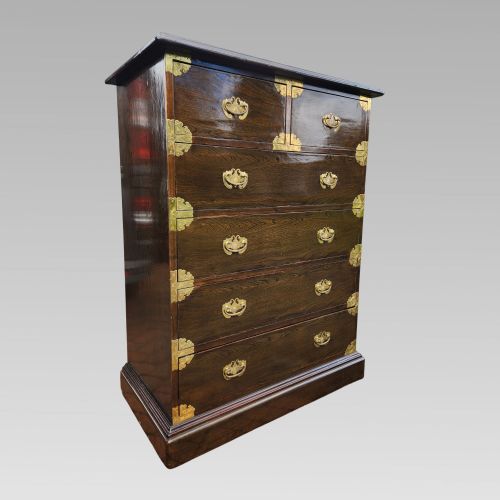


Brass Corner Dresser
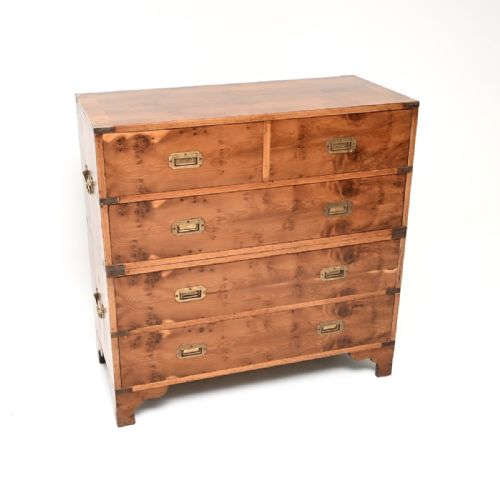
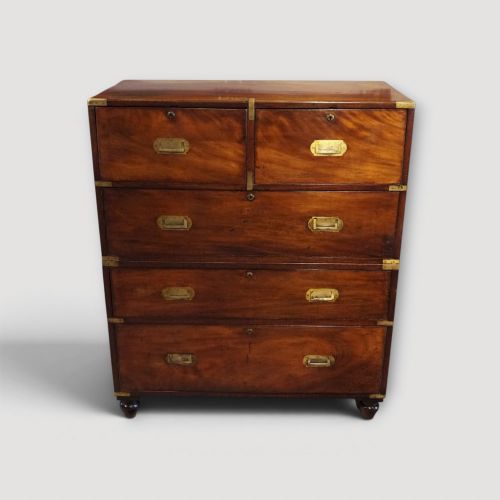
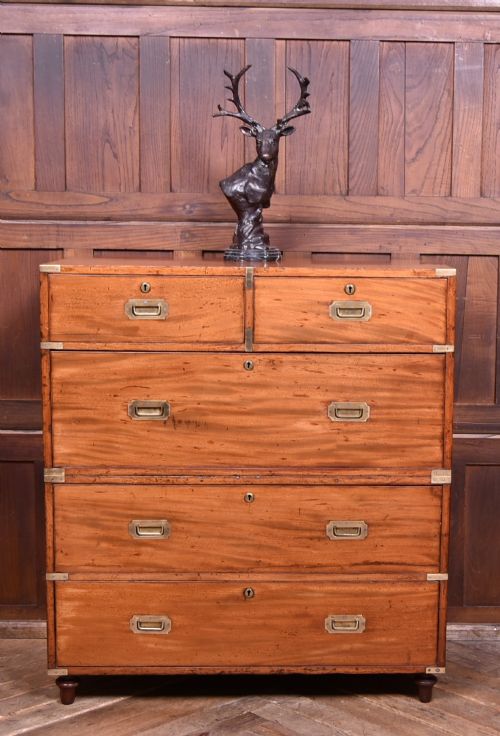
A brass corner dresser or campaign-style chest brings functional colonial portability and rich mahogany or teak timbers directly into your interior.
Brass Corner Dresser
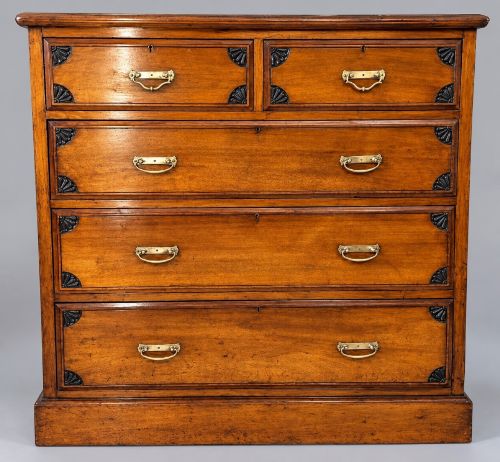
When you search for a brass corner dresser, you are looking at sturdy campaign chests and drawer units reinforced with metal mounts designed for travel. The pieces on this page span the eighteenth, nineteenth, and twentieth centuries, taking the form of robust chests of drawers.
You will most frequently meet nineteenth-century mahogany and teak campaign chests equipped with signature brass corners and flush handles. These practical forms originated to serve officers on the move, combining utility with rich hardwood construction.
The selection also extends to walnut, cedar, elm, and colonial revival variations, alongside traditional Korean bandaji chests. Each version offers a distinct regional interpretation of timber storage reinforced for endurance.
Construction and materials
Cabinetmakers constructed these chests using durable timbers such as mahogany, teak, walnut, cedar, and elm to withstand demanding journeys. Sections were frequently built in two separate parts to ease transportation.
Corner braces, binding, and recessed handles made of brass were screwed directly into the wood to protect vulnerable edges from impact. This metalwork forms the defining visual and structural characteristic of the group.
Brass Corner Dresser Retail Price Guide 2026
Typical asking prices for brass corner dresser among the pieces listed under this phrase on Sellingantiques today, from the lower quarter to the upper quarter. They describe what is for sale here now, not the wider market.
Military officers loved brass corners so much they practically invented the nineteenth-century obsession with shiny edges.
Assessing quality and craftsmanship
Quality rests in the precision of the brass fitting integration and the selection of figured hardwood veneers like elm. Finer examples display meticulous joinery where the metal hardware sits perfectly flush with the timber surface.
The integrity of the internal drawer construction and the original state of the timber finish separate standard utility pieces from superior examples. Secondary woods and the cleverness of modular two-piece setups further distinguish the tier of craftsmanship.
Ross and Co
The Brass Corner Dresser Glossary
- Campaign chest
- A modular chest of drawers built in sections with recessed handles and protective metal corners designed for easy transport by military officers. These items dismantle into separate modular units for travel.
- Bandaji
- A traditional Korean storage chest featuring prominent metal hardware and decorative strapwork. These pieces often utilise elm veneer and serve as striking focal points in a room.
- Secretaire
- A desk disguised as a chest of drawers featuring a fitted drop-front writing compartment. This dual-purpose form provides a compact workspace within a standard case piece.
- Serpentine chest
- A chest of drawers featuring a distinctive undulating curved front facade. This sophisticated profile requires advanced woodworking skill to execute properly.
- Flush handle
- A metal pull inset directly into the wood so it does not project beyond the surface. This prevents snagging during transport and creates a streamlined exterior.
Brass Corner Dresser: Frequently Asked Questions
What is a campaign chest?
A campaign chest is a portable set of drawers constructed in multiple sections for military officers on active service. They feature brass corners and recessed pulls to withstand rough travel.
These utilitarian pieces prioritise durability and modular convenience while maintaining handsome hardwood surfaces.
How were these chests used?
Officers utilised them to transport uniforms, documents, and personal belongings across colonies and military campaigns. The modular design allowed servants to pack and load the furniture quickly.
Today, they function as striking bedroom or living room storage units with a distinct historical pedigree.
How do I style a campaign chest?
Place one in a hallway or bedroom where its rich timber tones and gleaming brass hardware can catch the eye. The flat top provides an ideal surface for lamps or curated decorative objects.
Pair the piece with neutral walls to let the grain of the mahogany, teak, or walnut stand out.
How do I date a campaign chest?
Examine the secondary timbers inside the drawers, the style of the brass hardware, and the construction methods used on the backboards. Nineteenth-century examples often display specific locking mechanisms and dovetailing.
Comparing the timber species, such as cedar versus mahogany, also helps narrow down the period of manufacture.